AlloDerm Hardening and Fat Graft Calcification: Can Ultrasound-Guided Extraction Help?
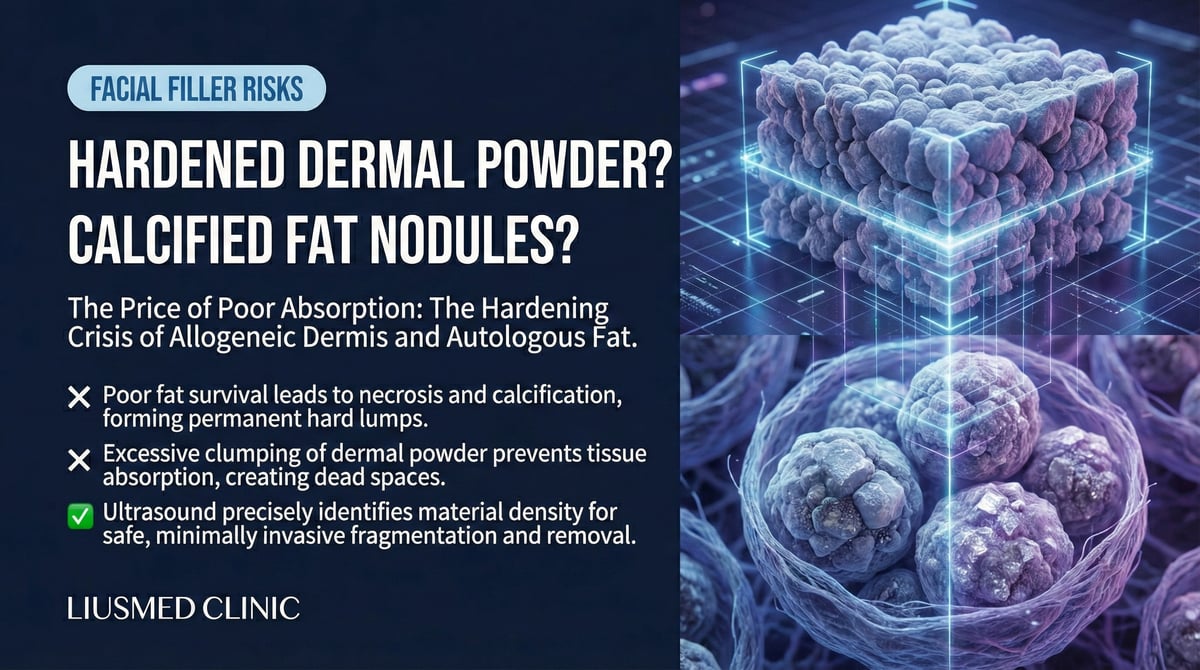
Biological Fillers Can Go Wrong Too: The Truth About AlloDerm and Fat Graft Complications
In the world of fillers, "biocompatibility" has always been a powerful selling point. AlloDerm (acellular dermal matrix) and autologous fat grafting are recommended by many practitioners as "more natural" options because they originate from human tissue. However, "natural" does not mean "risk-free."
Clinically, AlloDerm injections can result in poor tissue integration, hardened masses, and even chronic inflammation. Facial fat grafting can lead to fat necrosis, calcification, oil cysts, and other problems. These complications require professional management just like any synthetic filler issue.
Key Insight: Whether synthetic or biological, any material injected into soft tissue can provoke complications. Biological origin does not guarantee immunity from problems — what matters is timely identification and proper management.
AlloDerm Complications
What Is AlloDerm?
AlloDerm is a micronized acellular dermal matrix derived from processed human cadaveric dermis. Cellular components are removed while the collagen and elastin scaffold is preserved. After injection, host cells are meant to infiltrate this scaffold, theoretically creating "new tissue."
| Property | Description |
|---|---|
| Source | Processed human dermal tissue |
| Composition | Decellularized collagen matrix |
| Theoretical mechanism | Host cell infiltration, neovascularization, tissue integration |
| Common uses | Facial volume restoration, nasal augmentation, scar revision |
| Official claim | Full integration and absorption by the body |
Common Problems
Clinically observed AlloDerm complications include:
-
Poor Absorption and Lump Formation
- Dermal matrix particles fail to achieve adequate vascularization in certain areas
- Unvascularized particles cannot integrate and progressively fibrosis
- Resulting in palpable hard masses with a cartilage-like texture
-
Mass Aggregation
- Uneven particle distribution during injection
- Multiple particles cluster into larger masses
- Particularly common in confined spaces such as the nose
-
Chronic Foreign Body Reaction
- Residual antigens from incomplete decellularization
- Triggering low-grade chronic inflammatory response
- Recurrent localized redness, swelling, and tenderness
Key Insight: AlloDerm's "full integration" represents the theoretical best-case scenario. In reality, local blood supply, injection volume, particle size, and individual immune response all influence the actual outcome.
Facial Fat Graft Complications
How Fat Grafting Fails
Autologous facial fat grafting uses the patient's own fat cells to fill facial depressions or add volume. Although the material is autologous, complications still occur:
| Complication | Mechanism | Clinical Presentation |
|---|---|---|
| Fat necrosis | Grafted fat dies due to inadequate blood supply | Hard lumps, tenderness |
| Fat calcification | Necrotic fat gradually calcifies | Stone-hard nodules |
| Oil cyst | Necrotic fat liquefies into cystic collections | Compressible swelling |
| Overgrowth | Excessive fat survival in certain areas | Localized bulging, asymmetry |
| Fibrosis | Surgical trauma triggers fibrous tissue formation | Texture changes, skin tightness |
Why Calcification Occurs
The calcification process typically follows this sequence:
- Fat necrosis: Grafted fat fails to establish adequate blood supply
- Liquefactive necrosis: Dead fat cells release oil, forming oil cysts
- Chronic inflammation: Immune cells attempt to clear necrotic tissue
- Calcium deposition: Prolonged chronic inflammatory environment promotes calcium salt precipitation
- Hardened nodules: Eventually forming rigid calcified nodules
Common Problem Sites
| Site | Calcification Risk | Reason |
|---|---|---|
| Tear trough / under-eye | High | Limited vascularity, confined space |
| Forehead | Moderate | Risk increases with larger volumes |
| Temples | Moderate | Thin tissue, prone to irregularity |
| Cheeks | Low to moderate | Better blood supply but volume-dependent |
| Chin | Moderate | High mobility, pressure variations |
The Role of Ultrasound in Biological Filler Complications
Ultrasound Imaging Characteristics
| Lesion Type | Ultrasound Appearance | Identification Notes |
|---|---|---|
| AlloDerm mass | Medium echogenicity mass, irregular borders | Subtle contrast with surrounding tissue; requires experience |
| Fat necrosis | Hypoechoic area, possibly with hyperechoic rim | Hyperechoic rim reflects fibrosis |
| Oil cyst | Anechoic cystic structure | Compressible under probe pressure |
| Fat calcification | Hyperechoic focus with posterior acoustic shadow | Classic calcification appearance, easy to identify |
| Fibrous capsule | Hyperechoic ring-like structure | Outer layer encasing the lesion |
Feasibility of Ultrasound-Guided Extraction
For both types of biological filler complications, ultrasound-guided minimally invasive extraction applicability is as follows:
| Scenario | Extraction Feasibility | Notes |
|---|---|---|
| AlloDerm hardened mass | Feasible | Pinhole extraction of fibrotic mass |
| Fat necrosis lump | Feasible | Extraction of necrotic and fibrous tissue |
| Oil cyst | Highly feasible | Pinhole drainage of cyst contents |
| Fat calcification | Feasible (size/location dependent) | Precise extraction after ultrasound localization |
| Fat overgrowth | May require supplemental aspiration | Combined with micro-liposuction technique |
Treatment Process
Step 1: Comprehensive Evaluation
- Detailed history: Procedure date, material used, injection/grafting sites and volumes
- Physical examination: Palpation of all abnormal areas
- Ultrasound assessment: Confirm lesion type, size, depth, and relationship to surrounding structures
- Imaging documentation: Baseline for before-and-after comparison
Step 2: Treatment Plan
Select the most appropriate approach based on lesion type:
| Lesion | Recommended Treatment |
|---|---|
| Small lump (<1cm) | Ultrasound-guided pinhole extraction |
| Large mass (>2cm) | Staged extraction |
| Oil cyst | Ultrasound-guided drainage |
| Multiple calcifications | Sequential localized extraction |
| Widespread irregularity | Combined approach (extraction + adjuvant treatment) |
Step 3: Post-Procedure Follow-Up
- Week 1: Follow-up assessment of recovery
- Month 1: Ultrasound confirmation of extraction results
- Month 3–6: Evaluate need for additional treatment or volume restoration
Frequently Asked Questions
Will there be a depression after AlloDerm mass removal?
Some volume reduction is expected, but the AlloDerm mass itself is already abnormal tissue. Overall appearance typically improves after removal. If volume replenishment is needed, HA (Hyaluronic Acid — sugar molecule naturally in skin, holds water) filler can be safely placed after recovery.
Is fat calcification difficult to extract?
Calcified nodules display a classic hyperechoic pattern with acoustic shadowing on ultrasound, enabling highly precise localization. Extraction difficulty depends on the calcification's size and location, but most can be effectively removed through a pinhole under ultrasound guidance.
Can I have fat grafting again after a failed procedure?
Yes, but it is advisable to first address existing complications and allow tissue to fully recover before re-evaluation. Particular attention should be paid to optimizing survival rates and dose control during a second procedure.
Do Not Let Biological Filler Complications Persist
If you have experienced hardened masses, calcification, or oil cysts after AlloDerm injection or fat grafting, do not assume that "biological materials will resolve on their own." Timely ultrasound evaluation and precise minimally invasive treatment can help resolve these concerns.
There is one newer variant in the same material family worth telling apart. RE2O (Elravie Re2O), popular in Korea lately, is also particulated human acellular dermal matrix (phADM), but milled into microparticles suspended in a hyaluronic-acid carrier and injected as skin-booster microdroplets into the upper dermis — the same family as the block-form AlloDerm used here for facial augmentation and nasal projection, just a different form. Its complications lean toward scattered papules or a deep consolidated lump, and hyaluronidase only dissolves the carrier half. See the link below for how it is assessed and removed.
Further reading:
- RE2O human-ADM skin-booster complications: ultrasound typing and pinhole removal
- Pillow Face Correction: Repairing Overfilled Faces
- Why Dissolving Enzymes Fail When Capsules Form
- The Filler Repair Evaluation Process
About the Author
Dr. Ta-Ju Liu
- Current Position: Director, Liusmed Clinic
- Specialties: Minimally invasive surgery, filler complication repair, ultrasound-guided extraction
- Experience: 15+ years of clinical minimally invasive surgery; over 10,000 successful cases
- Philosophy: "Whether synthetic or autologous, the principle of complication management is the same: you must see it to treat it precisely. Ultrasound reveals what the naked eye cannot."
Related Services

Specialties
Credentials
- Kaohsiung Medical University, School of Medicine
- Attending Physician, Dermatology, Kaohsiung Chang Gung Memorial Hospital
- Attending Physician, Aesthetic Center, Kaohsiung Chang Gung Memorial Hospital
- Visiting Physician, Dermatology, Xiamen Chang Gung Hospital
- Visiting Physician, Aesthetic Center, Xiamen Chang Gung Hospital
"For every surgery, I strive to achieve a good outcome through a small incision and refined technique. Minimally invasive surgery is not just a technique — it's a commitment of respect to every patient."
Recovery after any procedure needs peer support too


Want to learn more?
Schedule a consultation for professional evaluation and advice