Why Antibiotics Alone Cannot Cure Biofilm-Related Filler Swelling
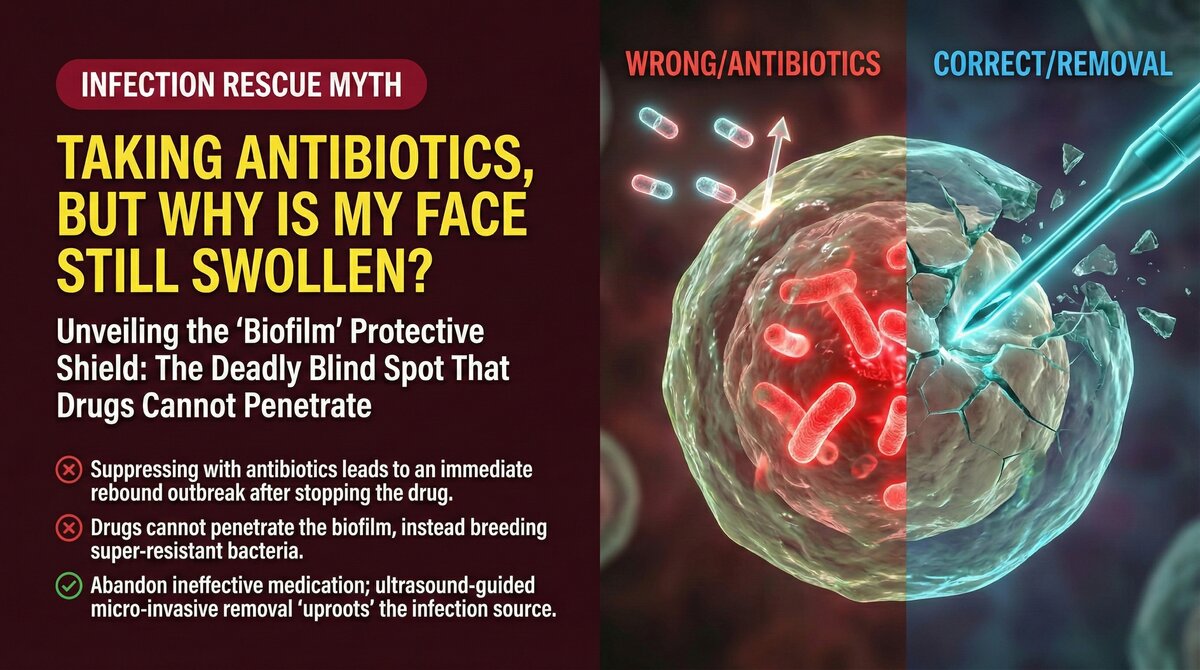
Round After Round of Antibiotics, Yet the Swelling Keeps Returning
Many patients with filler complications share a frustratingly familiar story: a previously injected area begins swelling, a doctor prescribes antibiotics, the swelling improves, then returns weeks later. Another course of antibiotics, another temporary improvement, another relapse—this cycle repeating for months or even years.
This pattern of "improves on medication, returns off medication" is usually not an ordinary bacterial infection. It is something far more resilient: a biofilm infection.
Understanding why biofilms defeat antibiotics is the first step toward breaking free from this treatment loop.
What Is a Biofilm? Why Is It Different from a Normal Infection?
Ordinary Bacterial Infections
In typical infections, bacteria exist in a "planktonic state"—dispersed individually throughout tissue or blood. Antibiotics can effectively reach and kill these free-floating bacteria.
Biofilm Infections
A biofilm is a highly organized bacterial community that forms on solid surfaces. The surface of filler material provides an ideal substrate for bacterial attachment. Once attached, bacteria secrete an "extracellular matrix" composed of polysaccharides, proteins, and DNA, creating a formidable protective barrier.
| Characteristic | Planktonic Bacteria | Biofilm Bacteria |
|---|---|---|
| Organization | Dispersed, individual | Community with structure |
| Protection | No special barrier | Extracellular matrix shield |
| Antibiotic sensitivity | Normal | Reduced 100-1,000× |
| Immune system clearance | Usually effective | Extremely difficult |
| Typical disease course | Acute, defined | Chronic, recurring |
Key Insight: A biofilm is not simply a "more severe infection"—it is a fundamentally different type of infection. Treating it with antibiotics alone is like sweeping moss off a concrete wall—the surface looks clean temporarily, but the root structure remains intact and regrows quickly.
Why Antibiotics Fail Against Biofilms
Reason 1: Physical Barrier Blocks Drug Penetration
The extracellular matrix acts as a wall that antibiotic molecules struggle to penetrate. Research shows that effective antibiotic concentrations within a biofilm may be only 1/100 to 1/1,000 of external levels.
Reason 2: Metabolic Dormancy
Bacteria deep within the biofilm enter a low-metabolism dormant state. Most antibiotics—particularly those targeting cell wall synthesis or protein synthesis—can only kill actively growing bacteria. Dormant bacteria are essentially immune to these drugs.
Reason 3: Genetic Resistance Transfer
The biofilm environment promotes "horizontal gene transfer" between bacteria, allowing resistance genes to spread rapidly throughout the community. Even bacteria initially sensitive to an antibiotic can quickly acquire resistance within the biofilm.
Reason 4: Immune Evasion
The biofilm structure prevents immune cells (neutrophils, macrophages) from effectively engulfing the bacteria inside. The immune system detects the infection but cannot eliminate it—explaining the persistent swelling and inflammation.
Key Insight: What antibiotics can kill are bacteria that detach from the biofilm surface and re-enter the planktonic state. This explains the treatment pattern perfectly: symptoms improve during medication because free-floating bacteria are eliminated, but relapse after stopping because the biofilm itself remains intact, continuously releasing new bacteria.
Cumulative Risks of Repeated Antibiotic Courses
Beyond failing to solve the problem, repeated antibiotic use carries its own risks:
| Risk Category | Description | Severity |
|---|---|---|
| Resistant strain development | Surviving bacteria evolve stronger resistance | High |
| Gut microbiome disruption | Long-term antibiotics damage normal intestinal flora | Moderate-high |
| Cumulative drug side effects | Increased liver/kidney burden, allergy risk | Moderate |
| Delayed proper treatment | Each "one more round" wastes critical treatment time | High |
| Ongoing tissue damage | Chronic inflammation causes surrounding tissue fibrosis | Moderate-high |
Worse still, each incomplete treatment allows the biofilm to mature further. Early biofilms are relatively fragile; over time, the matrix thickens, internal structure becomes more complex, and treatment difficulty escalates correspondingly.
Clinical Features of Filler Biofilm Infections
How can you distinguish recurring swelling caused by biofilm from ordinary infection?
Typical Presentation
- Timeline: Appears months to years after injection, not days
- Swelling pattern: Recurrent episodes, improving with medication but relapsing after stopping
- Location: Typically confined to specific injection areas
- Severity: Usually low-grade chronic inflammation rather than acute high fever
- Culture results: Standard bacterial cultures often negative (biofilm bacteria grow poorly on standard media)
Commonly Misdiagnosed As
- Allergic reaction
- Delayed-type hypersensitivity
- Autoimmune disease
- Lymph node enlargement
- Granuloma
For more on diagnostic confusion, see Common Filler Complication Misdiagnoses. For an in-depth look at biofilm and delayed swelling: Delayed Swelling: Why Injection Sites Swell Years Later.
What Effective Treatment Actually Requires
Medication Alone Is Not Enough—The Biofilm's "Home" Must Be Removed
The fundamental problem with biofilm is that it attaches to the filler surface. As long as the filler remains in the body, the biofilm has a substrate to live on. This is why antibiotics alone—regardless of how potent or prolonged—cannot achieve permanent resolution.
An effective treatment strategy must include:
- Physical removal of filler material—eliminating the biofilm's attachment substrate
- Debridement of infected tissue—removing tissue infiltrated by the biofilm
- Post-procedural antibiotics—once the biofilm structure is disrupted, antibiotics can effectively eliminate remaining bacteria
The Role of Ultrasound
The greatest challenge in treating biofilm-affected fillers is precise localization. Filler may have fragmented, migrated, or become encapsulated—visual inspection and palpation cannot accurately determine its distribution.
High-resolution ultrasound enables:
- Confirmation of exact filler location and extent
- Assessment of surrounding tissue inflammation
- Differentiation between biofilm-related swelling and other causes (granuloma, encapsulation)
- Guided precise extraction, preventing residual material from being left behind
Key Insight: Treating a biofilm infection is like dealing with termites in a house—spraying insecticide only kills surface insects. Without removing the infested wood, the colony survives. Antibiotics are the insecticide; surgical removal is the structural repair.
For more on extraction techniques: Precision Filler Extraction Technique.
When to Stop Trying "One More Round of Antibiotics"
The following situations strongly indicate the need to reassess treatment strategy:
- Two or more complete antibiotic courses completed with continued recurrence
- Swelling persisting for more than three months
- Bacterial cultures returning negative despite ongoing symptoms
- Swelling location corresponding to known filler injection sites
- Multiple different antibiotics failing to achieve lasting remission
What is needed at this point is not a stronger antibiotic but an ultrasound evaluation to determine whether biofilm infection is present and to develop a treatment plan that includes physical removal.
Schedule a consultation for professional ultrasound evaluation and a path out of the recurring cycle.
Conclusion
Biofilm is one of the most underestimated problems in filler complications. It is not a "worse infection" but a fundamentally different type of infection requiring an entirely different treatment approach. Understanding "why antibiotics are not enough" is not about dismissing the value of antibiotics—it is about recognizing that every treatment tool has its appropriate scope of application.
Key Insight: If the same problem has been treated with the same approach three or more times and continues to recur, the issue likely lies not in medication strength or dosage but in the direction of the treatment strategy. Recognizing this is the starting point for finding a real solution.
Related Services

Specialties
Credentials
- Kaohsiung Medical University, School of Medicine
- Attending Physician, Dermatology, Kaohsiung Chang Gung Memorial Hospital
- Attending Physician, Aesthetic Center, Kaohsiung Chang Gung Memorial Hospital
- Visiting Physician, Dermatology, Xiamen Chang Gung Hospital
- Visiting Physician, Aesthetic Center, Xiamen Chang Gung Hospital
"For every surgery, I strive to achieve a good outcome through a small incision and refined technique. Minimally invasive surgery is not just a technique — it's a commitment of respect to every patient."
Recovery after any procedure needs peer support too

Want to learn more?
Schedule a consultation for professional evaluation and advice