Underarm Odor Surgery Aftercare: Recovery Tips & Scar Prevention
The Importance of Post-Operative Care
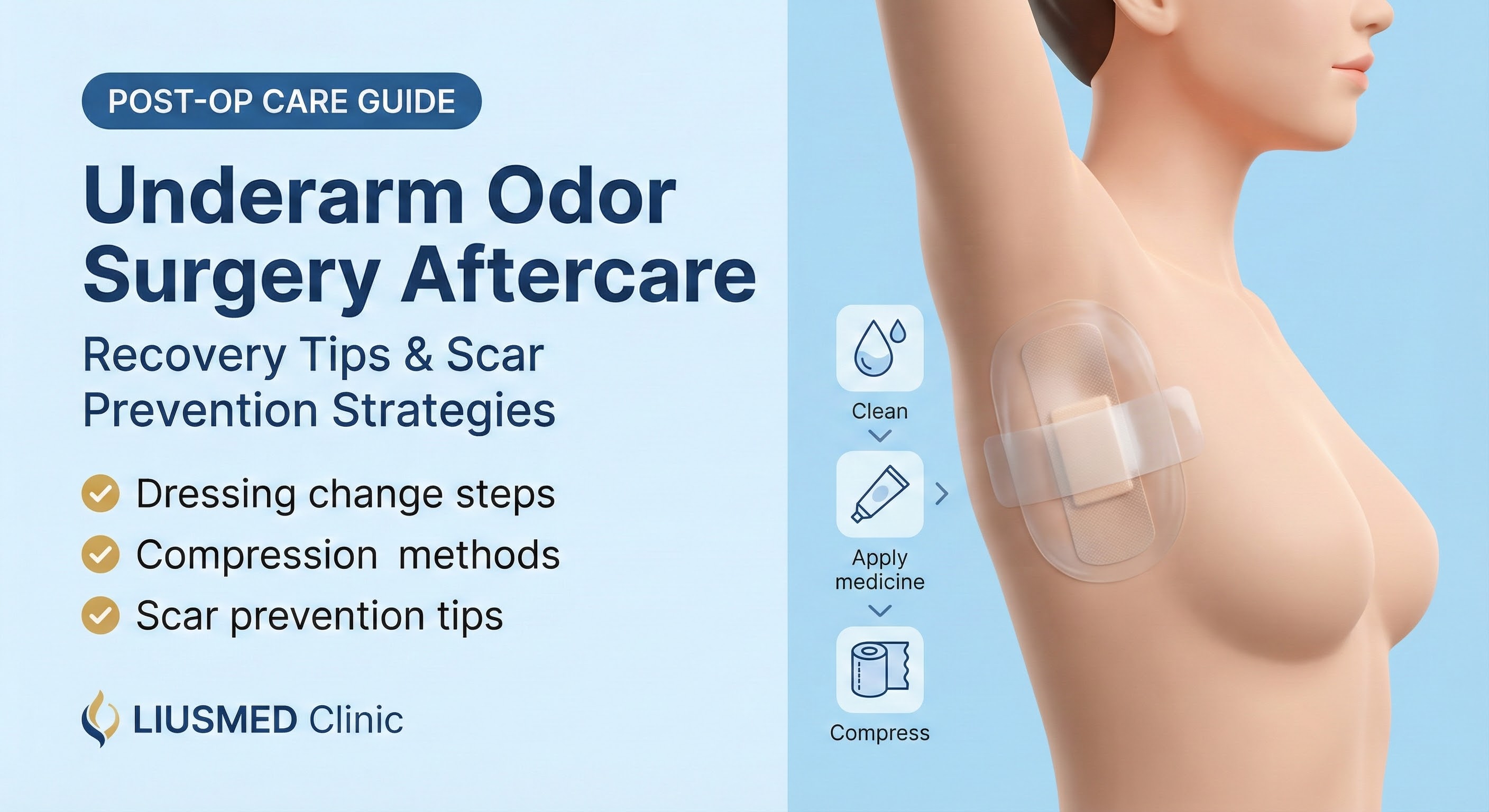
Post-operative wound care after minimally invasive body odor surgery is critical to treatment success. Proper care can reduce hematoma and skin flap necrosis risk, accelerate wound healing, and prevent scar formation. This guide covers the full course: the compression gauze period, gauze removal at the clinic, stitch removal on day 14, and about one month of arm restrictions.
Post-Operative Care Timeline
📅 Until Days 3–5: Compression Gauze Period (Most Critical)
| Item | Details |
|---|---|
| Wound Status | Underarm gauze with compression, arms bandaged to sides |
| Gauze | Leave the compression gauze in place; do not remove or change it yourself. Contact the clinic if it soaks through |
| Pain Level | Mild to moderate (2-4/10), controllable with pain medication |
| Activity Restrictions | 🚫 Arms cannot raise above 90 degrees, no heavy lifting |
| Sleeping Position | Sleep on back, arms naturally at sides |
| Diet | Normal diet, avoid alcohol, smoking, and spicy foods |
Why is compression so important?
After minimally invasive apocrine gland curettage, a cavity forms between skin and underlying tissue. Compression serves to:
- Prevent hematoma: Pressure stops bleeding, keeps skin adhered to underlying tissue
- Promote healing: Reduces dead space, allows tissue to bond quickly
- Prevent skin flap necrosis: Maintains normal blood circulation
⚠️ Dr. Liu's Reminder: "Compression before the gauze comes off is the most critical period of the entire recovery. Many complications occur because this period wasn't managed properly."
📅 Days 3–5: Gauze Removal Visit
| Item | Details |
|---|---|
| Follow-up | At your scheduled visit, the doctor removes the compression gauze at our clinic and checks wound healing (do not remove it yourself or elsewhere) |
| Wound Status | Skin should be adhered, no obvious hematoma |
| Activity Restrictions | Light arm movements OK, avoid large movements |
| Daily Activities | After gauze removal, light daily activities and office work that does not use your arms can resume |
| Dressing | Wet-compress dressing every morning and evening starts after gauze removal (see below) |
What does the doctor check?
- Skin adhesion
- Presence of hematoma or fluid collection
- Wound healing progress
- Whether continued compression is needed
📅 Days 6–13: Wet-Compress Care Until Stitch Removal
| Item | Details |
|---|---|
| Wound Status | Wound beginning to scab, swelling subsiding |
| Activity Restrictions | Keep arms down, not above shoulder height; no lifting, pushing or carrying heavy objects; avoid strenuous exercise |
| Bathing | Keep the underarm wounds out of water (at least 14 days) |
| Work | Light office work that does not use your arms is fine; hold off on physical labor |
📅 Day 14: Stitch Removal Visit
| Item | Details |
|---|---|
| Follow-up | Sutures removed, healing assessed |
| Post-Removal Care | Begin using cosmetic tape or silicone sheets |
| Activity | Keep arm movements gentle with no heavy lifting or pushing; normal activity resumes at about one month, once the wounds have fully healed |
Proper Compression Technique
Standard Compression Protocol
- Inner layer: Sterile gauze covering wound
- Middle layer: Cotton padding or gauze roll filling underarm hollow
- Outer layer: Elastic bandage wrapped around chest for fixation
Compression Guidelines
| ✅ Correct | ❌ Incorrect |
|---|---|
| Bandage snug, can insert one finger | Too tight causing numbness or purple fingers |
| Cotton pad fills underarm hollow | Pad too thin, no compression |
| Bandage secure, doesn't slip | Bandage loose and shifting |
| Maintained 24 hours | Removing or adjusting yourself |
💡 Tip: If you feel finger numbness, purple discoloration, or severe pain, return immediately to adjust bandage tightness.
Wet-Compress Dressing After the Gauze Comes Off
Do not change the dressing yourself before the gauze is removed. After the compression gauze is taken off at our clinic, and until the wounds heal, apply a saline wet compress every morning and evening for about 30 minutes each time, then ointment and dry gauze (as instructed by the doctor).
Supplies Needed
- Sterile saline
- Sterile cotton swabs
- Ointment prescribed by the doctor
- Sterile gauze
- Breathable medical tape
Dressing Change Steps
- Wash hands: Thoroughly with soap and dry
- Remove old dressing: Gently peel away, wet with saline if stuck
- Wet compress: Soak sterile gauze in saline and lay it over the wound for about 30 minutes; replace it with fresh gauze if it dries out
- Inspect wound: Check for redness, swelling, or abnormal discharge
- Apply ointment: Gently pat dry with a sterile cotton swab, then apply a thin layer of the prescribed ointment
- Cover with gauze: Dry sterile gauze, secured with tape
Dressing Change Frequency
| Period | Frequency |
|---|---|
| Before gauze removal (within 3–5 days) | Leave the compression gauze in place; do not remove or change it yourself. Contact the clinic if it soaks through |
| From gauze removal until the wounds heal | Wet-compress dressing every morning and evening |
| After the wounds heal | Stop once the doctor confirms |
Bathing and Cleaning
Bathing by Stage
| Period | Recommended Method |
|---|---|
| Before gauze removal (within 3–5 days) | 🚫 No showering, use wet towel for other body areas |
| From gauze removal to day 14 | 🚫 Keep the underarm wounds out of water; clean other areas by wiping |
| After stitch removal on day 14 | Water contact only once the wounds have fully healed and the doctor confirms; slower healers may need another 2–3 weeks |
| After the wounds fully heal | Normal showers; check with the doctor before baths or swimming |
Tips on Water Contact
- Keep the underarm wounds out of water until they heal
- If unsure whether you can get them wet, send us a photo of the wounds and the doctor will advise
- Once water is allowed, still avoid prolonged hot water on the underarm area
- Replace gauze immediately if it gets wet
Activity and Exercise Restrictions
Post-Op Activity Timeline
| Activity Type | When to Start | Notes |
|---|---|---|
| Light daily activities | After gauze removal (days 3–5) | Avoid large arm movements |
| Office work | After gauze removal (days 3–5) | Light work that does not use your arms only; no heavy lifting, reaching high |
| Driving | Day 7 | Ensure arms move freely |
| Light exercise (walking) | Day 7 | Don't swing arms |
| Moderate exercise (jogging) | Day 14 | Avoid vigorous upper body movements |
| Strenuous exercise (weight training) | From about day 30, once the wounds have fully healed | Check with the doctor first; increase intensity gradually |
| Swimming | Once the wounds have fully healed and the doctor confirms | Slower healers may need longer |
Prohibited Movements (Until Stitch Removal, About 14 Days)
- ❌ Raising arms above shoulder level
- ❌ Lifting items over 2 kg (4.4 lbs)
- ❌ Reaching arms backward
- ❌ Putting on/removing pullover clothing (wear button-up clothes)
- ❌ Riding a motorcycle (arms need wide range of motion)
Scar Prevention and Care
Minimally Invasive Wound Scarring Advantage
| Item | Traditional Surgery | Minimally Invasive |
|---|---|---|
| Wound length | 5-8 cm | about 4 mm |
| Scar location | Visible underarm area | Hidden in underarm crease |
| Scar width | Wider | Very fine |
| Healed appearance | Visible scar | Nearly invisible |
Post-Op Scar Care Steps
Phase One: Weeks 1-4 After Suture Removal
- Apply cosmetic tape along wound direction
- Change every 3-5 days
- Keep wound clean and dry
Phase Two: Months 1-3
- Switch to silicone sheets or scar gel
- Use at least 12 hours daily
- Massage scar (gentle circular motions)
Phase Three: Months 3-6
- Continue silicone products
- Avoid direct sunlight on wound
- Laser treatment if needed
💡 Dr. Liu's Experience: "Minimally invasive wounds are already small, and hidden in the underarm crease. Most patients can barely see the scar by 3 months post-op."
Handling Abnormal Situations
When to Return Immediately 🚨
| Warning Sign | Possible Cause | Action |
|---|---|---|
| Significant underarm swelling | Hematoma formation | Return immediately, may need drainage |
| Skin turning black or purple | Skin flap circulation problem | Emergency return for evaluation |
| Heavy wound bleeding | Bleeding not stopped | Apply pressure, return immediately |
| Fever over 38°C (100.4°F) | Possible infection | Seek care promptly |
| Wound pus, bad odor | Wound infection | Needs antibiotics |
| Severe increasing pain | Hematoma or infection | Immediate evaluation |
Normal Findings (Don't Worry)
- Mild swelling (resolves in 1-2 weeks)
- Bruising (changes from purple to yellow, gone in 1-2 weeks)
- Mild itching (normal healing sign)
- Underarm feeling numb or firm to the touch (gradually improves over about 6–12 months)
- Small amount of light yellow discharge
Dietary Recommendations
✅ Recommended Foods
| Nutrient | Food Sources | Benefit |
|---|---|---|
| Protein | Chicken, fish, eggs, tofu | Tissue repair |
| Vitamin C | Citrus, guava, kiwi | Collagen synthesis |
| Zinc | Oysters, nuts, pumpkin seeds | Wound healing |
| Vitamin A | Carrots, sweet potato, spinach | Skin regeneration |
❌ Foods to Avoid
| Food | Reason |
|---|---|
| Smoking | Constricts blood vessels, affects circulation |
| Alcohol | Increases bleeding risk, affects healing |
| Spicy foods | May worsen inflammation |
| Very salty foods | Worsens swelling |
Frequently Asked Questions
Q1: Can I work normally after surgery?
A1: Depends on your job. Rest at home until the gauze comes off (3–5 days after surgery); once it is removed, light office work that does not use your arms can resume. If your work involves frequent arm use or heavy lifting, avoid it for about one month and return once the wounds have fully healed and the doctor confirms.
Q2: When can I wear normal clothes?
A2: The first 3 days, wear loose button-front clothing for easy dressing changes and compression. After a week, normal clothing is fine, but avoid very tight sleeves.
Q3: Will underarm hair stop growing?
A3: Apocrine glands sit around the hair follicles, so the follicles inside the cleared area are affected as well — thinner underarm hair is an expected result, not a complication. In our clinic's post-op observation, underarm hair volume drops by about 50–70% (the extent varies by individual), though it does not stop growing entirely. Many consider this an added benefit.
Q4: Will I still need antiperspirant after surgery?
A4: Most patients don't need antiperspirant after surgery. With apocrine glands removed, the odor problem is substantially improved; in our clinic's post-op observation, sweat volume drops by about 80–90% versus before surgery, and the extent varies by individual.
Q5: What if a hematoma is found at follow-up?
A5: If hematoma is found, the doctor will drain it as needed. Early-detected hematomas can usually be managed without affecting final results. This is why scheduled follow-ups are important.
Recovery Timeline Summary
| Milestone | Timing |
|---|---|
| Gauze removal | Days 3–5 |
| Light activity and office work that does not use your arms | After gauze removal |
| Stitch removal | Day 14 |
| Water contact | After stitch removal, once the wounds have fully healed and the doctor confirms |
| Light exercise | Day 14 |
| Normal arm activity, strenuous exercise | From about day 30, after checking with the doctor |
| Scar fading | 1-3 months |
| Firmness and reduced sensation gradually improve | 6–12 months |
Related Reading
- Underarm Odor Treatment Comparison: Antiperspirant vs Botox vs Surgery
- Complete Guide to Underarm Odor Surgery
- How to Prevent Post-Op Scar Formation
About the Author
Dr. Ta-Ju Liu
- Current Position: Director, Liushi Clinic
- Specialties: Minimal incision surgery (lipoma, cyst), hyperhidrosis surgery, thread lifting
- Experience:
- 15+ years of clinical minimal incision surgery experience
- Over 10,000 successful minimal incision cases
- Board-certified dermatologist
- Philosophy: "Post-operative care is just as important as the surgery itself. Our team follows every patient's recovery and manages every variable we can control."
Related Services

Specialties
Credentials
- Kaohsiung Medical University, School of Medicine
- Attending Physician, Dermatology, Kaohsiung Chang Gung Memorial Hospital
- Attending Physician, Aesthetic Center, Kaohsiung Chang Gung Memorial Hospital
- Visiting Physician, Dermatology, Xiamen Chang Gung Hospital
- Visiting Physician, Aesthetic Center, Xiamen Chang Gung Hospital
"For every surgery, I strive to achieve a good outcome through a small incision and refined technique. Minimally invasive surgery is not just a technique — it's a commitment of respect to every patient."
Want to learn more?
Schedule a consultation for professional evaluation and advice