Underarm Odor Treatment Comparison: Antiperspirant vs Botox vs Surgery
Treatment Choices: Root Treatment vs Temporary Control
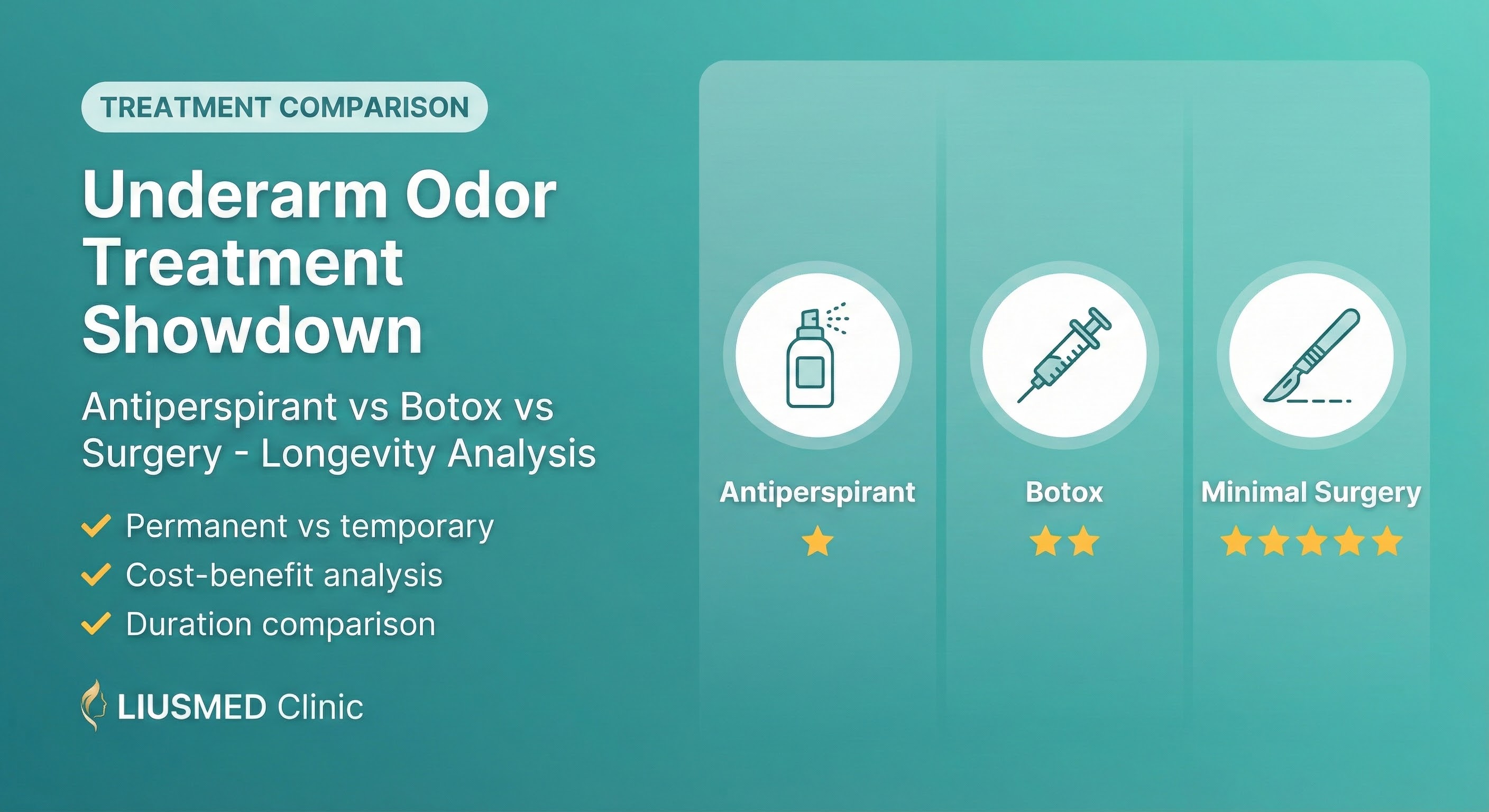
The key question in body odor treatment is: Do you want temporary control or long-term stable improvement? Antiperspirants and Botox can temporarily reduce symptoms but cannot eliminate apocrine glands; only minimally invasive surgery can address the problem at its root. This article provides a complete comparison of three mainstream treatments to help you make the best choice.
Complete Comparison of Three Treatment Methods
| Comparison | Antiperspirant/Deodorant | Botox Injection | Minimally Invasive Curettage |
|---|---|---|---|
| Mechanism | Masks odor, suppresses sweating | Blocks nerve signals to reduce sweating | Directly removes apocrine glands |
| Duration | Several hours | 4-6 months | Long-term stable |
| Improvement Rate | ❌ Cannot cure | ❌ Cannot cure | ✅ Long-term stability for most patients; sweat volume drops by about 80–90% versus before surgery in our clinic's post-op observation (extent varies by individual) |
| Cost Structure | Repeated purchases | Repeat every 4-6 months | One-time expense |
| Long-term Total | Ongoing spending | Far higher than surgery long-term | No repeat treatments |
| Invasiveness | None | Very low (injection) | Low (minimally invasive) |
| Recovery Time | None | None | 7-14 days |
| Best For | Mild body odor | Those avoiding surgery | Those wanting long-term stability |
Antiperspirants and Deodorants: Temporary Masking
Mechanism
- Antiperspirants: Contain aluminum salts that temporarily block sweat gland openings
- Deodorants: Mask odor with fragrance or inhibit bacteria with antibacterial ingredients
Advantages
- Readily available, can be used anytime
- No medical intervention needed
- Affordable
Disadvantages
| Problem | Explanation |
|---|---|
| Short-lived | Only lasts a few hours, requires repeated application |
| Cannot cure | Only masks, doesn't treat |
| May irritate skin | Long-term use can cause sensitivity, discoloration |
| Limited effectiveness | Poor results for moderate to severe body odor |
| Psychological burden | Constant worry about being detected |
Ideal Candidates
- Mild body odor, barely noticeable
- Occasional short-term masking (important occasions)
- Not ready for other treatments
💡 Dr. Liu's View: "Antiperspirants are fine for occasional emergencies, but if you need to use them daily—reapplying multiple times—it's time to seriously consider more effective treatment."
Botox Injections: Temporarily Reducing Sweat
Mechanism
Botulinum toxin (Botox) is injected into underarm skin, blocking nerve-to-sweat-gland signals and reducing sweat secretion. With less sweat, there's less substrate for bacteria to break down, reducing odor.
Procedure
- Apply numbing cream to underarms (about 30 minutes)
- Multiple injections with fine needles
- Entire process takes about 10-15 minutes
- Effects begin in 3-7 days
Advantages
- Non-surgical, no incisions
- Quick procedure, can be done during lunch break
- No recovery time, normal activities same day
Disadvantages
| Problem | Explanation |
|---|---|
| Limited effect | Only reduces sweating, doesn't eliminate odor glands |
| Requires repeat injections | Every 4-6 months |
| High long-term cost | Long-term cumulative cost can exceed 10x a one-time surgery |
| Diminishing returns | Some people report reduced effectiveness over time |
| Cannot cure | Odor returns when injections stop |
Cost Analysis
Botox must be repeated every 4-6 months, so the long-term cumulative cost is significantly higher than a one-time surgery. Exact fees are discussed case-by-case via LINE or in person.
Ideal Candidates
- Fear of surgery, want to try non-invasive treatment first
- Short-term improvement needed (wedding, job interview)
- Mild to moderate body odor
Minimally Invasive Apocrine Gland Curettage: Long-Term Stable Improvement
Mechanism
The root cause of body odor is "apocrine glands" (large sweat glands). These glands secrete substances that produce odor when broken down by skin bacteria. Minimally invasive surgery directly removes apocrine glands, eliminating the source of odor.
Procedure
- Local anesthesia
- One small incision (about 4 mm) in each underarm
- Special curette removes apocrine glands
- Wound closure, compression dressing
Advantages
| Advantage | Explanation |
|---|---|
| Stable, lasting effect | Apocrine glands don't regenerate, so most patients maintain results long-term after one treatment |
| High clearance rate | Based on 15 years of clinical follow-up by Dr. Liu, axillary apocrine clearance can reach >99% (varies by individual) |
| Cost-effective long-term | One-time expense, no repeat treatments |
| Also reduces sweating | Underarm sweating drops markedly as well in our clinic's post-op observation (extent varies by individual) |
Disadvantages
- 7-14 day recovery period
- Post-operative arm movement restrictions
- Minimal scarring possible
Cost Analysis
Minimally invasive surgery is a one-time fee with no repeat treatments, so the long-term total is far lower than recurring options. The exact fee is individualized after an in-person or LINE consultation.
Ideal Candidates
- Moderate to severe body odor significantly affecting daily life
- Want long-term stability, don't want repeated treatments
- Willing to accept short recovery period for long-term results
💡 Dr. Liu's Recommendation: "Looking at the long term, minimally invasive surgery is often a relatively cost-effective choice in both price and results. One treatment, with long-term benefit for most patients."
Long-Term Cost Comparison: 10-Year Analysis
For a 25-year-old with moderate body odor, here's the 10-year cost comparison:
| Treatment | Cost Structure | Long-term Total |
|---|---|---|
| Antiperspirant | Repeated purchases | Ongoing spending |
| Botox | Repeat every 4-6 months | Far higher than surgery |
| Minimally Invasive Surgery | One-time fee | No repeat treatments |
⚠️ Key Point: The long-term cumulative cost of Botox can exceed 10x a one-time minimally invasive surgery. Plus, odor returns when you stop Botox, while surgery typically holds long-term after a single treatment.
How to Choose the Right Treatment?
Choose Antiperspirant/Deodorant ✅
- Very mild body odor, only noticeable up close
- Only need occasional emergency use
- Limited budget, not ready for other treatments
Choose Botox ✅
- Fear of surgery, want to try non-surgical option first
- Important occasion coming up soon
- Can accept treatments every 6 months
- Mild to moderate odor level
Choose Minimally Invasive Surgery ✅
- Noticeable odor affecting work or social life
- Want a one-time procedure, no repeated treatments
- Willing to accept a 7-14 day recovery
- Seeking best long-term value
Frequently Asked Questions
Q1: Is it true that repeated Botox becomes less effective?
A1: Some patients do report diminishing effects after multiple injections. This may be related to antibody development. However, not everyone experiences this—there's significant individual variation.
Q2: Will I still sweat after surgery?
A2: Yes. Surgery removes "apocrine glands" (causing odor), not the "eccrine glands" that regulate body temperature, so your sweating function stays intact. In our clinic's post-op observation, underarm sweat volume drops by about 80–90% versus before surgery, and the extent varies by individual.
Q3: Can I try Botox first, then consider surgery later?
A3: Absolutely. Many patients try Botox first to experience the effect, confirm they want a permanent solution, then decide on surgery. The two don't conflict.
Q4: What about laser treatment for body odor?
A4: Laser treatments (like miraDry) use heat energy to destroy sweat glands. Results vary—some patients report less-than-expected or temporary results. Cost is usually higher than surgery, and multiple treatments may be needed.
Q5: Can oral medication treat body odor?
A5: Currently no oral medication can cure body odor. Some medications can reduce sweating, but effects stop when you stop taking them, and side effects like dry mouth and constipation are possible.
Treatment Decision Flowchart
Conclusion
| Need | Best Choice |
|---|---|
| Just want temporary masking | Antiperspirant |
| Want to experience effect first | Botox |
| Want long-term stable improvement | Minimally Invasive Surgery |
| Best long-term value | Minimally Invasive Surgery |
Related Reading
- Complete Guide to Underarm Odor Surgery
- Underarm Odor Surgery Aftercare Guide
- Areola Odor Surgery Safety Analysis
About the Author
Dr. Ta-Ju Liu
- Current Position: Director, Liushi Clinic
- Specialties: Minimal incision surgery (lipoma, cyst), hyperhidrosis surgery, thread lifting
- Experience:
- 15+ years of clinical minimal incision surgery experience
- Over 10,000 successful minimal incision cases
- Board-certified dermatologist
- Philosophy: "Before choosing a treatment method, you should understand the pros and cons of each option. My job is to provide complete information to help you make the best decision for yourself."
Related Services

Specialties
Credentials
- Kaohsiung Medical University, School of Medicine
- Attending Physician, Dermatology, Kaohsiung Chang Gung Memorial Hospital
- Attending Physician, Aesthetic Center, Kaohsiung Chang Gung Memorial Hospital
- Visiting Physician, Dermatology, Xiamen Chang Gung Hospital
- Visiting Physician, Aesthetic Center, Xiamen Chang Gung Hospital
"For every surgery, I strive to achieve a good outcome through a small incision and refined technique. Minimally invasive surgery is not just a technique — it's a commitment of respect to every patient."
Want to learn more?
Schedule a consultation for professional evaluation and advice