Face Swelling After a Cold or Vaccine? Watch Out for Biofilm Reactivation
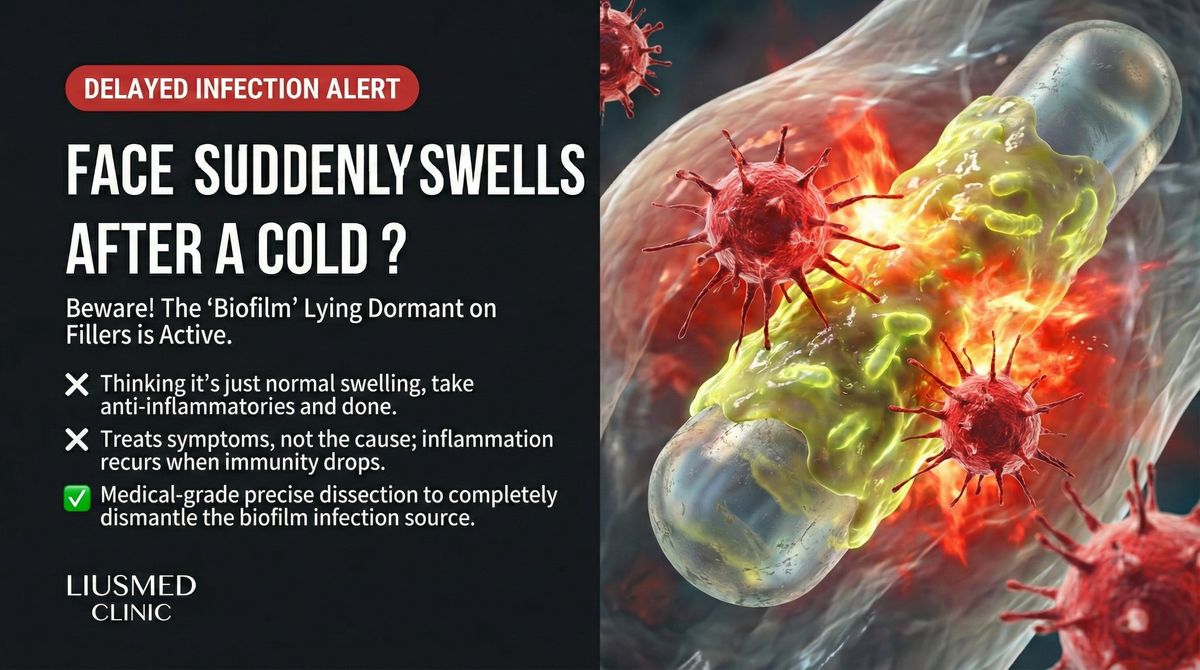
Your Filler Was Fine for Months—Then You Got Sick and It Swelled Up
You had filler injected months or even years ago. Everything was stable. Then you caught a cold, or received a flu vaccine, or a COVID booster. Days later, you notice the area where filler was injected is suddenly swollen—red, puffy, tender, as if the filler has "woken up."
The connection between these seemingly unrelated events has a clear medical explanation.
Why a Cold or Vaccine Can "Awaken" Filler Problems
The Role of the Immune System
| Trigger Event | Immune Mechanism | Effect on Filler |
|---|---|---|
| Upper respiratory infection | Systemic immune activation | Reawakens dormant local inflammation |
| Influenza vaccine | Immune activation simulating infection | Immune cells re-focus on filler site |
| COVID vaccine | Strong immune response | Documented to trigger filler-site swelling |
| Dental infection | Local immune activation in facial area | Directly stimulates nearby filler zones |
| Severe stress or fatigue | Immune dysregulation | Reduces suppression of latent infection |
Key Insight: Your immune system normally maintains a state of "peaceful coexistence" with filler material. When a cold, vaccine, or other event triggers the immune system into high-alert mode, this balance breaks—immune cells re-"notice" abnormalities around the filler, especially latent biofilm.
What Is Biofilm, and Why Does It Relate to Immune Triggers
Biofilm is a protective structure formed by bacteria adhering to the filler surface. It acts like an invisible shield, allowing bacteria to survive quietly around the filler without provoking an obvious inflammatory response.
The Dormancy-Activation Cycle of Biofilm
- Dormancy phase: Biofilm exists stably. The immune system maintains low-level surveillance but doesn't mount an attack. The patient feels everything is normal.
- Activation phase: The immune system is activated by an external event (cold, vaccine, etc.) and re-engages with the biofilm. Redness, pain, and swelling appear.
- Re-dormancy: If only antibiotics or anti-inflammatory drugs are used to suppress inflammation, the swelling subsides but the biofilm persists. The next immune trigger may cause another flare.
Key Insight: This is why some patients experience a "recurring flare" pattern—every time they get sick or receive a vaccine, the same area swells. The real problem isn't the cold itself, but the biofilm that has been present all along, merely suppressed.
How to Recognize Biofilm-Triggered Swelling
Typical Characteristics
- Temporal association: Appears within days of a cold, vaccination, or other immune event
- Site specificity: Swelling precisely corresponds to a previous filler injection site
- History of recurrence: Previous episodes of swelling under similar circumstances
- Partial antibiotic response: Antibiotics improve symptoms but don't completely resolve them
- Temporary steroid suppression: Steroids can temporarily reduce swelling, but it recurs after discontinuation
Distinguishing From Other Causes
- Allergic reaction: Typically faster onset, more widespread, not limited to filler sites
- Simple immune reaction: Mild and self-limiting, usually resolves within days
- Delayed inflammatory reaction: May overlap; ultrasound helps differentiate further
Why Ultrasound Assessment Is Essential
For suspected biofilm reactivation, ultrasound can confirm:
- Filler status: Whether there is aggregation, encapsulation, or structural changes
- Surrounding tissue inflammation: Extent and severity of edema
- Abscess formation: Whether liquefactive necrosis or abscess has developed
- Filler-biofilm relationship: Biofilm typically adheres to the filler surface
- Residual volume: Critical information for treatment planning
Key Insight: Without imaging, it's impossible to distinguish between a simple immune-mediated reaction (which may resolve on its own) and true biofilm reactivation (which will keep recurring). Ultrasound provides the diagnostic clarity needed to make this distinction.
Treatment Strategies
Acute Phase Management
During acute swelling, inflammation control comes first:
- Appropriate antibiotic therapy (specialized regimens targeting biofilm)
- Judicious use of anti-inflammatory medication
- Avoiding premature invasive procedures
The Definitive Solution
Why antibiotics alone aren't enough: Biofilm creates a natural barrier against antibiotics. Antibiotics can kill free-floating bacteria outside the biofilm but cannot fully eradicate the biofilm structure itself. This is the fundamental reason for recurring flares.
Filler removal: When ultrasound confirms evidence of biofilm infection around the filler, the definitive solution is removing the infected filler—because biofilm adheres to the filler surface, removing the filler removes the biofilm's "home."
Ultrasound-guided extraction: Precisely locating and extracting infected filler under ultrasound guidance while maximally preserving normal tissue. See biofilm and filler swelling for more detail.
Strategies to Prevent Recurrence
- Recognize the pattern: If you experience swelling every time you get sick or vaccinated, it's not coincidence
- Seek early evaluation: The first recurrence warrants ultrasound assessment
- Consider preventive removal: For patients with recurrent flare history, removing filler even during a quiescent period may be appropriate
- Pre-vaccination consultation: Patients with recurrence history may benefit from consulting before receiving vaccines
If you've experienced filler-site swelling after a cold or vaccine, schedule a consultation. Let ultrasound determine whether biofilm is present and whether definitive treatment is needed. See also delayed swelling years later and lumps years after injection.
Frequently Asked Questions
Why does the spot where I had filler swell up whenever I catch a cold or get a vaccine?
Normally your immune system and the filler sit in a kind of peaceful coexistence. A cold, the flu, or a vaccine puts the whole immune system on high alert, and it starts noticing the low-grade abnormality around the filler again — especially a biofilm hiding on the filler's surface. The swelling usually shows up within a few days of that event, and it maps precisely onto where you were originally injected.
How do I tell this swelling apart from an allergic reaction?
An allergic reaction usually comes on faster and spreads wider, not confined to just the filler area. Biofilm-activated swelling has a few tells: it follows a cold or a vaccine, it matches the old injection site precisely, it has often swelled the same way before, and antibiotics help but don't fully clear it. To really tell them apart, it takes ultrasound to look at what's actually going on around the filler.
The swelling goes down once I take anti-inflammatories or antibiotics — does that mean it's resolved?
Not necessarily. A biofilm has a natural barrier against antibiotics — they can kill the free-floating bacteria on the outside and calm the inflammation for a while, but they can't clear the biofilm itself; steroids are the same, and it tends to flare again once you stop. So symptoms settling doesn't mean the root cause is dealt with — the next time the immune system is triggered, the same spot can swell up again.
The same spot swells every time I get a cold — does it need treatment?
If the same spot swells every time you catch a cold or get a vaccine, that's usually not a coincidence — it points to a biofilm that's been sitting there and getting repeatedly suppressed. I'd suggest an ultrasound assessment at the first recurrence to see the filler's state, how far the inflammation reaches, and whether there's an abscess, rather than keeping it down with anti-inflammatories over and over.
Do I have to have the filler removed?
When ultrasound confirms evidence of biofilm infection around the filler, the more fundamental approach is to remove the infected filler — because the biofilm sits on the filler's surface, so as long as the filler is there, it has a "home". Our approach is to locate it precisely under ultrasound guidance and remove it through a minimal incision, preserving as much healthy tissue as possible. Whether it comes to that, and how much can be removed, still depends on an in-person assessment and varies from person to person.
Related Reading
- Biofilm and Filler Swelling
- Sudden Swelling Years After Filler Injection
- Hard Lump Years After Filler? Don't Rush to Dissolve
Related Services
Specialties
Credentials
- Kaohsiung Medical University, School of Medicine
- Attending Physician, Dermatology, Kaohsiung Chang Gung Memorial Hospital
- Attending Physician, Aesthetic Center, Kaohsiung Chang Gung Memorial Hospital
- Visiting Physician, Dermatology, Xiamen Chang Gung Hospital
- Visiting Physician, Aesthetic Center, Xiamen Chang Gung Hospital
"For every surgery, I strive to achieve a good outcome through a small incision and refined technique. Minimally invasive surgery is not just a technique — it's a commitment of respect to every patient."
Recovery after any procedure needs peer support too


Want to learn more?
Schedule a consultation for professional evaluation and advice