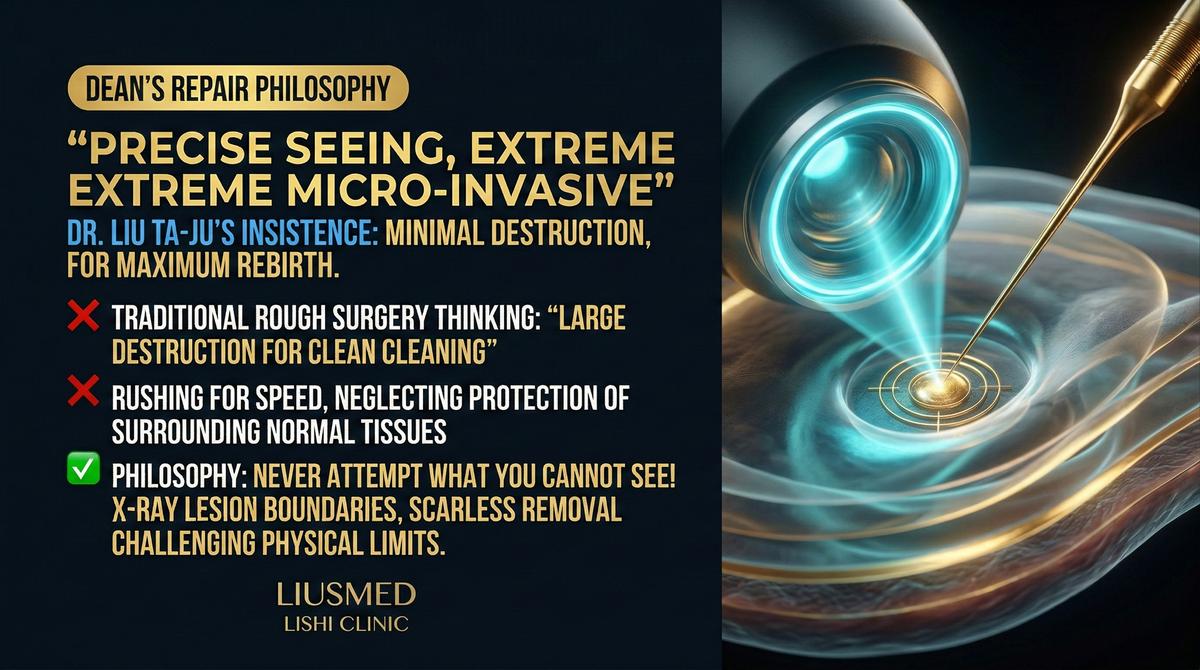
Dr. Liu's 'Precision Vision, Maximum Minimalism' Revision Philosophy
One Philosophy, Woven Through Every Stage of Revision
In the highly specialized field of filler revision, technology and equipment certainly matter — but what truly determines long-term quality is the team's core principles and medical philosophy. Dr. Liu's team's commitment to "Precision Vision, Maximum Minimalism" is not marketing packaging — it is a set of clinical practice principles that run through every stage from diagnosis to surgery to post-operative care.
"Precision Vision": Diagnosis Is the Foundation of Revision
Why "Seeing" Matters So Much
In traditional filler revision, many physicians rely on palpation, patient descriptions, or even educated guesses to assess problems. But filler distribution in tissue is often far more complex than expected — it may spread, layer, integrate with tissue, or even become encapsulated.
"Precision Vision" means:
| Principle | Practice | Clinical Significance |
|---|---|---|
| Don't guess, see | All assessments based on ultrasound imaging | Avoiding errors from subjective judgment |
| See everything, miss nothing | Systematic scanning of all potentially affected areas | Avoiding treating only surface-level problems |
| See depth, determine layers | Confirming which tissue layer contains the filler | Determining the safest extraction pathway |
| See changes, assess reactions | Evaluating tissue response to the filler | Deciding whether inflammation control is needed first |
| See vessels, ensure safety | Marking all important vascular locations | Ensuring surgical safety |
Key Insight: "Precision Vision" does not mean "having ultrasound is enough." It means the physician must have sufficient anatomical knowledge and clinical experience to correctly interpret every signal on the ultrasound screen. Seeing is the first step; understanding is what matters.
From Seeing to Understanding
Dr. Liu's ultrasound examination practice includes:
- Complete scanning: Not just the area the patient identifies, but systematic scanning of the entire face
- Material identification: Determining filler type based on echo characteristics
- Extent mapping: Precise measurement of filler boundaries and depth
- Vascular localization: Pre-operatively confirming all structures that must be avoided
- Image documentation: Preserving complete ultrasound records for surgical planning and post-operative comparison
Related reading: Ultrasound-Guided Pinhole Extraction Explained
"Maximum Minimalism": Achieving Maximum Results with Minimum Impact
Minimally Invasive Means More Than "Small Wounds"
Many equate "minimally invasive" with "small incisions," but in Dr. Liu's philosophy, maximum minimalism encompasses far more:
| Dimension | Conventional Understanding | True Meaning of Maximum Minimalism |
|---|---|---|
| Wound | Smaller incision is better | Choose the smallest entry point while ensuring adequate operative space |
| Tissue | Avoid cutting | Precisely target objectives, maximally preserve surrounding normal tissue |
| Time | Faster surgery is better | Reduce tissue exposure time while ensuring quality |
| Frequency | One session ideally | Complete treatment in one session when safely possible to avoid repeat surgery |
| Recovery | Quick recovery | Minimize overall trauma for smoother natural healing |
Technical Implementation of Maximum Minimalism
| Technical Element | Practice |
|---|---|
| Pinhole entry | Operating through 1-2mm micro-incisions |
| Ultrasound guidance | Full image guidance ensuring every step is precise |
| Selective extraction | Removing only the filler, not damaging surrounding tissue |
| Real-time verification | Continuous scanning to confirm extraction progress |
| Minimized manipulation | Avoiding unnecessary tissue exploration and flap creation |
Key Insight: The core of maximum minimalism is not "daring to operate through a small wound" — it is "having the ability to achieve precision, completeness, and safety through a small wound." This requires both ultrasound guidance technique and deep anatomical foundation.
Related reading: Filler Lump Extraction Technique
How Philosophy Translates to Clinical Decisions
Decision Principles
In every clinical case, "Precision Vision, Maximum Minimalism" translates to these decision principles:
| Scenario | Decision Principle | Practical Example |
|---|---|---|
| Conservative if possible | If the issue can resolve with medication or time, don't rush to surgery | Control mild inflammation with medication first |
| Minimally invasive over open | If pinhole extraction is feasible, don't use open excision | Ultrasound-guided pinhole extraction |
| Remove less when possible | Only extract what must be removed, preserve harmless material | Selective extraction of problematic areas |
| One session when safe | Complete treatment in one session within safety bounds | Thorough pre-operative planning |
| Don't risk uncertainty | Prefer cautious observation over operating with uncertainty | Pause and re-evaluate |
Honest Communication with Patient Expectations
In the revision field, patients often arrive with strong expectations. The "Precision Vision" philosophy extends to communication:
- Honestly communicate what can and cannot be achieved
- Never over-promise to retain a patient
- If outcomes are uncertain, recommend observation
- Respect the patient's autonomy in decision-making
The Formation of This Philosophy
From Clinical Observation to Core Beliefs
Dr. Liu's revision philosophy did not appear from nowhere — it emerged from years of clinical observation:
- Seeing too many patients requiring second or third surgeries due to careless first revisions
- Cases where blind extraction damaged tissue that should not have been touched
- The surface meaning of "minimally invasive" being misused while actual procedures lacked precise guidance
- Patients whose trust in medicine collapsed after multiple failures
These observations drove a conviction: Revision should not create more problems. It should proceed with maximum caution, guided by what can be seen, achieving the best results at the lowest possible cost.
Applying the Philosophy Across Different Scenarios
Simple Cases
Even in relatively straightforward cases, "Precision Vision, Maximum Minimalism" is never compromised:
- Complete ultrasound assessment is still performed
- Vessels and safe pathways are still marked
- The smallest possible wound still achieves the extraction
Complex Cases
For complex cases, this philosophy provides a decision framework:
- If findings are more complex than anticipated, stage the procedures rather than risk doing everything at once
- If ultrasound shows vessels too close, adjust the extraction pathway rather than force the approach
- If mixed materials are discovered, identify each separately and treat accordingly
International Patients
For patients who travel specifically to Taiwan:
- Thorough pre-trip communication to reduce expectation gaps
- Extra surgical caution, as patients cannot return for frequent follow-ups
- Comprehensive remote follow-up protocols established post-operatively
Conclusion: Philosophy Determines Quality
In medicine, techniques can be learned, equipment can be purchased, but philosophy cannot be replicated. "Precision Vision, Maximum Minimalism" is Dr. Liu's team's commitment — we do not pursue maximum surgical volume, but rather optimal quality for every single case.
If you are looking for a team that approaches revision with careful diligence, schedule a consultation and let us start with "Precision Vision."
Related reading: Why You Need a Dual-Specialty Team
Related Services
Specialties
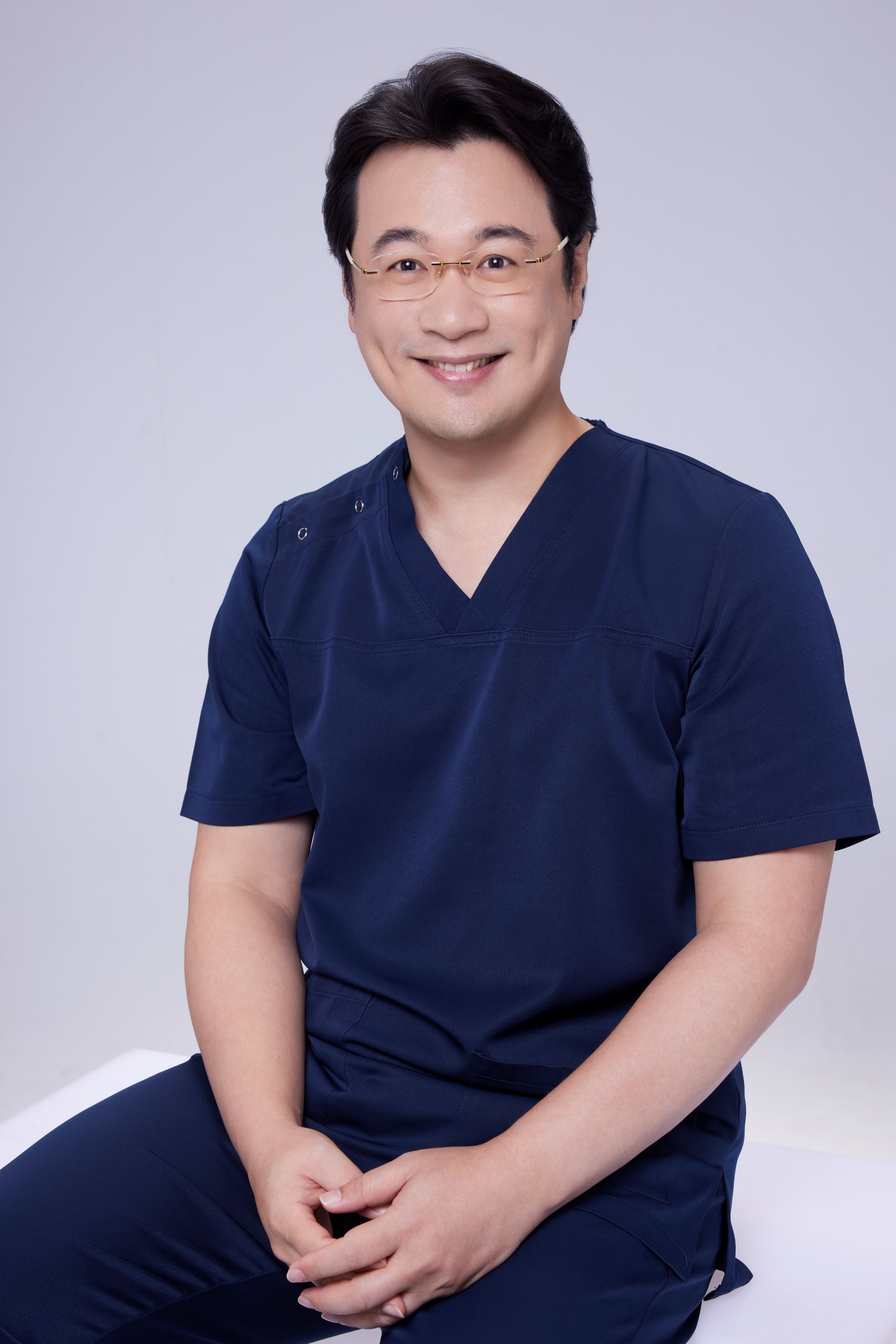
Credentials
- Kaohsiung Medical University, School of Medicine
- Attending Physician, Dermatology, Kaohsiung Chang Gung Memorial Hospital
- Attending Physician, Aesthetic Center, Kaohsiung Chang Gung Memorial Hospital
- Visiting Physician, Dermatology, Xiamen Chang Gung Hospital
- Visiting Physician, Aesthetic Center, Xiamen Chang Gung Hospital
"For every surgery, I strive to achieve a good outcome through a small incision and refined technique. Minimally invasive surgery is not just a technique — it's a commitment of respect to every patient."
Recovery after any procedure needs peer support too

Want to learn more?
Schedule a consultation for professional evaluation and advice