Why Complex Filler Complications Require a Team Trained in Both Dermatology and Surgical Micro-Extraction
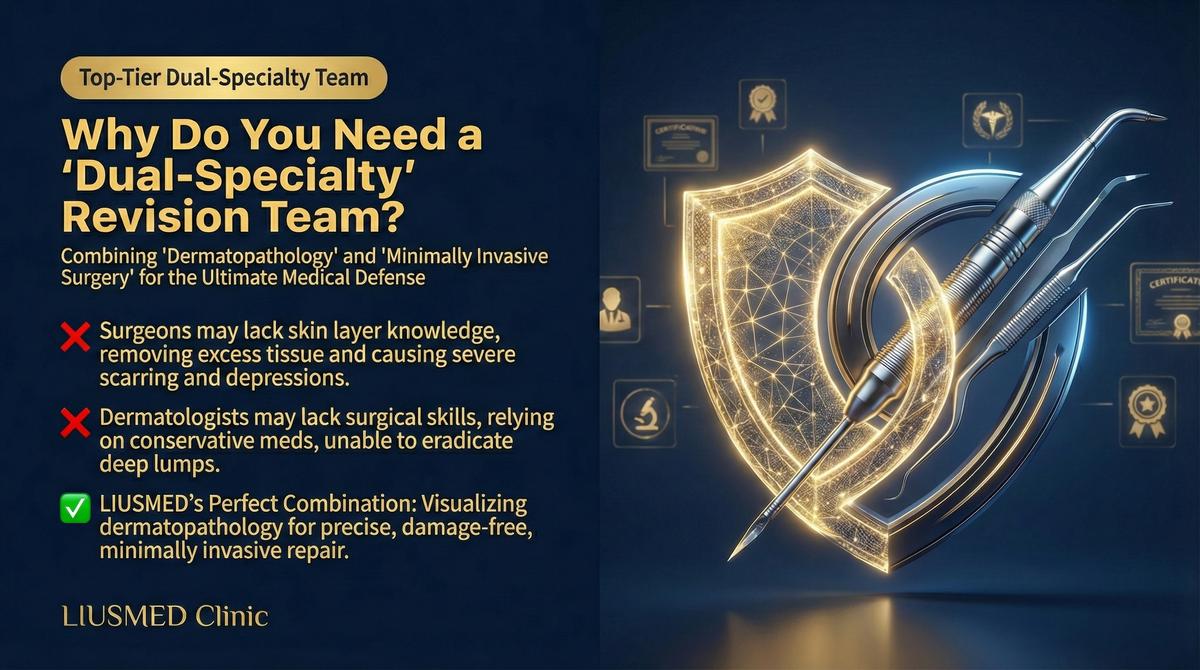
Why Filler Revision Is Not a "One-Doctor-Fixes-All" Problem
Managing aesthetic filler complications may seem as simple as "taking out what was put in," but it actually involves the intersection of dermatological science, diagnostic imaging, and surgical micro-extraction technique. Many patients who have undergone repeated dissolution attempts, steroid injections, or even open surgical excision still find their problems unresolved. The root cause is often that the treating team's expertise was incomplete.
This article examines why managing complex filler complications requires a team with both dermatological and minimally invasive surgical capabilities.
The Complexity of Filler Complications: More Than "Foreign Material Under the Skin"
Complications Span Multiple Layers
Post-filler problems are never as simple as "the filler is still there." Depending on the type of complication and how long it has been evolving, the issues may involve:
| Problem Layer | Specialty Required | Typical Scenario |
|---|---|---|
| Material identification | Dermatology + Imaging | Unknown filler type, mixed injections |
| Tissue reaction | Dermatological immunology | Granuloma, chronic inflammation, biofilm |
| Location assessment | Ultrasound imaging | Filler near deep vessels or nerves |
| Extraction technique | Surgical micro-extraction | Minimally invasive channel design, hemostasis |
| Post-operative recovery | Dermatology + Surgery | Wound healing, scar management, follow-up |
Key Insight: Filler complication management requires seamless integration between "diagnosis" and "surgery." If the diagnosing physician cannot perform the extraction, or if the surgeon does not understand skin layers and tissue reactions, treatment may be incomplete or create new problems.
The Limitations of Single-Specialty Approaches
Blind Spots of Dermatology Alone
Dermatologists have excellent training in tissue reaction interpretation, pharmacological treatment, and non-invasive assessment, but when physical extraction is needed, limitations may include:
- Limited microsurgical training: Dermatology training emphasizes medications and laser therapy, with less focus on deep-tissue surgical manipulation
- Insufficient extraction pathway design: Minimally invasive channel creation requires surgical thinking
- Hemostasis and tissue handling: Deep procedures may involve vessels and nerves requiring surgical safety protocols
Blind Spots of Surgery Alone
Surgeons excel at operative technique, wound management, and tissue reconstruction, but face their own gaps with filler complications:
- Limited filler material identification: Different fillers appear very differently on ultrasound, requiring dermatological imaging training
- Pharmacological management of tissue reactions: Granuloma and chronic inflammation require dermatological immunology knowledge
- Precise skin-layer judgment: Each facial skin layer has unique anatomical properties requiring dermatological understanding
Key Insight: This is not a criticism of either specialty—it is an objective observation that filler complications are inherently cross-disciplinary problems requiring cross-disciplinary capabilities.
Core Advantages of a Dual-Specialty Team
A Complete Chain from Diagnosis to Treatment
The greatest advantage of a dual-specialty team is that every step from evaluation to surgery is performed by a team that understands the complete picture:
| Treatment Phase | Dermatology Role | Surgical Role | Dual-Specialty Benefit |
|---|---|---|---|
| Initial consultation | Material ID, tissue reaction assessment | Feasibility and surgical risk evaluation | Complete assessment in one visit |
| Ultrasound examination | Filler imaging characteristics | Extraction pathway and safety planning | Diagnosis = surgical planning |
| Pre-operative preparation | Inflammation control, infection management | Surgical plan design | Simultaneous, shortened waiting |
| Surgical extraction | Real-time imaging guidance interpretation | Minimally invasive channel operation | Precise localization + safe extraction |
| Post-operative care | Skin recovery, scar management | Wound assessment, healing follow-up | Comprehensive aftercare |
Reducing the Risk of Repeat Procedures
Clinically, many patients endure prolonged revision journeys because the first treatment was not thorough enough:
- Only partial filler dissolution, with residual material continuing to trigger reactions
- Extraction that damaged normal tissue, creating new appearance concerns
- Failure to identify different materials in mixed injections, leaving behind foreign material
A dual-specialty team can maximize completeness from the first treatment, reducing the burden of repeated visits.
The Role of Ultrasound in Dual-Specialty Integration
Ultrasound is not merely a "diagnostic tool." Within a dual-specialty team, it simultaneously serves as both a diagnostic instrument and a surgical guidance system:
Dual Functions of Ultrasound
| Function | Dermatology Application | Surgical Application |
|---|---|---|
| Diagnosis | Identify filler type, extent, depth | Assess surgical feasibility and risk |
| Guidance | Real-time confirmation of extraction completeness | Guide instruments away from vessels and nerves |
| Follow-up | Post-operative residual assessment | Wound healing and tissue change monitoring |
This is why Dr. Liu's team emphasizes the "see before you treat" philosophy—ultrasound enables diagnosis and surgery to occur on the same screen, and a dual-specialty background ensures every piece of information on that screen is correctly interpreted and acted upon.
Related reading: Filler Lump Extraction Technique
Which Situations Especially Require a Dual-Specialty Team?
Not all filler problems need complex intervention, but the following situations particularly warrant seeking a dual-specialty team:
High-Complexity Scenarios
| Scenario | Why Dual-Specialty Is Needed | Single-Specialty Risk |
|---|---|---|
| Unknown filler | Dermatological imaging ID + surgical extraction | Misidentifying material leads to wrong treatment |
| Multiple injection history | Layer-by-layer analysis and extraction | Missing deep residual deposits |
| Concurrent infection/inflammation | Dermatological medication + surgical drainage | Medication alone cannot cure |
| Sensitive areas (nose, periorbital) | Precise localization + microsurgical technique | Increased damage risk |
| Previous failed revision | Complete re-evaluation with different strategy | Repeating the same mistakes |
| Collagen stimulator complications | Distinguishing stimulated tissue from filler boundaries | Excessive removal of normal tissue |
Key Insight: If you have already tried treatment elsewhere with unsatisfactory results, you likely need a dual-specialty team that can "re-evaluate from zero."
Related reading: The Complete Filler Repair Evaluation Process
How to Evaluate Whether a Team Has Dual-Specialty Capability
Here is a checklist patients can use when selecting a revision team:
Evaluation Checklist
- Is the physician trained in both dermatology and surgery?
- Does the clinic have diagnostic-grade ultrasound equipment (not just injection-guidance devices)?
- Can real-time ultrasound examination be performed during the consultation?
- Can the physician both interpret ultrasound images and personally perform the extraction?
- Does the team have experience with various filler types and treatment locations?
- Is post-operative follow-up managed by the same team?
Liusmed Clinic's Dual-Specialty Integration Model
Dr. Ta-Ju Liu has dual training in dermatology and surgical micro-extraction, enabling the following to be accomplished in a single visit:
- Dermatological assessment: Material identification, tissue reaction interpretation, medication planning
- Ultrasound examination: Real-time imaging confirmation of filler location, extent, and surrounding tissue status
- Surgical plan design: Personalized minimally invasive extraction plan based on complete assessment
- Surgical execution: Ultrasound-guided precision micro-extraction
- Post-operative management: Skin recovery, scar prevention, and long-term follow-up
This "one-stop integration" model means patients do not need referrals between different specialists, avoiding information gaps that can lead to overlooked problems.
Related reading: Ultrasound-Guided Pinhole Extraction Explained
Conclusion: Choosing the Right Team Is the First Step to Successful Revision
When facing filler complications, technique matters—but choosing a team with comprehensive capabilities is the foundation of successful revision. A dual-specialty team is not a luxury; it is a necessity for addressing complex problems.
If you are seeking professional evaluation for filler revision, schedule a consultation to receive a comprehensive ultrasound examination and treatment plan.
Related Services

Specialties
Credentials
- Kaohsiung Medical University, School of Medicine
- Attending Physician, Dermatology, Kaohsiung Chang Gung Memorial Hospital
- Attending Physician, Aesthetic Center, Kaohsiung Chang Gung Memorial Hospital
- Visiting Physician, Dermatology, Xiamen Chang Gung Hospital
- Visiting Physician, Aesthetic Center, Xiamen Chang Gung Hospital
"For every surgery, I strive to achieve a good outcome through a small incision and refined technique. Minimally invasive surgery is not just a technique — it's a commitment of respect to every patient."
Recovery after any procedure needs peer support too


Want to learn more?
Schedule a consultation for professional evaluation and advice