Ellansé S/M/L Complication Differences: M Is Already Hard
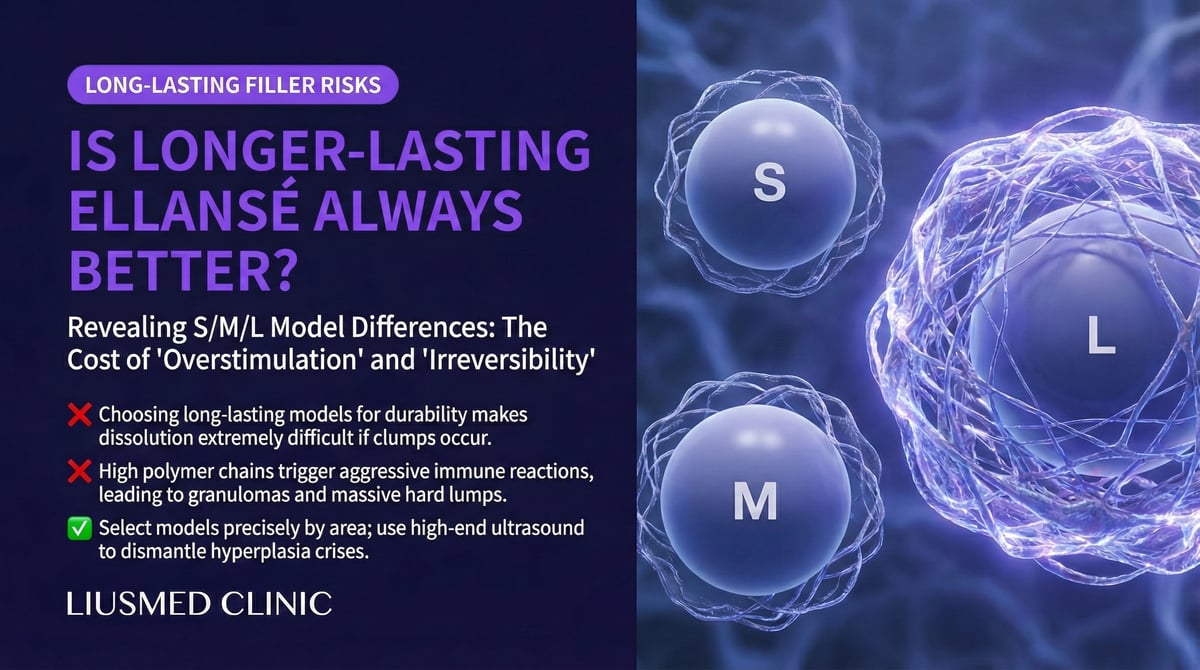
The literature says L and E are the hard ones. That is not what I see on the table
Ellanse is a collagen-stimulating filler built around polycaprolactone (PCL) microspheres, supplied in four formulations — S, M, L and E — with progressively longer duration.
When the international literature discusses difficult Ellanse removal, it is almost always discussing L and E: higher PCL content, thicker capsule, more entangled with tissue, therefore neither dissolvable nor easily extracted. That direction is not wrong. The longer it lasts, the longer PCL microspheres sit in the tissue.
But here is something that rarely gets written down: M is already hard.
We have actually removed it. The capsule around M, and the degree to which M has knitted itself into the surrounding tissue, is not the easy picture implied by "shorter formulation, easier to manage." The literature files M under the forgiving group. There is a gap between that filing and what I meet on the operating table.
So if what you had was M, do not assume that "well, at least I didn't get L" means a problem would be simple to clean up. The threshold sits earlier than people assume.
One thing I want to state plainly, so this isn't read as scaremongering: this does not mean M will go wrong. Most people who have it are fine. And my vantage point is biased by definition — the people who reach me are the ones who already have a problem and need it dealt with, so they cluster at the difficult end. I cannot tell you an incidence rate. That is not something my position lets me see.
What I can tell you is the other half: when it does come to removal, M is not in the easy tier.
Key Insight: When choosing a formulation, everyone asks how long it lasts. The question to ask alongside it is — if this has to come out, how hard is it to get out?
Fundamental Differences Between the Four Formulations
PCL Microsphere Characteristics
| Formulation | Duration | PCL Content | Microsphere Properties | Collagen Stimulation Period |
|---|---|---|---|---|
| Ellansé S | ~1 year | Lowest | Smaller, faster degradation | ~6–12 months |
| Ellansé M | ~2 years | Moderate | Medium size | ~12–18 months |
| Ellansé L | ~3 years | Higher | Larger, slower degradation | ~18–30 months |
| Ellansé E | ~4 years | Highest | Largest, slowest degradation | ~24–36 months |
Recommended Use Versus Clinical Reality
| Formulation | Manufacturer Positioning | Clinical Reality |
|---|---|---|
| S | First-time users, conservative approach | Used relatively less (shorter duration) |
| M | Most commonly recommended | Most widely used — and the formulation I most often remove |
| L | Patients seeking long-term results | Used in some markets |
| E | Special needs | Not available in some markets |
In practice the two that actually get injected in volume are S and M, so the discussion below centres on those. L and E stay in the article because people do get them injected elsewhere and come to us afterwards.
How Formulation Affects Complications
Nodule Formation Risk
The longer PCL microspheres remain in tissue, the greater the chance of nodule formation:
| Factor | S/M Types | L/E Types |
|---|---|---|
| PCL retention time | Shorter (1–2 years) | Longer (3–4+ years) |
| Capsule development | Thinner | Potentially thicker and more mature |
| Collagen overgrowth risk | Lower | Higher |
| Palpable nodule incidence | Lower | Higher |
| Delayed inflammatory reaction | Less common | More common |
Extraction Difficulty
When Ellanse removal is needed, formulation directly affects surgical complexity:
| Extraction Factor | S | M | L | E |
|---|---|---|---|---|
| Residual PCL volume | Low | Moderate | High | Highest |
| Capsule thickness | Thin | Already not thin | Thick | Thickest |
| Tissue entanglement | Low | Considerable | High | Highest |
| Single-session completion rate | High | Depends on spread and capsule | Moderate | Lower |
| Post-extraction tissue recovery | Fast | Moderate | Slow | Slowest |
Read this table together with the section above. L and E are harder — that much is true. But do not read the M column as "easy." That is how the literature groups it. It is not how it groups on the operating table.
Key Insight: Long-acting formulations are harder to clean up, and that is correct. What gets underestimated is M: it is filed under "short-acting, manageable," but by the time you are actually removing it, it is no longer in the easy tier.
Typical Complication Scenarios by Formulation
S Type: The Most Forgiving Choice
S type has the lowest PCL content and fastest degradation, making it the lowest-risk formulation:
- Nodule formation is rare and usually small
- Even if problems arise, significant improvement typically occurs within 12–18 months
- If extraction is needed, the thin capsule makes removal relatively straightforward
M Type: The Most Common — and the Most Underestimated
M is the most widely used formulation, and the one I most often end up removing.
- Nodules may appear 6–12 months post-injection
- Steroid injections may help with early inflammatory nodules
- But when it comes to removal: the capsule around M is already not thin, and the tissue entanglement is considerable
"M is short-acting, therefore easy to manage" is a smooth inference, and it is how the literature groups it. All I can tell you is that when you actually open it up, there is distance between that impression and what is in front of you. Whether it comes out cleanly in one session depends on how far it has spread and what the capsule is doing — not on the letter on the box.
L Type: Risk Begins to Escalate
L type's increased PCL content and duration bring elevated management challenges:
- Nodule formation risk is higher than M type
- Thicker capsules reduce steroid and 5-FU penetration
- Extraction may require more refined ultrasound guidance
- Some cases may need staged extraction
E Type: Highest Risk
E type has the longest duration and highest PCL content, with the greatest complication risk and management difficulty:
- Highest nodule formation risk
- Capsules may be very thick and mature
- Medical treatment is usually of limited effect
- Extraction surgery is most complex
- Multiple sessions may be necessary
The Critical Role of Ultrasound Across Formulations
Ultrasound Appearance by Formulation
| Formulation | Ultrasound Appearance | Clinical Significance |
|---|---|---|
| S residual | Small hypoechoic area, thin capsule | Relatively easy to locate and extract |
| M residual | Moderate hypoechoic area, visible capsule line | Standard extraction procedure |
| L residual | Larger hypoechoic area, prominent capsule | Careful extraction path planning needed |
| E residual | Extensive hypoechoic area, thick septated capsule | May require staged management |
Formulation-Specific Extraction Strategy
S/M Type Strategy
- A single pinhole is usually enough to get in
- Localise on ultrasound first, see where the capsule ends, then move
- But with M, do not assume it will all come out in one go — when the capsule is thick and the entanglement tight, stage it. Forcing a single clean sweep costs you tissue.
L/E Type Strategy
- May require multiple entry points
- Capsule fragmentation before stepwise extraction
- Staged approach may be safer
- More intensive post-procedure ultrasound follow-up required
Factors to Consider Before Choosing a Formulation
For Patients
| Consideration | Recommendation |
|---|---|
| First time using collagen stimulators | Start with S or M |
| History of filler complications | Avoid L and E |
| Duration expectations | Balance expectations with risk |
| Tolerance for uncertainty | Conservative patients should choose shorter formulations |
| Willingness for follow-up visits | Longer formulations require more diligent monitoring |
For Practitioners
| Consideration | Recommendation |
|---|---|
| Injection precision | L/E types demand higher technical standards |
| Complication management capability | Should have ultrasound-guided extraction capability |
| Patient selection | Avoid longer formulations in high-risk patients |
| Follow-up scheduling | Longer formulations require extended monitoring |
Already injected, and something is wrong?
Whether you had S, M, or one of the longer formulations, if you already have nodules, asymmetry or anything else going on: don't panic, but don't sit on it either. The sequence is:
- Ultrasound assessment: establish where the residual PCL is, how far it extends, what the capsule is doing. If you cannot see it, do not go in. That is the principle.
- Conservative treatment: for early inflammatory nodules, steroids or 5-FU may help.
- Minimally invasive extraction: when medical treatment fails, ultrasound-guided extraction is the definitive answer.
One warning: repeated steroid injections will not dissolve PCL. They cannot. Keep going and the skin atrophies while the thing that needs to come out is still sitting there.
For more on Ellanse removal, see Can Ellanse Be Removed?
Further reading:
- Collagen Stimulator Nodules: What to Do When 5-FU Fails
- Minimally Invasive Filler Lump Extraction Technique
Common questions
I had M, so I don't really need to worry about removal, right?
The literature does file M under the more manageable group, but when you actually open it up to take it out, the capsule around M is already not thin and the tissue entanglement is considerable. So don't assume that "at least I didn't get L" means a cleanup would be simple. This does not mean M will go wrong — it just means that if it ever comes to removal, M is not in the easy tier.
Does M always cause problems?
No. Most people who have it are fine. To be honest, the people who reach me are the ones who already have a problem and need it dealt with, so they cluster at the difficult end, and I cannot give you an incidence rate. The point of this article is the difficulty of removal, not that everyone will run into trouble.
Once a nodule appears, can repeated steroid injections dissolve the Ellanse?
For early inflammatory nodules, steroids or 5-FU sometimes help. But repeated steroid injections will not dissolve PCL — it simply cannot be dissolved that way. Keep going and the skin atrophies while the thing that needs to come out is still sitting there, so leaning on injections indefinitely is not a good plan.
Can Ellanse be taken out cleanly in one session?
That depends on how far it has spread and what the capsule is doing, not on the letter on the box. With M, don't assume it will all come out in one go — when the capsule is thick and the entanglement is tight, stage it. Forcing a single clean sweep costs you tissue.
I already have a nodule or asymmetry — what is the first step?
Start with an ultrasound assessment to establish where the residual PCL is, how far it extends, and what the capsule is doing. If you cannot see it, you do not go in — that is the principle. Early inflammatory nodules can be tried on steroids or 5-FU first; when medical treatment fails, ultrasound-guided minimally invasive extraction is the definitive answer. No need to panic, but don't sit on it either.
About the Author
Dr. Ta-Ju Liu
- Current Position: Director, Liusmed Clinic
- Specialties: Minimally invasive surgery, filler complication repair, ultrasound-guided extraction
- Experience: 15+ years of clinical minimally invasive surgery; over 10,000 successful cases
- Philosophy: "Everyone choosing a formulation asks how long it will last. I would like you to ask one more thing — if this has to come out, how hard is it to get out? And I will be honest with you: M is already hard."
Related Services

Specialties
Credentials
- Kaohsiung Medical University, School of Medicine
- Attending Physician, Dermatology, Kaohsiung Chang Gung Memorial Hospital
- Attending Physician, Aesthetic Center, Kaohsiung Chang Gung Memorial Hospital
- Visiting Physician, Dermatology, Xiamen Chang Gung Hospital
- Visiting Physician, Aesthetic Center, Xiamen Chang Gung Hospital
"For every surgery, I strive to achieve a good outcome through a small incision and refined technique. Minimally invasive surgery is not just a technique — it's a commitment of respect to every patient."
Recovery after any procedure needs peer support too


Want to learn more?
Schedule a consultation for professional evaluation and advice