Bumps and Waves on the Forehead After Filler—Migration, Superficial Placement, or Both?
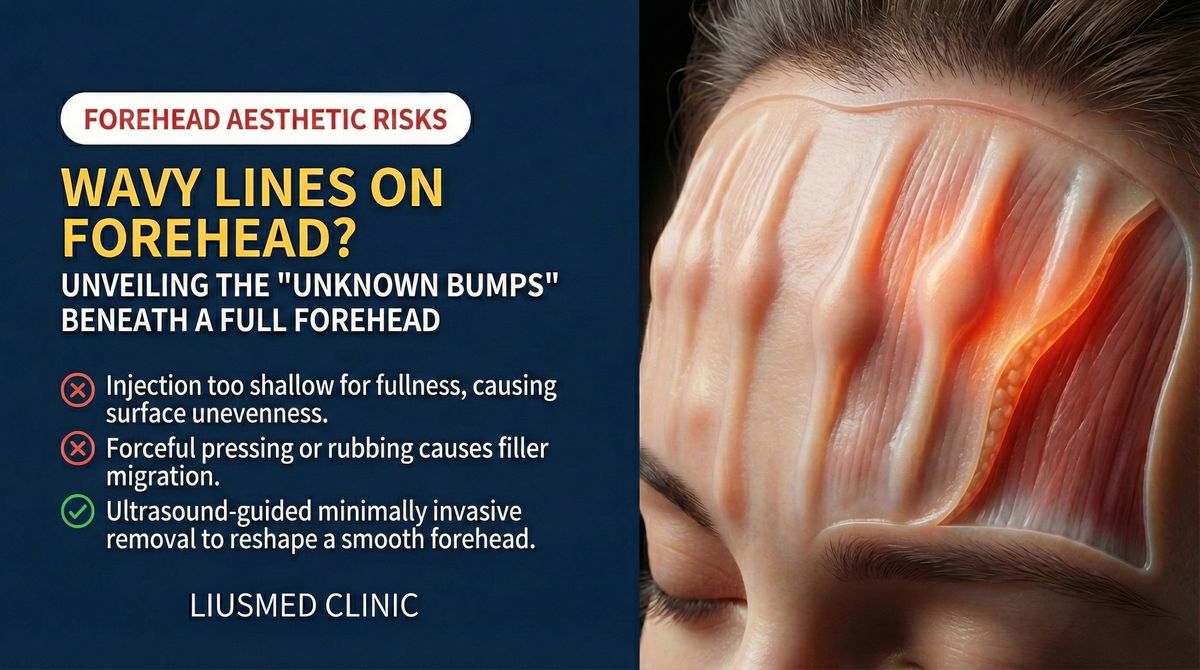
Those Bumps on Your Forehead Aren't Your Imagination
You had forehead filler to create a smoother, more rounded contour. At first it looked great. But gradually, under certain lighting, you notice the surface isn't smooth anymore—there are subtle bumps, wave-like ridges, or even palpable masses. Worse, you notice new fullness around the brow area or glabella that wasn't there before.
These issues are more common than you might think, and their causes can vary significantly.
Classifying Forehead Filler Problems
| Problem Type | Appearance | Feel | Common Cause |
|---|---|---|---|
| Superficial filler deposits | Visible bumps or ridges under certain light | Palpable edges | Injection too shallow |
| Uneven distribution | Wave-like surface irregularity | Undulating texture | Technique or product choice |
| Downward migration | New fullness at glabella or above brows | Elastic or firm on pressing | Gravity + tissue planes |
| Focal filler clumping | Localized round bumps | Distinct lumps | Concentrated injection |
| Fibrous encapsulation | Fixed, immovable bumps | Hard, non-compressible | Chronic foreign body reaction |
Key Insight: The forehead is one of the flattest areas of the face. Any subtle irregularity is amplified under overhead or angled lighting. This means the forehead demands exceptional evenness of filler distribution—and problems are easier to detect here than almost anywhere else.
Why the Forehead Is Particularly Challenging
Anatomical Factors
The forehead's anatomy creates unique challenges for filler placement:
- Relatively thin soft tissue: Especially in the upper forehead, where limited subcutaneous tissue means even slightly superficial placement becomes visible
- Flat bony foundation: The frontal bone provides limited natural contour to "hide" filler irregularities
- Constant muscle activity: The frontalis muscle continuously contracts and relaxes, squeezing and displacing filler over time
- Clear gravity pathway: Forehead filler can migrate along tissue planes toward the glabella and brow region
Key Insight: Forehead augmentation isn't simply about "filling the hollow." It requires precise control of injection depth, product selection, and volume distribution to avoid visible irregularities in this high-exposure zone.
The Specific Pattern of Forehead Filler Migration
The most common migration direction for forehead filler is downward—toward the glabella and above the eyebrows. This creates:
- Unnatural fullness or bulging at the glabella region
- A "shelf" effect above the eyebrows
- Diminished improvement at the original injection site on the forehead
- Upper eyelids that appear heavier
This migration is often gradual. Many people don't notice until someone points it out or they see the change in photographs compared to their baseline.
The Role of Ultrasound Assessment
For forehead filler issues, ultrasound provides critical diagnostic information:
- Exact location and depth: Confirming whether filler sits on periosteum, within muscle, or subcutaneously
- Distribution uniformity: Identifying focal clumps or gaps in coverage
- Migration extent: How far filler has traveled and its current position
- Encapsulation status: Whether fibrous capsule has formed
- Residual volume: Estimating how much needs to be removed
Why "See Before You Treat" Matters Here
The forehead region has complex vascular and neural anatomy. Before any intervention, establishing a clear ultrasound "map" not only enables precise filler treatment but also helps avoid critical structures and reduces complication risk.
Treatment Strategies
For Superficial Deposits
If filler sits too close to the skin surface, the approach depends on filler type:
- Hyaluronic acid: Precisely targeted enzyme injection to dissolve the superficial component
- Non-HA (Hyaluronic Acid) fillers: Ultrasound-guided pinhole extraction
For Uneven Distribution
Minor irregularities may respond to massage and molding (only in early cases without encapsulation). Significant unevenness may require partial removal and re-injection.
For Migration to the Brow Region
Ultrasound-guided localization of displaced filler followed by precise extraction is essential—this vascular-rich area demands image guidance to prevent complications. See how fillers migrate for a detailed explanation.
For Encapsulated Bumps
Dissolving enzymes cannot penetrate fibrous capsules. Ultrasound-guided pinhole extraction is the most direct and effective approach.
For a real case of Ellansé forehead lumps two years old, mapped first and then removed, see a three-month record of Ellansé forehead lumps.
Prevention Guidelines for Forehead Filler
- Choose soft, tissue-compatible products that integrate well with surrounding tissue
- Inject at appropriate depth—primarily supraperiosteal or deep subcutaneous
- Avoid concentrated single-point injections; use multiple small deposits for even distribution
- Avoid vigorous pressing or rubbing the forehead after injection
- Schedule follow-up assessments to monitor filler distribution over time
If you're unhappy with your forehead filler result, schedule a consultation. Ultrasound can precisely visualize how filler is distributed within the forehead and guide the most appropriate treatment plan. See also the filler repair evaluation process.
Related Reading
- Why Do Fillers Migrate?
- The Filler Repair Evaluation Process
- Ultrasound-Guided Pinhole Filler Extraction
- Two years of Ellansé forehead lumps: from ultrasound map to three months after repair
Related Services
Common questions
Is it my imagination that my forehead looks bumpy or wavy after filler?
No. The forehead is one of the flatter areas of the face, so even a small irregularity gets amplified under certain lighting, and what you're feeling or seeing is usually real. The cause isn't always the same, though: it could be filler placed too shallow, uneven spread, clumping, or downward migration, so the first job is working out which one it is.
Why does the forehead get these problems more than other areas?
The skin over the upper forehead is thin and the frontal bone is flat, so filler that sits even slightly too shallow is hard to hide. On top of that, the frontalis muscle is active all day, gradually squeezing filler and pushing it downward, which makes the forehead sensitive to both the depth and the spread of the injection.
Filler has moved to my glabella or above my eyebrows—can that still be treated?
Yes, but that region is dense with vessels and nerves, so we map where the filler has travelled with ultrasound first and then remove it precisely rather than working blind. This kind of migration is often gradual, and many people only notice it when someone points it out or they compare photographs.
Is the treatment the same for hyaluronic acid and non-HA filler?
No. Hyaluronic acid can be dissolved with a targeted enzyme where it sits too shallow, while non-HA filler is taken out through ultrasound-guided pinhole extraction. And once a fibrous capsule has formed, the enzyme can't get through it, so either type then has to be removed physically.
Why do you do an ultrasound before treating?
Because we need to see which layer the filler is in, how evenly it's spread, how far it has moved, whether a capsule has formed, and how much is left before deciding what to do. The forehead has complex vascular and neural anatomy, so building a clear map first lets us avoid important structures and lower the risk.

Specialties
Credentials
- Kaohsiung Medical University, School of Medicine
- Attending Physician, Dermatology, Kaohsiung Chang Gung Memorial Hospital
- Attending Physician, Aesthetic Center, Kaohsiung Chang Gung Memorial Hospital
- Visiting Physician, Dermatology, Xiamen Chang Gung Hospital
- Visiting Physician, Aesthetic Center, Xiamen Chang Gung Hospital
"For every surgery, I strive to achieve a good outcome through a small incision and refined technique. Minimally invasive surgery is not just a technique — it's a commitment of respect to every patient."
Recovery after any procedure needs peer support too


Want to learn more?
Schedule a consultation for professional evaluation and advice