How Hyperhidrosis Treatments Differ: ETS and Local Underarm Gland Treatment
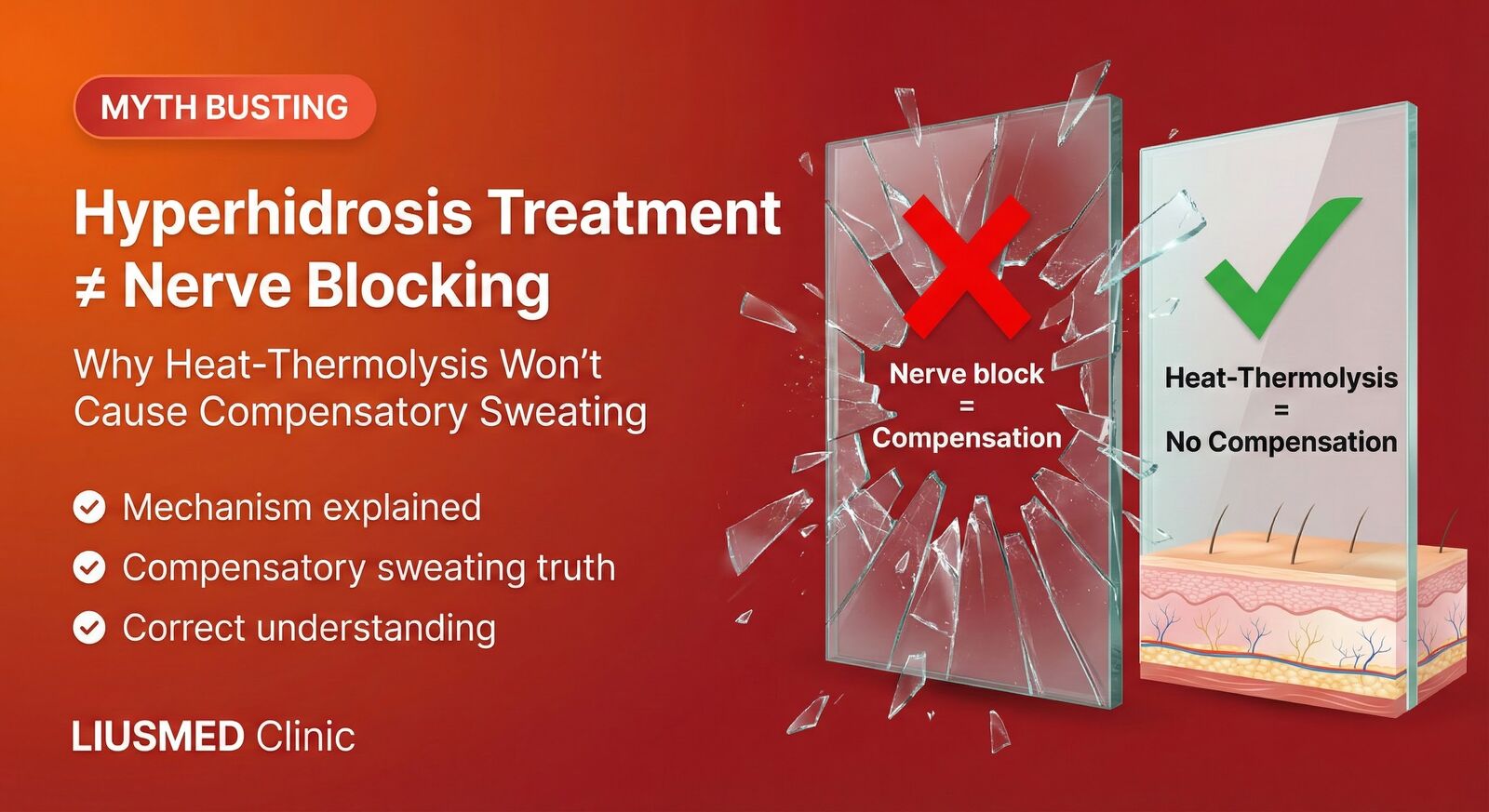
First Distinguish ETS from Local Underarm Treatment
Patients often ask whether treatment will increase sweating elsewhere. ETS and underarm thermal ablation act at different sites: ETS blocks the thoracic sympathetic trunk, while local treatment addresses glands in the underarm. This clinic does not have enough follow-up data to establish that sweating elsewhere remains unchanged after a local procedure.
Why Does the "Compensatory Sweating" Myth Exist?
It Comes from Sympathetic Nerve Surgery
Compensatory sweating is a risk to discuss before ETS. Changes after other local treatments should be assessed by procedure and patient:
| Surgery Type | Mechanism | Compensatory Sweating Risk |
|---|---|---|
| Endoscopic Thoracic Sympathectomy (ETS) | Cuts or clamps the thoracic sympathetic trunk | Common and potentially severe; varies by procedure and follow-up |
| Sweat Gland Thermal Ablation | Treats local underarm glands | No verifiable clinic incidence rate; changes elsewhere require follow-up |
The Source of Confusion
Many people hear "hyperhidrosis surgery causes compensation" without distinguishing surgery types:
| Surgery | Treatment Area | Method | Affects Nerves? |
|---|---|---|---|
| ETS Surgery | Palmar/facial sweating | Thoracoscopic nerve cutting | ✅ Yes |
| Sweat Gland Thermal Ablation | Underarm sweating | Thermal energy destroys glands | ❌ No |
💡 Treatment difference: ETS blocks the thoracic sympathetic trunk; underarm treatment addresses local glands. An ETS rate cannot be applied directly to an underarm procedure, and anatomy alone does not establish zero risk.
What Is Compensatory Sweating?
Sweating Changes That May Follow ETS
After thoracic sympathetic conduction is blocked, sweating at the target and other sites may change. Sweat does not necessarily follow one fixed transfer pathway:
Characteristics of Compensatory Sweating
| Characteristic | Description |
|---|---|
| Location | Back, chest, abdomen, thighs |
| Amount | May be more than pre-surgery hand sweating |
| Triggers | Heat, nervousness, exercise |
| Incidence | Varies with ETS procedure, symptom definition, and follow-up; discuss potentially severe outcomes before surgery |
| Severity | Ranges from mild to severe |
How Underarm Thermal Ablation and ETS Act
Completely Different Mechanisms
| Comparison | Sympathetic Nerve Surgery | Sweat Gland Thermal Ablation |
|---|---|---|
| Surgery Location | Inside chest (nerve ganglia) | Underarm skin layer |
| Target | Sympathetic nerves | Sweat/apocrine glands |
| Effect on Nerves | Blocks thoracic sympathetic conduction | Does not cut the thoracic sympathetic trunk |
| Effect on Sweating Elsewhere | Sweating elsewhere may increase | Changes elsewhere still need observation |
| Increased Sweating Elsewhere | Common and potentially severe | No verifiable clinic incidence rate |
What Sweat Gland Thermal Ablation Actually Does
- Small incision in underarm (< 1cm)
- Enter the dermal layer of skin
- Use thermal energy to destroy sweat/apocrine glands in that area
- Close wound
Key point: Local gland treatment does not cut the thoracic sympathetic trunk, but that does not prove sweating elsewhere stays unchanged for every person.
⚠️ Critical distinction: These treatments have different indications and target sites. If sweating elsewhere changes after treatment, seek assessment rather than assigning a cause yourself.
Detailed Comparison of Both Surgeries
Surgical Method Comparison
| Item | ETS (Sympathectomy) | Sweat Gland Thermal Ablation |
|---|---|---|
| Anesthesia | General anesthesia | Local anesthesia |
| Incision Location | Through armpit into chest | Underarm skin |
| Surgical Depth | Deep into chest cavity | Superficial skin |
| Procedure Time | Varies by technique and patient | Varies by area and procedure |
| Hospital Stay | Often day surgery; overnight observation varies by center and patient | Usually outpatient |
| Recovery Time | Varies; ask the ETS specialist | Varies; discuss wound care and activity limits |
Effect and Risk Comparison
| Item | Sympathetic Nerve Surgery | Sweat Gland Thermal Ablation |
|---|---|---|
| Applicable Areas | Palms, face, underarm | Primarily underarm |
| Effect Duration | Long-lasting | Long-lasting |
| Increased Sweating Elsewhere | Common and potentially severe; varies by study | No verifiable clinic incidence rate |
| Other Risks | Discuss with the ETS specialist | Assess wound care, local response, and sweating changes individually |
| Reversibility | Transection cannot simply be undone; a clip can be removed but recovery is uncertain | Local gland treatment cannot be undone |
Why Do People Still Worry About Compensation?
Information Confusion
Online information often doesn't clearly distinguish between different surgeries:
| Incorrect Statement | Correct Explanation |
|---|---|
| "All hyperhidrosis surgeries cause compensation" | ETS has a documented risk; ETS figures cannot be applied directly to local procedures |
| "Other areas will sweat more after surgery" | Assess separately by procedure and individual situation |
| "The body must shift sweat elsewhere" | One simple sweat-transfer model does not explain all changes |
Influence of Past Experience
In the 1990s-2000s, sympathetic nerve surgery was the mainstream treatment for hyperhidrosis, and compensatory sweating troubled many patients. This impression persists today, causing current patients to mistakenly think all hyperhidrosis surgeries cause compensation.
What the Evidence Can Tell Us
An Incidence Rate Needs Verifiable Follow-up
ETS studies describe specific procedures and follow-up groups: Gossot et al., PMID 12683540 and Chiou, PMID 15739526. Their rates cannot be transferred to underarm gland treatment. Day-case ETS is documented in a same-day discharge series, PMID 17462412, so an overnight stay is not universal.
This clinic does not have a published follow-up denominator and consistent definition for its underarm thermal procedure. It therefore cannot claim zero compensation or a fixed improvement rate. Ask about the procedure, follow-up time, and possible discomfort:
| Finding | Data |
|---|---|
| Increased sweating elsewhere after treatment | No verifiable clinic incidence rate |
| Symptom definition and follow-up | Ask how changes are recorded and when to return |
| Underarm sweat improvement | Individual outcomes require follow-up; there is no established fixed percentage |
| Patient satisfaction | No verifiable clinic denominator |
Questions to Ask at Consultation
"How does this procedure record changes in sweating elsewhere? How long is follow-up, and how can I seek assessment if symptoms disrupt my life?"
Frequently Asked Questions
Q1: Will other areas really not sweat more after thermal ablation?
A1: It cannot be predicted. Local underarm treatment does not cut the thoracic sympathetic trunk and differs from ETS, but this clinic lacks enough data to show sweating elsewhere always stays unchanged. Seek assessment if you notice a change.
Q2: My friend says their back sweats profusely after hyperhidrosis surgery?
A2: First confirm which treatment your friend received. ETS blocks the thoracic sympathetic trunk, while local underarm treatment addresses glands; their indications and risks differ.
Q3: If I have both severe palm and underarm sweating, what should I do?
A3: These are different problems requiring separate treatment:
| Area | Recommended Treatment | Compensation Risk |
|---|---|---|
| Palm sweating | Botox/iontophoresis (conservative) | Individual assessment |
| Palm sweating | ETS surgery (higher risk) | Yes |
| Underarm sweating | Sweat Gland Thermal Ablation | Follow changes elsewhere |
Assess palm and underarm sweating separately; discuss conservative options and the risks of each treatment with a clinician.
Q4: Will I still sweat from my underarms after thermal ablation?
A4: Normal underarm sweating may remain. The degree of improvement after local gland treatment varies by procedure and person and needs actual follow-up.
Q5: How long does thermal ablation last?
A5: Destroyed sweat/apocrine glands don't regenerate—the effect typically lasts long-term. After adulthood, gland count is fixed; once destroyed, they won't grow back.
Treatment Selection Recommendations
Underarm Hyperhidrosis / Body Odor → Local Gland Treatment
Advantages:
- ✅ Long-lasting effect
- ✅ Does not cut the thoracic sympathetic trunk; follow changes in sweating elsewhere
- ✅ Local anesthesia, outpatient
- ✅ Quick recovery
Ideal Candidates:
- Excessive underarm sweating
- Underarm odor
- Want a long-term, stable solution without repeated treatments
Palm Sweating → Conservative Treatment First
Recommended Order:
- Topical antiperspirant (aluminum chloride)
- Iontophoresis
- Botox injection
- ETS surgery (last resort, must fully understand compensation risk)
Summary
| Myth | Fact |
|---|---|
| All hyperhidrosis surgeries cause compensation | ❌ Risks differ by procedure |
| Local underarm treatment has zero risk | ❌ No verifiable zero-incidence data |
| The body must shift sweat elsewhere | ❌ Sweat regulation is more complex |
| Thermal ablation touches nerves | ❌ Only treats glands |
| Sweating elsewhere never changes after surgery | ❌ Individual follow-up is needed |
Conclusion: Underarm thermal ablation and ETS have different target sites and indications. Discuss the sites that trouble you, acceptable risks, and follow-up with your clinician. Unchanged sweating elsewhere after local treatment cannot be promised.
Related Reading
- Palmar, Axillary & Plantar Hyperhidrosis: Best Treatment by Area
- Complete Guide to Underarm Hyperhidrosis Surgery
- Underarm Odor Treatment Comparison: Antiperspirant vs Botox vs Surgery
About the Author
Dr. Ta-Ju Liu
- Current Position: Director, Liushi Clinic
- Specialties: Minimal incision surgery (lipoma, cyst), hyperhidrosis surgery, thread lifting
- Experience:
- 15+ years of clinical minimal incision surgery experience
- Over 10,000 successful minimal incision cases
- Board-certified dermatologist
- Philosophy: "Busting myths is a doctor's responsibility. Many patients hesitate due to incorrect information, missing opportunities to improve their quality of life. I hope to help everyone make informed choices through proper education."
Related Services

Specialties
Credentials
- Kaohsiung Medical University, School of Medicine
- Attending Physician, Dermatology, Kaohsiung Chang Gung Memorial Hospital
- Attending Physician, Aesthetic Center, Kaohsiung Chang Gung Memorial Hospital
- Visiting Physician, Dermatology, Xiamen Chang Gung Hospital
- Visiting Physician, Aesthetic Center, Xiamen Chang Gung Hospital
"For every surgery, I strive to achieve a good outcome through a small incision and refined technique. Minimally invasive surgery is not just a technique — it's a commitment of respect to every patient."
Want to learn more?
Schedule a consultation for professional evaluation and advice