Palmar, Axillary & Plantar Hyperhidrosis: Best Treatment by Area
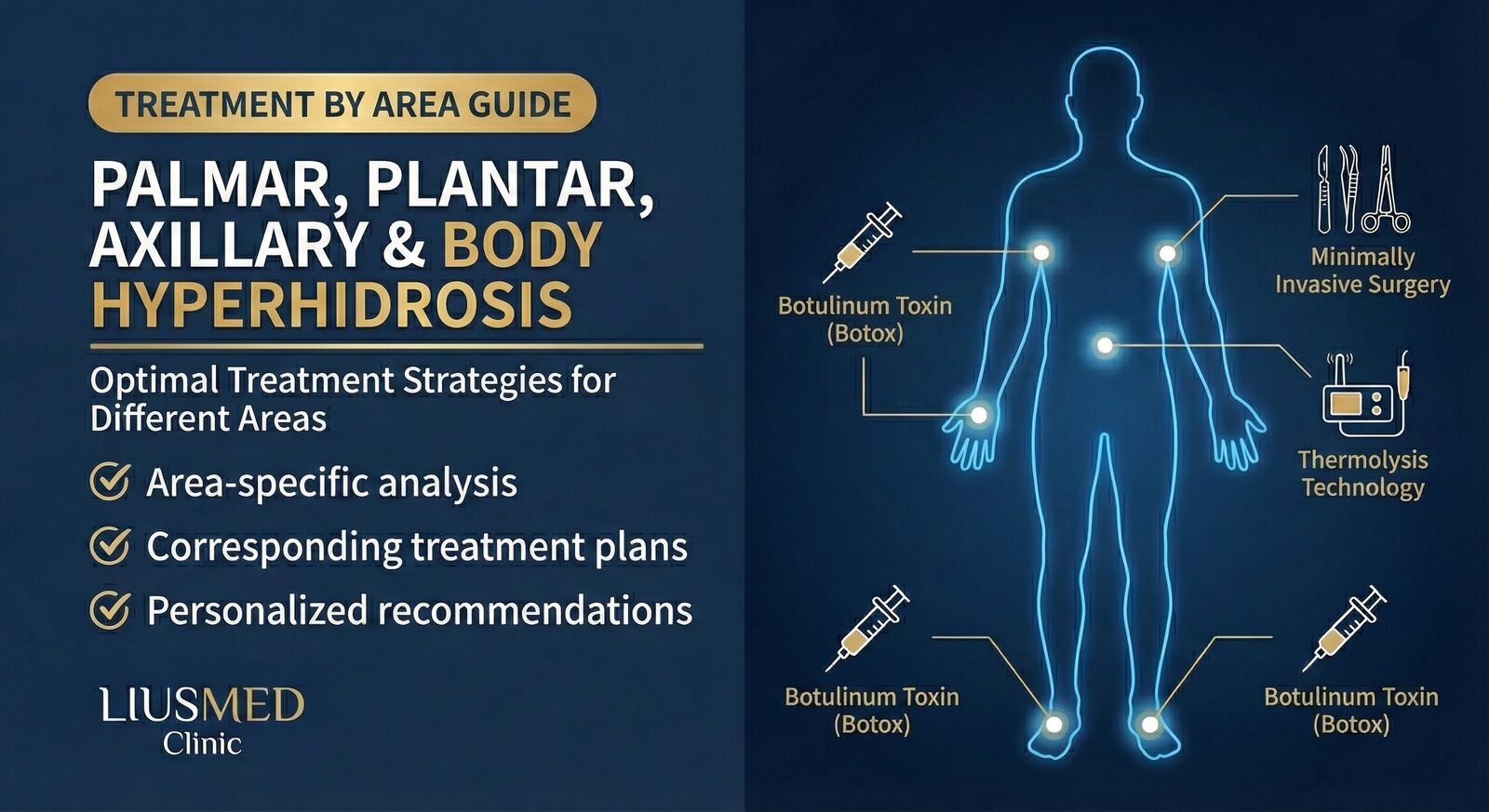
Understanding Area-Specific Hyperhidrosis
Hyperhidrosis isn't "one disease" but rather a group of symptoms. Different body areas have different causes, levels of impact, and optimal treatment approaches. This article explains the characteristics and treatment strategies for palmar, axillary, and plantar hyperhidrosis to help you find the best solution.
Hyperhidrosis Overview by Area
| Area | Main Concerns | First-Line Treatment |
|---|---|---|
| Palms | Work, social, writing | Iontophoresis/Botox |
| Underarms | Clothing stains, odor | Micro-Curettage |
| Feet | Wet shoes, odor | Antiperspirant/Iontophoresis/Botox |
| Head/Face | Social embarrassment | Botox |
| Generalized | Full body sweating | Oral medications/Non-invasive treatment/Botox |
Prevalence by body area depends entirely on who ran the survey. A Japanese questionnaire study of 5,807 respondents aged 5 to 64, administered at companies and schools, broke it down by site: axillae 5.75%, palms 5.33%, head 4.7%, soles 2.79% (PMID 24106874). A nationally representative US sample of 8,160 people put overall hyperhidrosis prevalence at 4.8% (PMID 27744497).
Both rely on self-report, and they differ in country, age range and recruitment, so the figures cannot be subtracted from one another or transplanted to another population. That is why the table above ranks sites and treatments rather than prevalence.
Palmar Hyperhidrosis (Hand Sweating)
Symptom Characteristics
| Characteristic | Description |
|---|---|
| Severity | Mild (moist) to severe (dripping) |
| Triggers | Nervousness, anxiety, heat |
| Occurrence | Often constant or easily triggered |
| Associated | Frequently combined with foot sweating |
Daily Life Impact
- Paper gets wet when writing
- Embarrassment when shaking hands
- Difficulty operating electronic devices
- Career limitations (precision work, service industry)
Treatment Options Comparison
| Treatment | Duration | Pros | Cons |
|---|---|---|---|
| Antiperspirant | Hours | Convenient, cheap | Limited effect, may irritate |
| Iontophoresis | Ongoing | Safe, home use possible | Weekly maintenance |
| Botox | 4-6 months | Significant effect | Expensive, repeat needed |
| Oral Medication | Ongoing | Convenient | Side effects (dry mouth) |
| ETS Surgery | Irreversible | Marked improvement | ⚠️ High compensatory sweating risk |
Where these effectiveness figures come from, and what the control arms scored, is set out below in "Why These Tables Carry No Effectiveness Column".
Recommended Treatment Strategy
⚠️ Dr. Liu's Warning: "ETS (Endoscopic Thoracic Sympathectomy) surgery for hand sweating has a compensatory sweating risk of 30-90%. Many patients end up troubled by compensatory sweating on their back or thighs after surgery. Unless hand sweating severely affects life and work, I recommend prioritizing non-surgical methods."
Axillary Hyperhidrosis (Underarm Sweating)
Symptom Characteristics
| Characteristic | Description |
|---|---|
| Severity | Clothes soaked, visible stains |
| Triggers | Heat, nervousness, exercise |
| Associated | Often combined with underarm odor |
| Impact | Affects clothing choices, social confidence |
Daily Life Impact
- Can only wear dark or black clothes
- Need to frequently change clothes
- Worry about visible sweat stains
- Prone to underarm odor
Treatment Options Comparison
| Treatment | Duration | Pros | Cons |
|---|---|---|---|
| Antiperspirant | Hours to 1 day | Convenient, cheap | May irritate, limited effect |
| Botox | 4-6 months | Good effect | Repeat needed, expensive |
| miraDry | Longer-lasting | Non-invasive | Expensive, may need multiple |
| Micro-Curettage | Stable over years | ✅ Treated in a single procedure | Recovery period needed |
Where these effectiveness figures come from, and what the control arms scored, is set out below in "Why These Tables Carry No Effectiveness Column".
Recommended Treatment Strategy
Why Is Underarm Sweating Usually Treated with Micro-Curettage?
| Advantage | Explanation |
|---|---|
| Long-lasting effect | One surgery, long-term stability |
| Lower compensation risk | Doesn't affect nerves, compensation is uncommon |
| Treats odor too | Solves body odor simultaneously |
| Cost-effective | Cheaper than Botox long-term |
| Quick recovery | About 7-14 days to resume daily activities |
💡 Dr. Liu's Recommendation: "Underarms are well suited to micro-curettage surgery. Unlike hand sweating, compensation after underarm surgery is uncommon, and because the glands are removed the effect is usually stable over the long term—it's well worth considering."
Plantar Hyperhidrosis (Foot Sweating)
Symptom Characteristics
| Characteristic | Description |
|---|---|
| Severity | Slippery inside shoes, socks soaked |
| Triggers | Wearing shoes, nervousness, heat |
| Associated | Foot odor, athlete's foot (fungal infection) |
| Impact | Affects shoe choices, social situations |
Daily Life Impact
- Shoes wear out quickly
- Need to prepare multiple pairs of socks
- Embarrassment in situations requiring shoe removal
- Prone to fungal infections
Treatment Options Comparison
| Treatment | Duration | Pros | Cons |
|---|---|---|---|
| Foot antiperspirant | Hours | Convenient | Limited effect |
| Iontophoresis | Ongoing | Safe | Weekly maintenance |
| Botox | 4-6 months | Significant effect | Expensive, injections painful |
| Oral medication | Ongoing | Convenient | Side effects |
Where these effectiveness figures come from, and what the control arms scored, is set out below in "Why These Tables Carry No Effectiveness Column".
Recommended Treatment Strategy
Daily Foot Sweat Management
| Method | Description |
|---|---|
| Choose breathable shoes | Leather or mesh materials |
| Change socks | At least 1-2 times daily |
| Use foot powder | Absorbs moisture, reduces friction |
| Rotate shoes | Give shoes time to dry |
| Antifungal treatment | Prevent fungal infections |
Head and Facial Hyperhidrosis
Symptom Characteristics
| Characteristic | Description |
|---|---|
| Common areas | Forehead, hairline, cheeks |
| Triggers | Nervousness, eating (gustatory), heat |
| Impact | Highly visible in social situations |
Treatment Options
| Treatment | Target Area | Notes |
|---|---|---|
| Botox | Forehead, hairline | Most common, needs repeat every 4-6 months |
| Oral medication | Entire face | Dry mouth side effect common |
| ETS surgery | Severe facial sweating | ⚠️ Very high compensation risk |
Where these effectiveness figures come from, and what the control arms scored, is set out below in "Why These Tables Carry No Effectiveness Column".
⚠️ Note: ETS surgery for facial sweating has extremely high compensation risk and may cause dry eyes (Horner's syndrome). Generally not recommended.
Generalized Hyperhidrosis
Possible Causes
Generalized hyperhidrosis requires ruling out underlying conditions:
| Cause Category | Examples |
|---|---|
| Endocrine | Hyperthyroidism, diabetes |
| Infection | Tuberculosis, chronic infections |
| Medications | Some antidepressants, hormonal drugs |
| Autonomic dysfunction | Stress, anxiety-related |
| Menopause | Hormonal changes |
| Primary | Constitutional after ruling out above |
Management Recommendations
- See a doctor first: Rule out underlying conditions
- Treat the cause: Address underlying disease first if present
- Symptom control: Oral medications, lifestyle improvements
Why These Tables Carry No Effectiveness Column
The four tables above deliberately leave out an effectiveness column. The percentages this page used to carry could not be traced to any source, and the figures that can be traced make a different point: a percentage on its own tells you very little. What matters is how "response" was defined, who was in the denominator, and what the control arm scored.
Underarms: the one site of the four with controlled trials
For Botox, a double-blind placebo-controlled trial of 320 patients defined response as a reduction of at least 50% in spontaneous sweat production from baseline. At week 4, 94% responded against 36% on placebo; by week 16 it was 82% against 21% (PMID 11557704). Microwave thermolysis has a sham-controlled trial of 120 patients: 89% responded at 30 days against 54% in the sham group, then 74% at three months and 69% at twelve (PMID 22289389). Prescription-strength 20% aluminium chloride was tested in a 25-patient single-centre open-label study using an improvement of two or more grades on the HDSS as the threshold: 33% at week 4, against 92% for the Botox arm of the same study (PMID 18380203).
Micro-curettage has a prospective study of 42 patients that measured sweat rate gravimetrically, and the result depended on the baseline rate. Above 50 mg/min the group fell from 85.6 to 21.6 mg/min; between 25 and 50 mg/min it fell from 36.8 to 16.5; and below 25 mg/min there was no significant reduction at all. Median follow-up was 11 months (PMID 12460297).
The control-arm numbers are the ones worth reading. Placebo responded 36%, sham responded 54%. Read only the treatment arm's response rate and a large share of natural variation and expectation gets counted as treatment effect. So the conversation in the clinic is about what your sweat rate is now and what it could realistically come down to, not about a percentage. The curettage study makes the same point bluntly: if your baseline rate is low, surgery may not buy you a difference you can feel, which is why we measure first.
Palms and soles: thin data, and not interchangeable
A UK systematic review covering 50 studies put the strength of evidence plainly: there is moderate-quality evidence of a large effect for Botox in axillary hyperhidrosis, weak but consistent evidence for iontophoresis in palmar hyperhidrosis, and low or very low quality evidence for everything else (PMID 29271741). Antiperspirants for palms and feet have no standalone quantitative study to cite; the numbers you can find are all from the underarm.
Botox for the soles has a retrospective case series of 129 patients, with response judged by Minor starch-iodine test: 71.67% at one month, 63.44% at three, 47.78% at six and 34.13% at nine, with a mean duration of response of 6.16 months (PMID 37964488). The effect fades faster on the feet than in the underarm, which is far more useful to know than a single effectiveness figure.
Oral anticholinergics have a placebo-controlled trial of 62 patients: low-dose oxybutynin improved HDSS in 60% against 27% on placebo, at the cost of dry mouth in 43% against 11%. Note that 83% of those patients had generalized hyperhidrosis rather than isolated palmar or facial sweating (PMID 26114588).
ETS: you cannot get "how effective" and "how risky" from the same dataset
Effectiveness figures for ETS deserve particular caution; the number this page used to carry has no traceable source. The closest figure comes from a proportional meta-analysis of 13 studies and 1,463 patients: symptom control 96% (95% CI 93-99%) and satisfaction 92%, but the authors state that the quality of evidence was extremely low, and that the rate of compensatory sweating could not be assessed because heterogeneity between studies was too high. That analysis is in primary axillary hyperhidrosis, so it cannot be transferred to palmar sweating (PMID 34282698). A symptom-control rate alone cannot tell you whether ETS is worth it.
Head and face: the weakest evidence of any site
For Botox, oral medication and topical antiperspirants on the head and face, the primary literature does not go beyond case-report level, with no quantitative controlled studies. The facial table therefore carries no effectiveness figures at all.
Treatment Summary by Area
| Area | First-Line Treatment | Long-Term Solution | Notes |
|---|---|---|---|
| Palms | Iontophoresis/Botox | ETS (evaluate compensation risk) | Non-surgical first |
| Underarms | Antiperspirant→Botox | ✅ Micro-Curettage | Compensation uncommon |
| Feet | Antiperspirant/Iontophoresis/Botox | No ideal option | Daily management focus |
| Head/Face | Botox | Surgery not recommended | Regular maintenance |
| Generalized | Oral medication/Non-invasive treatment/Botox | Treat underlying cause | Needs evaluation |
How to Choose the Right Treatment?
Factors to Consider
| Factor | Question |
|---|---|
| Impact level | How much does it affect daily life? |
| Cost consideration | Can you afford long-term treatment costs? |
| Time investment | Can you accept regular follow-ups? |
| Risk tolerance | Can you accept surgical risks? |
| Expected outcome | Want complete dryness or just reduction? |
Decision Flowchart
Frequently Asked Questions
Q1: I sweat heavily from both palms and underarms—can I treat both?
A1: You can treat them separately, but I recommend prioritizing underarms:
- Underarms: Micro-curettage surgery (treated in a single procedure, stable over years, compensation uncommon)
- Palms: Iontophoresis or Botox (try non-surgical methods first)
Both can be scheduled at different times without affecting each other.
Q2: What is iontophoresis? Can I do it at home?
A2: Iontophoresis uses mild electrical current through water to reduce sweat gland activity. You can do it at home, but you'll need:
- Purchase specialized equipment
- Initially 3-4 times per week, 20-30 minutes each
- Maintenance phase 1-2 times per week
- Must continue to maintain effect
Q3: Are there side effects from long-term antiperspirant use?
A3: Regular antiperspirants (containing aluminum salts) with long-term use may cause:
- Skin irritation, redness
- Local pigmentation
- Folliculitis
If discomfort occurs, reduce frequency or switch products. Prescription-strength antiperspirants are more effective but also more irritating.
Q4: How long does Botox for hyperhidrosis last?
A4:
| Area | Duration | Notes |
|---|---|---|
| Underarms | 4-9 months | Effect lasts longer |
| Palms | 3-6 months | Effect slightly shorter |
| Feet | 3-6 months | Injections more painful |
Most people need injections 1-2 times per year.
Q5: Should I go straight to surgery?
A5: It depends on the area and severity:
- Underarm sweating: If severe and you want long-term stability, micro-curettage is an excellent choice
- Palm sweating: Recommend trying non-surgical methods first; ETS surgery has high compensation risk
- Foot sweating: Currently no ideal surgical option; conservative treatment is primary
Conclusion
| Area | Best Strategy |
|---|---|
| Palm sweating | Iontophoresis/Botox (be cautious with ETS) |
| Underarm sweating | Micro-Curettage (recommended) |
| Foot sweating | Conservative treatment + daily management |
| Facial sweating | Botox |
Most importantly: Different areas of hyperhidrosis require different strategies. Don't apply the "hand surgery causes compensation" concept to underarm sweating. Underarm micro-curettage is a safe, effective option where compensation is uncommon and the effect is stable over the long term.
Related Reading
- Hyperhidrosis Treatment ≠ Nerve Blocking: Why Micro-Curettage Won't Cause Compensation
- Complete Guide to Underarm Hyperhidrosis Surgery
- Underarm Odor Treatment Comparison: Antiperspirant vs Botox vs Surgery
About the Author
Dr. Ta-Ju Liu
- Current Position: Director, Liushi Clinic
- Specialties: Minimal incision surgery (lipoma, cyst), hyperhidrosis surgery, thread lifting
- Experience:
- 15+ years of clinical minimal incision surgery experience
- Over 10,000 successful minimal incision cases
- Board-certified dermatologist
- Philosophy: "Hyperhidrosis treatment requires individualized strategies. I recommend the most suitable treatment based on each patient's affected area, severity, and expectations."
Related Services

Specialties
Credentials
- Kaohsiung Medical University, School of Medicine
- Attending Physician, Dermatology, Kaohsiung Chang Gung Memorial Hospital
- Attending Physician, Aesthetic Center, Kaohsiung Chang Gung Memorial Hospital
- Visiting Physician, Dermatology, Xiamen Chang Gung Hospital
- Visiting Physician, Aesthetic Center, Xiamen Chang Gung Hospital
"For every surgery, I strive to achieve a good outcome through a small incision and refined technique. Minimally invasive surgery is not just a technique — it's a commitment of respect to every patient."
Want to learn more?
Schedule a consultation for professional evaluation and advice