Bumps, Bubbles, or Nodules After Lip Filler: Can Ultrasound-Guided Extraction Help?
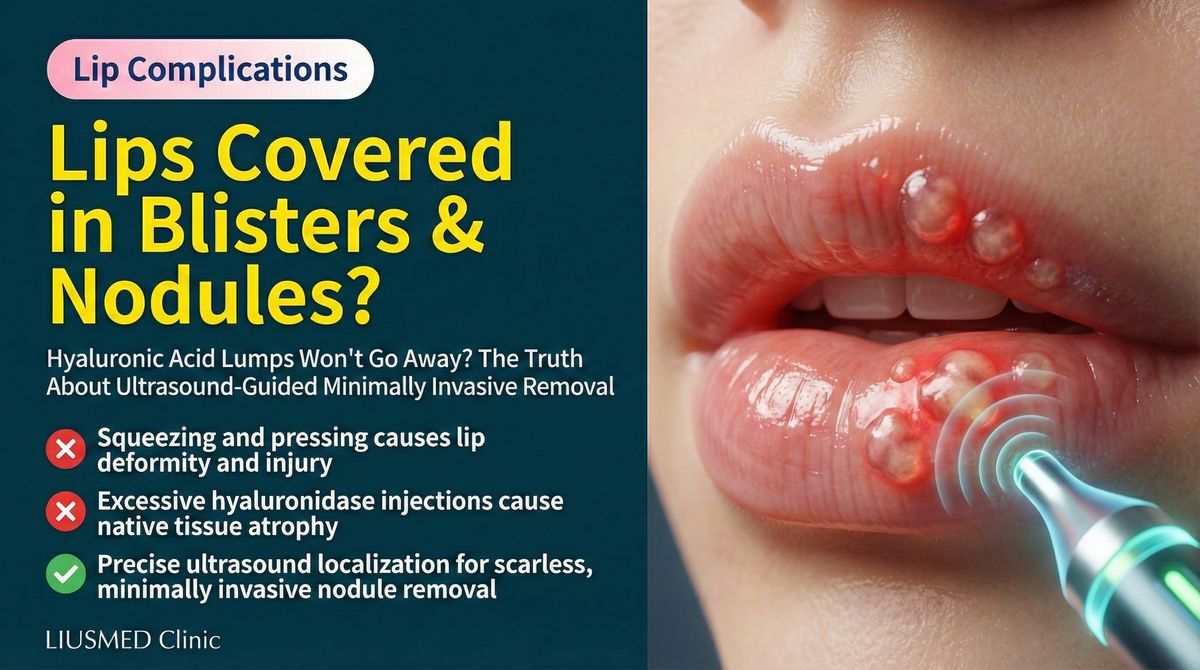
Those Bumps on Your Lips—It Is More Than Just "Too Shallow"
You had hyaluronic acid injected into your lips hoping for plump, smooth contours. But days or weeks later, you see small bumps on the lip surface—some look like tiny blisters, others like hard pellets. Running your finger across your lips, you feel an unmistakable unevenness. When you pucker, it becomes more obvious, as if a row of tiny beads is hidden inside.
This is not rare. The lips are one of the areas with the highest complication rates for filler, due to several unique anatomical challenges.
Why Lips Are Especially Prone to Problems
The Unique Anatomy of the Lip
| Lip Characteristic | Impact on Filler | Complication Risk |
|---|---|---|
| Extremely thin skin (lip vermillion has no stratum corneum) | Even slight depth errors make filler visible | High |
| Few tissue layers | Minimal margin of error for injection depth | High |
| Constant dynamic movement | Speaking and eating continuously squeeze filler | Medium–high |
| Dense vascularity | More bleeding and swelling during injection | Medium |
| Limited lymphatic drainage | Edema resolves more slowly | Medium |
| Dense sensory innervation | Nodules are easily felt | High |
Key Insight: Lip injection is not impossible—it simply demands exceptionally precise technique. The same depth error that would be invisible on the cheek creates an obviously visible granule on the lip.
Classification of Lip Nodules
Not All "Bumps" Are the Same
Post-injection bumps and nodules on the lips can be classified by cause:
1. Superficial placement type (most common)
- HA (Hyaluronic Acid — sugar molecule naturally in skin, holds water) injected too superficially—almost directly under the skin
- Appearance: Bluish-white translucent granules (Tyndall effect manifesting on the lip)
- Feel: Soft, mobile
- Timeline: Visible within days
2. Aggregate cluster type
- Filler distributed unevenly, collecting into small clusters
- Appearance: Skin-colored or slightly whitish bumps
- Feel: Like small marbles with distinct borders
- Timeline: Days to weeks
3. Fibrous encapsulation type
- Body produces fibrotic reaction, forming a hard shell around the cluster (see encapsulation)
- Appearance: Skin-colored firm nodule, may protrude above lip surface
- Feel: Hard, minimally mobile
- Timeline: Weeks to months, forming gradually
4. Inflammatory or infectious type
- Accompanied by inflammatory response or low-grade infection
- Appearance: Redness, swelling, may have blister-like appearance
- Feel: Tender, surrounding warmth
- Timeline: Any time post-injection
5. Granuloma type
- Immune system's foreign body response to filler (see lumps years after injection)
- Appearance: Hard, fixed, may gradually enlarge
- Feel: Stone-like hardness, immobile
- Timeline: Months to years
Why Blind Dissolving May Backfire
Risks of Hyaluronidase (enzyme that dissolves HA filler) in the Lips
The natural first instinct is "dissolve it with hyaluronidase." While sometimes appropriate, blind hyaluronidase use in the lips carries specific risks:
Risk 1: Over-dissolution Lip tissue is thin, and hyaluronidase diffuses into surrounding normal hyaluronic acid—including your body's own HA. This can cause the lips to lose significant overall volume while treating the nodule, potentially creating depressions.
Risk 2: Cannot reach the target If the nodule is encapsulated in fibrous tissue, hyaluronidase cannot penetrate the capsule to reach the HA inside. You dissolve normal surrounding filler while the nodule remains untouched.
Risk 3: The vicious cycle of repeated dissolving Dissolve → unsatisfied → re-inject → nodules again → dissolve again—each cycle increases tissue damage and fibrosis risk.
Key Insight: Hyaluronidase is not a universal "undo button." Before using it on the lips, you need to know each nodule's exact position, depth, encapsulation status, and surrounding tissue condition—information only ultrasound can provide. See also does HA truly get completely absorbed?
Ultrasound-Guided Precision Treatment
See It to Treat It
At Liusmed Clinic, our standard protocol for lip nodules is:
1. Ultrasound Assessment High-resolution ultrasound scans the entire lip, creating a "filler map":
- Each nodule's position, size, and depth
- Capsule presence
- Surrounding tissue status
- Spatial relationship to normal filler
2. Individualized Strategy
| Nodule Type | Recommended Approach |
|---|---|
| Superficial placement (no capsule) | Ultrasound-guided precise hyaluronidase or micro-needle drainage |
| Aggregate cluster (no capsule) | Ultrasound-guided hyaluronidase |
| Fibrous encapsulation | Ultrasound-guided pinhole extraction |
| Inflammatory/infectious | Control infection first, then assess extraction need |
| Granuloma | Ultrasound-guided pinhole extraction |
3. Ultrasound-Guided Pinhole Extraction For nodules that cannot be resolved with hyaluronidase:
- Precisely locate each nodule under real-time ultrasound
- Extract through a tiny pinhole entry one by one
- Avoid the lip's rich nerve and vascular network
- Preserve normally distributed filler
Recovery After Lip Nodule Treatment
After extraction, the lips undergo a recovery period:
- Days 1–3: Mild swelling and bruising—this is normal
- Days 3–7: Swelling gradually subsides, improvement becomes visible
- Weeks 1–2: Most swelling resolves, lip texture noticeably improved
- Weeks 2–4: Complete recovery, final results assessable
During recovery:
- Avoid spicy foods and very hot beverages
- Do not bite your lips or pucker forcefully
- Keep lips clean and moisturized
- Avoid kissing or activities that pressure the lips
Preventing Lip Nodules
If you have not yet had lip filler, or want to re-inject after nodule treatment, these measures reduce nodule risk:
- Choose lip-appropriate products: Softer, lower cross-linked HA is better suited to thin lip tissue
- Less is more: Excessive single-session volume is the primary cause of lip nodules
- Correct injection plane: Too superficial becomes visible; too deep may distort lip shape
- Avoid extreme augmentation goals: Over-filling increases both nodule and migration risk
Common questions
Will the lumps from lip filler go away on their own?
Not necessarily. Superficial, un-encapsulated hyaluronic acid may partially metabolize over time, but once a nodule is wrapped in fibrous tissue or the material has clumped together, it often will not settle on its own—many patients assume it will "just get absorbed," yet years later the lump is still clearly visible on ultrasound. If a lump lasts more than a few months, feels firm, or has a distinct border, it is worth getting an ultrasound assessment rather than continuing to wait.
After lip filler I can feel little bumps along my lip—is that normal, and how long until it settles?
Mild graininess in the first one to two weeks is often just swelling plus filler that has not spread out evenly yet, and it usually improves as the swelling goes down. But if you can still feel distinct lumps or nodules after three to four weeks, or they stick out more when you pucker, that is no longer simple swelling—it may be superficial placement, clustering, or an encapsulated nodule, and it deserves a closer look.
Do lip nodules always have to be dissolved with hyaluronidase or cut out?
It is not one or the other. A superficial nodule with no capsule can be handled with a small, ultrasound-guided dose of hyaluronidase; a nodule that is already encapsulated or granulomatous is one the enzyme cannot penetrate, so ultrasound-guided pinhole extraction is a better fit—the entry is only the size of a needle hole, not traditional surgery. The point is to use ultrasound first to see how deep each nodule sits and whether it is encapsulated, then decide, so you avoid blind dissolving that can collapse the lip shape.
You Do Not Have to Live with Nodules
If you are troubled by lip nodules, I understand the impact extends beyond appearance to how your lips feel every time you speak, eat, or smile. You do not need to "learn to accept it" or "wait for it to absorb on its own" (it may never disappear spontaneously).
Modern ultrasound-guided techniques allow us to precisely address each problematic nodule without incisions or large-scale dissolving.
Schedule a consultation and let us use ultrasound to evaluate your lip condition and develop the most suitable treatment plan.
Related Reading
- Does Hyaluronic Acid Truly Get Completely Absorbed?
- Ultrasound-Guided Minimally Invasive Filler Extraction Technique
- Why Dissolvers Fail: The Encapsulation Problem
Related Services

Specialties
Credentials
- Kaohsiung Medical University, School of Medicine
- Attending Physician, Dermatology, Kaohsiung Chang Gung Memorial Hospital
- Attending Physician, Aesthetic Center, Kaohsiung Chang Gung Memorial Hospital
- Visiting Physician, Dermatology, Xiamen Chang Gung Hospital
- Visiting Physician, Aesthetic Center, Xiamen Chang Gung Hospital
"For every surgery, I strive to achieve a good outcome through a small incision and refined technique. Minimally invasive surgery is not just a technique — it's a commitment of respect to every patient."
Recovery after any procedure needs peer support too


Want to learn more?
Schedule a consultation for professional evaluation and advice