The Cumulative Damage of Repeated Hyaluronidase: Your Normal Tissue Gets Dissolved Too
The "Let Us Try Another Round" Trap
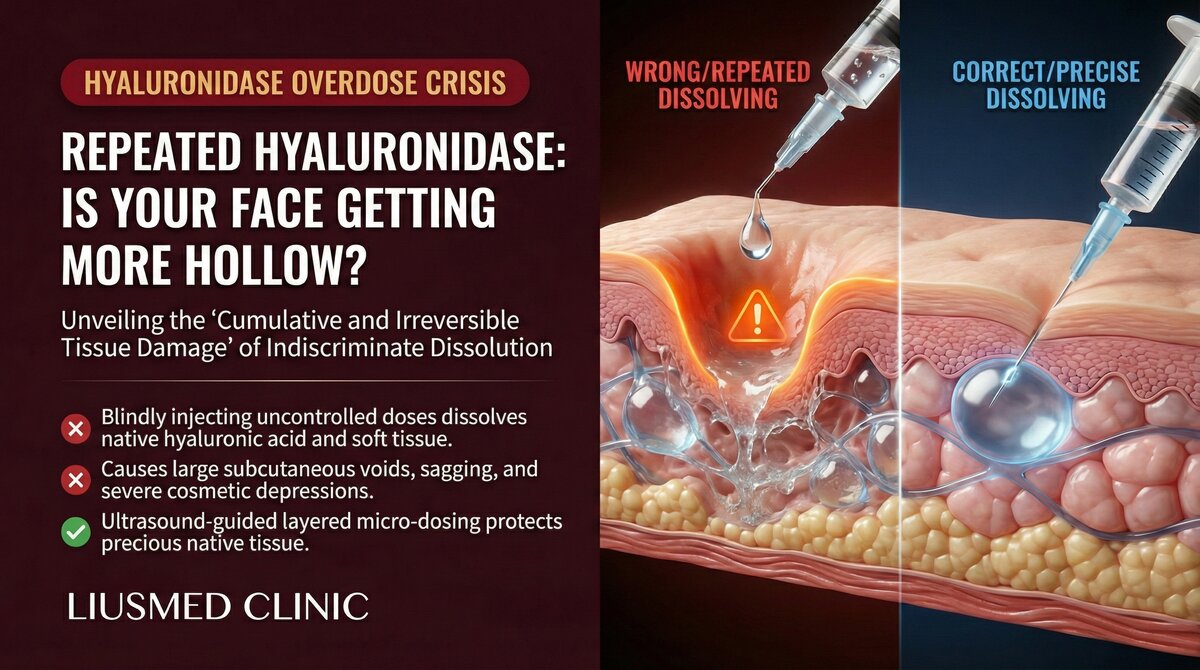
When the first hyaluronidase injection fails to fully dissolve a lump, many practitioners default to: "The dose was probably insufficient—let us try again." Second round fails? Then a third. This "more rounds will work" mentality appears logical but conceals serious cumulative risks.
Hyaluronidase (enzyme that dissolves HA filler) is not a precision weapon targeting only filler—it is a broad-spectrum enzyme that breaks down all hyaluronic acid molecules in the injection zone, including your body's own native HA (Hyaluronic Acid — sugar molecule naturally in skin, holds water). Each injection depletes these natural components that maintain skin hydration, elasticity, and structural integrity.
The Non-Selective Nature of Hyaluronidase
It Does Not Distinguish "Good" from "Bad" Hyaluronic Acid
Native hyaluronic acid in human tissue plays critical roles:
| Native HA Function | Effect When Dissolved |
|---|---|
| Maintains skin hydration | Dry, dull skin |
| Supports dermal structure | Skin laxity, increased fine lines |
| Lubricates tissue spaces | Increased tissue friction |
| Facilitates cell communication | Reduced tissue repair capacity |
| Maintains tissue volume | Localized depression, volume loss |
Key Insight: Hyaluronidase does not "see" the filler before it starts working. After diffusing through the injection area, it simultaneously breaks down all hyaluronic acid it contacts—whether injected filler or native tissue components. This is why repeated injections cause cumulative tissue damage.
Three Stages of Cumulative Damage
Stage 1: Initial Damage (After 1-2 Injections)
- Filler partially dissolved (if material is HA and not encapsulated)
- Surrounding native HA collaterally dissolved
- Local temporary swelling and inflammation
- Usually partially recoverable within weeks
Stage 2: Cumulative Worsening (After 3-5 Injections)
- Easily dissolvable portions of filler already exhausted
- Each injection primarily dissolves native HA
- Noticeable skin texture changes begin
- Visible tissue laxity around injection site
- Irregular depressions may appear
Stage 3: Severe Damage (6+ Injections)
- Local native HA severely depleted
- Paper-thin skin with increased translucency
- Obvious tissue depression and volume loss
- Encapsulated filler lump essentially unchanged
- The problem has evolved from "filler lump" to "filler lump plus tissue atrophy"
A Typical Clinical Pattern
The typical story we encounter in clinic:
- Patient discovers filler lump, returns to original clinic
- Practitioner injects hyaluronidase; lump partially shrinks
- Weeks later lump appears to have grown (actually surrounding tissue has thinned, making lump more prominent)
- Hyaluronidase injected again
- Cycle repeats 3-5 times
- Final result: lump remains (due to encapsulation) but surrounding tissue is severely damaged
Key Insight: When the lump persists after three rounds of hyaluronidase, the problem is almost certainly not "insufficient dose." More likely causes are non-HA material, encapsulation, or biofilm. Continuing to increase dosage only creates more normal tissue damage. What is needed is not more hyaluronidase but an ultrasound evaluation to determine the actual cause.
For more on why hyaluronidase fails: 7 Reasons Hyaluronidase Fails
How Ultrasound Changes This Equation
Before Injection: Confirm Whether Hyaluronidase Should Be Used
- Confirm material is hyaluronic acid
- Assess encapsulation degree
- Determine whether hyaluronidase has a reasonable chance of success
Replacing Hyaluronidase: Physical Extraction
When hyaluronidase is inappropriate or has failed, ultrasound-guided extraction provides an alternative that does not rely on chemical dissolution, preserving native tissue HA.
| Comparison | Repeated Hyaluronidase | Ultrasound-Guided Extraction |
|---|---|---|
| Effect on native HA | Significant dissolution | No effect |
| Effect on encapsulated filler | Nearly ineffective | Direct removal |
| Cumulative damage | Increases with each round | None |
| Number of treatments | Potentially unlimited | Usually one |
| Post-recovery tissue condition | May be lax and atrophied | Tissue integrity preserved |
What to Do If You Have Already Had Multiple Injections
If you have undergone multiple rounds of hyaluronidase without resolution:
- Stop further hyaluronidase injections immediately
- Get an ultrasound evaluation to assess residual filler and tissue status
- Determine whether physical extraction is needed based on findings
- Evaluate whether damaged tissue requires subsequent repair
See: Filler Repair Evaluation Process and The Myth of Complete HA Absorption.
Schedule a consultation and let us find a solution that stops harming your tissue.
Common questions
If I keep repeating hyaluronidase, will the stubborn lump eventually dissolve?
Not necessarily. If the lump is still there after one or two rounds, it usually means this is not a simple HA problem—the material may not be hyaluronic acid at all, it may be encapsulated, or there may be biofilm. Adding more dose in that situation leaves the lump where it is and just keeps dissolving the normal tissue around it.
Doesn't hyaluronidase only dissolve the filler? Why would it harm my own tissue?
Because it does not pick and choose. It is a broad-spectrum enzyme, so once it spreads through the injection area it breaks down any hyaluronic acid it touches—including the natural HA already in your skin that holds water and supports structure. Every round chips away at those natural components too.
A few weeks after dissolving, my lump looks more obvious—did the filler grow back?
It did not grow; the area around it got thinner. Repeated dissolving thins the tissue next to the lump, so the lump stands out more against a collapsed background. It looks bigger, but really the surroundings dropped.
I have already had several rounds without resolution—what should I do now?
Stop first and do not add another round. Then get an ultrasound evaluation to see what the residual filler and the tissue actually look like, and decide from there whether to remove it physically. It is also the moment to check whether the tissue that was already damaged needs any follow-up care.
How is ultrasound-guided extraction different from just repeating hyaluronidase?
It does not rely on chemical dissolution. Ultrasound-guided minimally invasive extraction takes the filler out together with its capsule, so it does not sacrifice the natural HA in your normal tissue, and it can address a lump that has already encapsulated. It is usually a single treatment rather than an open-ended series that keeps adding damage.
Conclusion
Hyaluronidase is a useful but limited tool. When it fails after reasonable attempts (typically 1-2), continuing to inject repeatedly is not persistence in treatment—it is ongoing tissue damage. Acknowledging a method's limitations and transitioning to a more appropriate alternative is the responsible approach.
Related Services

Specialties
Credentials
- Kaohsiung Medical University, School of Medicine
- Attending Physician, Dermatology, Kaohsiung Chang Gung Memorial Hospital
- Attending Physician, Aesthetic Center, Kaohsiung Chang Gung Memorial Hospital
- Visiting Physician, Dermatology, Xiamen Chang Gung Hospital
- Visiting Physician, Aesthetic Center, Xiamen Chang Gung Hospital
"For every surgery, I strive to achieve a good outcome through a small incision and refined technique. Minimally invasive surgery is not just a technique — it's a commitment of respect to every patient."
Recovery after any procedure needs peer support too


Want to learn more?
Schedule a consultation for professional evaluation and advice