Thread Lift Complications: Thread Protrusion and Inflammation — Can Ultrasound-Guided Removal Help?
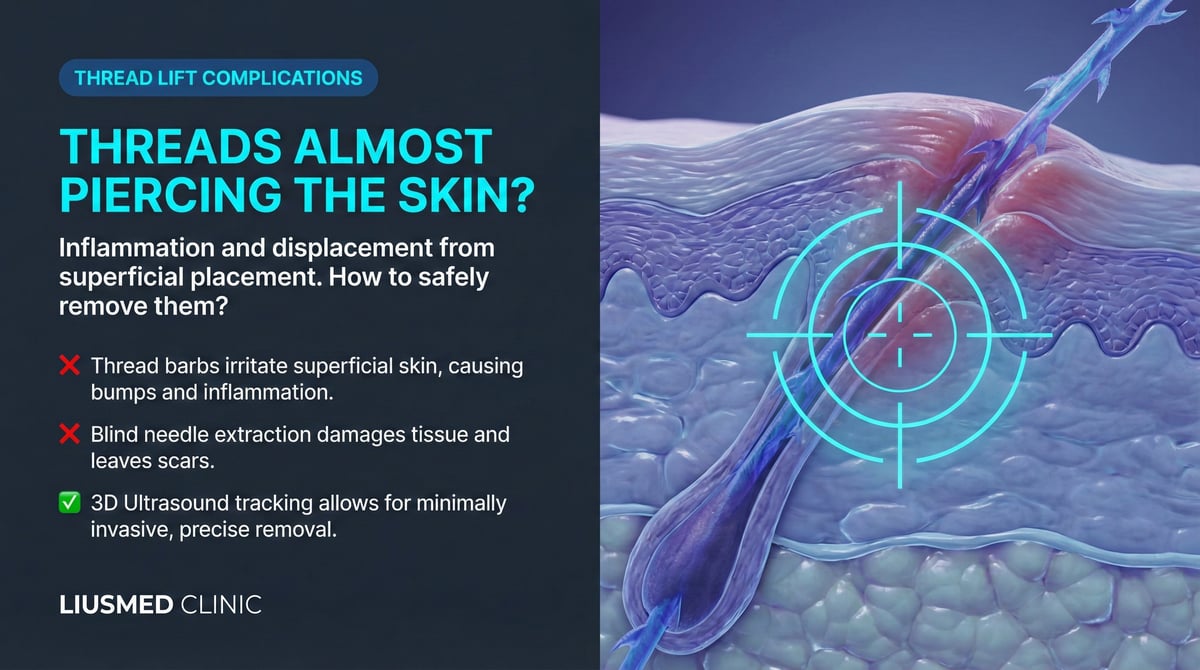
After a Thread Lift (dissolving threads for mechanical lift): Why Do Threads Come Through the Skin?
Thread lifting has become one of the most popular minimally invasive cosmetic procedures in recent years. Absorbable threads are placed beneath the skin to physically lift tissue while stimulating collagen production for a tightening effect. However, when threads protrude through the skin, trigger recurrent inflammation, or create a palpable foreign body sensation, what started as a pursuit of beauty becomes a source of ongoing anxiety.
Thread extrusion is not an uncommon complication of thread lifting. A thread end poking through the skin surface, repeated inflammation at the same site, or feeling thread material when touching the face — these problems affect not only appearance but also create persistent psychological distress.
Key Insight: Thread lift materials come in many types, each with distinct complication profiles. The first step in managing thread lift complications is confirming the thread type, location, and current condition.
Common Thread Materials and Complication Comparison
Thread Type Characteristics
| Thread Type | Material | Absorption Time | Common Complications |
|---|---|---|---|
| PDO threads | Polydioxanone | 6–8 months | Protrusion, infection, asymmetry |
| PLLA threads | Poly-L-lactic acid | 12–18 months | Nodules, chronic inflammation |
| PCL threads | Polycaprolactone | 24–36 months | Foreign body reaction, palpability |
| Hybrid threads | PDO+PLLA combinations | Varies | Uneven absorption, local reactions |
Why Complications Occur
-
Thread Protrusion
- Insufficient placement depth: Threads positioned too close to the skin surface
- Thin skin: Higher risk in areas like the jawline and temples where skin is thinner
- Tissue tension: Facial movements (chewing, expressions) place continuous stress on threads
- Improper thread end management: Thread ends not adequately anchored in deep tissue
-
Recurrent Inflammation
- Biofilm formation on thread surfaces
- Foreign body reaction continually activating the immune system
- Chronic low-grade infection around the thread
- Degradation products from the absorption process causing irritation
-
Palpable Threads
- Inappropriate placement layer
- Tissue atrophy causing the thread to shift relatively closer to the surface
- Thread migration to a shallower plane
- Uneven collagen encapsulation
Key Insight: Timing matters in thread complication management. Protrusion or inflammation detected early is typically easier to manage than cases left for months. If a thread has partially protruded through the skin, do not attempt to push it back or pull it out yourself.
The Role of Ultrasound in Thread Lift Complications
Why Ultrasound Is Needed
The greatest challenge in managing thread lift complications is invisibility. The thread's path through tissue, its depth, and its relationship to surrounding structures cannot be adequately assessed through palpation and visual inspection alone.
| Ultrasound Capability | Clinical Value |
|---|---|
| Thread localization | Confirm the precise course and depth of each thread |
| Protrusion assessment | Determine whether protrusion is a local issue or entire thread displacement |
| Inflammation mapping | Evaluate the degree of tissue reaction around the thread |
| Vascular identification | Avoid important facial blood vessels |
| Multi-thread tracking | Identify each thread individually in cases with multiple placements |
Ultrasound Appearance of Different Threads
| Thread Type | Ultrasound Appearance | Identifying Features |
|---|---|---|
| PDO threads | Linear hyperechoic signal | Clear linear structure |
| PLLA threads | Hyperechoic with surrounding hypoechoic halo | More pronounced surrounding tissue reaction |
| PCL threads | Hyperechoic linear structure | Well-defined boundary with surrounding tissue |
| Cog threads | Serrated hyperechoic pattern | Barb structures may be visible |
Ultrasound-Guided Thread Removal
Indications
Ultrasound-guided thread removal is recommended when:
- Thread protrusion through the skin recurs repeatedly
- Persistent inflammation around a thread continues for 4–6 weeks or longer
- Palpable threads cause discomfort or affect appearance
- Chronic infection from the thread responds poorly to antibiotics
- The patient strongly desires thread removal
The Removal Process
Assessment Phase
- History confirmation: Thread type, placement date, performing practitioner, symptom timeline
- Ultrasound scan: Trace the course, depth, and skin proximity of all threads
- Surrounding tissue evaluation: Inflammation degree, infection signs, vascular positions
Surgical Phase
- Local anesthesia
- Ultrasound-guided identification of the target thread
- Entry through a micro-incision (1–2mm) or the existing protrusion site
- Under continuous ultrasound monitoring, separate and extract the thread along its course
- Confirm complete thread removal or manage remaining segments
- Ultrasound verification of extraction result
Post-Procedure Care
- Clean wound care
- Ice application within 48 hours to reduce swelling
- Avoid excessive facial movements for one week
- Follow-up appointment at one week
Challenges and Expectations
| Scenario | Removal Difficulty | Expected Outcome |
|---|---|---|
| Partially protruding thread | Lower | Can be guided out through the protrusion site |
| Deep intact thread | Moderate | Requires precise ultrasound localization for extraction |
| Cog thread (barbed) | Higher | Barbs may be entangled with tissue; careful separation needed |
| Multiple threads | Moderate to high | Sequential removal; may require staged sessions |
| Peri-thread abscess | Lower | Remove thread and drain simultaneously |
| Partially absorbed remnant | Moderate | Remove symptomatic remaining segments |
Inflammation Without Protrusion: What to Do?
Conservative Treatment Options
Not every thread lift complication requires thread removal. Conservative management may be appropriate in the following situations:
| Scenario | Recommended Approach |
|---|---|
| Early mild swelling (<2 weeks post-procedure) | Observation, ice, oral anti-inflammatory medication |
| Mild localized tenderness | Observe for 4–6 weeks; most resolve spontaneously |
| Superficial infection | Oral or topical antibiotics |
| Deep infection | Oral antibiotics + ultrasound monitoring |
When to Transition From Conservative to Removal
- No improvement after 2–4 weeks of antibiotic therapy
- Recurrent inflammatory episodes
- Formation of a definite abscess
- Thread beginning to protrude
- Patient unable to tolerate continued discomfort
Preventing Thread Lift Complications
Pre-Procedure Evaluation
- Skin thickness assessment: Extra caution in thin-skinned areas
- History of allergies and foreign body reactions
- Understanding of thread type and quality
- Selection of an experienced practitioner
Post-Procedure Guidelines
- Avoid wide facial movements for 48–72 hours post-procedure
- Avoid sleeping on the treated side
- Attend scheduled follow-up appointments
- Seek immediate medical attention if you notice redness, increasing pain, or the sensation of a thread end
Common questions
A thread is poking out — can I just pull it out or push it back in myself?
Please don't. As the article notes, once a thread has partly come through the skin, pushing it back or pulling it out on your own can make things messier. It's safer to have it looked at first, so we can use ultrasound to check the thread's path and how inflamed the area is before deciding what to do.
I keep getting inflammation but no thread is sticking out — do I have to have the thread removed?
Not necessarily. Not every complication needs removal. Early mild swelling, localized tenderness, or a superficial infection can often be watched, iced, and managed with oral anti-inflammatories or antibiotics first. Removal comes into the picture if there's no improvement after a few weeks, if it keeps flaring up, if an abscess forms, or if the thread starts to protrude.
Why is ultrasound needed to take a thread out — can't you just find it?
Because the thread sits under the skin: you can feel it but you can't see it. Palpation and looking at the surface aren't enough to know how deep it runs, which way it travels, or how close it is to blood vessels. Ultrasound acts as our eyes — it locates the thread, shows how much inflammation is around it, and helps us stay clear of important facial vessels, which makes the removal safer and more precise.
Are cog (barbed) threads harder to remove?
They can be a bit more involved. Barbed threads have little hooks that tend to get tangled with tissue, so they need careful separation. That's part of why we map the structure with ultrasound first and work along the thread's path slowly, rather than tugging it out.
My thread lift was a while ago — is it too late to deal with a problem now?
Generally, protrusion or inflammation caught early is easier to manage, but that doesn't mean later cases can't be handled. Different thread materials absorb over different timeframes — some take a year or more. The important thing is to come in for an assessment so we can check the thread's current state on ultrasound and decide between conservative care and removal.
Do Not Let Thread Problems Affect Your Daily Life
If you are experiencing thread protrusion, recurrent inflammation, or discomfort after a thread lift, seeking professional evaluation promptly is the most important step. Ultrasound localization allows us to precisely understand the thread's condition and develop the most appropriate management plan for you.
Further reading:
- Minimally Invasive Filler Lump Extraction Technique
- The Filler Repair Evaluation Process
- Why Dissolving Enzymes Fail When Capsules Form
About the Author
Dr. Ta-Ju Liu
- Current Position: Director, Liusmed Clinic
- Specialties: Minimally invasive surgery, filler complication repair, thread lifting, ultrasound-guided extraction
- Experience: 15+ years of clinical minimally invasive surgery; over 10,000 successful cases
- Philosophy: "The challenge with thread complications is that the threads are hidden beneath the skin — you might feel them, but you cannot see them. Ultrasound becomes our eyes, making the removal process safer and more precise."
Related Services

Specialties
Credentials
- Kaohsiung Medical University, School of Medicine
- Attending Physician, Dermatology, Kaohsiung Chang Gung Memorial Hospital
- Attending Physician, Aesthetic Center, Kaohsiung Chang Gung Memorial Hospital
- Visiting Physician, Dermatology, Xiamen Chang Gung Hospital
- Visiting Physician, Aesthetic Center, Xiamen Chang Gung Hospital
"For every surgery, I strive to achieve a good outcome through a small incision and refined technique. Minimally invasive surgery is not just a technique — it's a commitment of respect to every patient."
Recovery after any procedure needs peer support too


Want to learn more?
Schedule a consultation for professional evaluation and advice