Failed Thread Lift Rescue: Managing Thread Protrusion, Dimpling, and Asymmetry
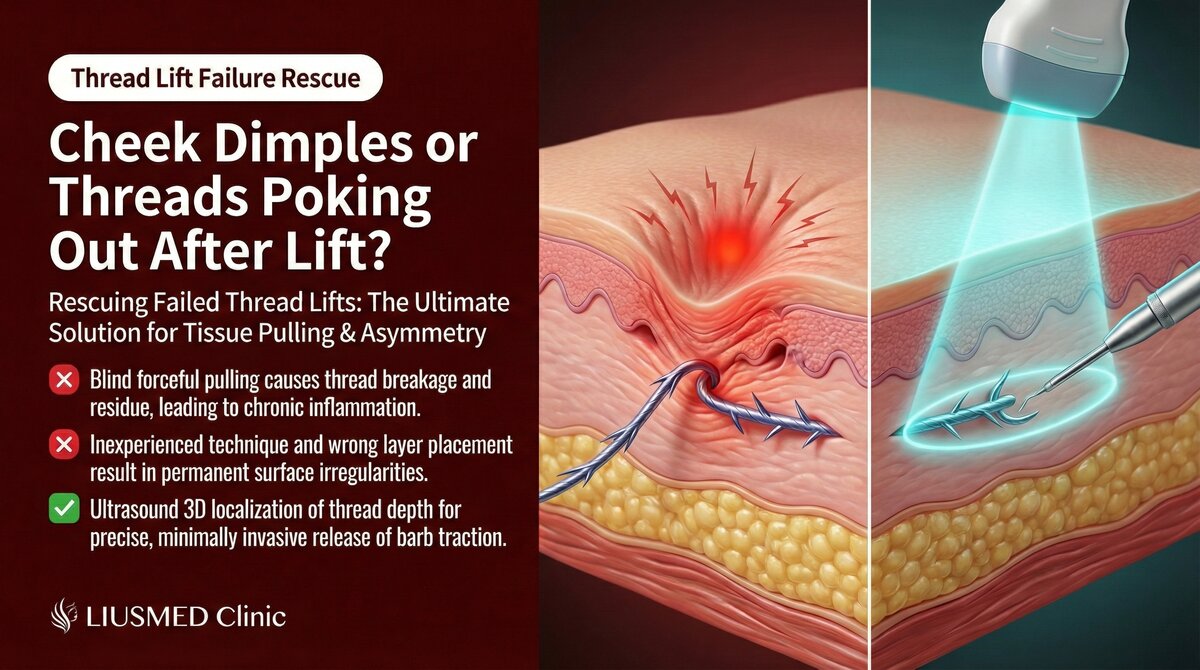
When "Minimally Invasive Lifting" Becomes a Problem Requiring Repair
Thread lifts are marketed as "minimally invasive" and "lunchtime procedures," leading many to believe they carry minimal risk. The reality is different: thread lifts involve placing foreign material into subcutaneous tissue, and any procedure that places foreign material in the body carries the potential for complications.
Common thread lift problems include:
- Thread ends protruding through the skin
- Visible dimpling or puckering along the insertion path
- Severe asymmetry between the two sides
- Incorrect thread placement creating an unnatural appearance
- Persistent pain or foreign body sensation from threads
- Infection or granuloma formation around threads
These problems sometimes appear immediately post-procedure, sometimes emerging gradually over weeks to months.
Common Causes of Thread Lift (dissolving threads for mechanical lift) Failure
Technique-Related Factors
| Problem Type | Common Technical Cause | Consequence |
|---|---|---|
| Thread protrusion | Insufficient insertion depth, excessive tension | Infection risk, cosmetic deformity |
| Skin dimpling | Improper trajectory selection, excessive barb grip | Visible unnatural indentations |
| Asymmetry | Unequal thread count or tension between sides | May require surgical correction |
| Persistent pain | Thread contacting nerves or incorrect anchor point | Long-term discomfort |
| Rapid effect loss | Inappropriate thread selection, insufficient tissue grip | Needs retreatment |
Material-Related Factors
- PDO (Polydioxanone (suture/thread)) threads: Absorbable but individual variation in degradation rate; sometimes incomplete degradation leaves remnants
- PCL (Polycaprolactone (Ellansé)) threads: Slower degradation means problems persist longer
- PLLA (Poly-L-Lactic Acid (Sculptra)) threads: May provoke stronger foreign body reactions and granulomas
- Non-absorbable threads: Permanent presence; once problems develop, physical removal is required
Patient-Related Factors
- Skin too thin to withstand thread tension
- High-mobility areas (such as perioral region) where threads easily shift
- Keloid tendency increasing granuloma risk
- Non-compliance with post-procedure instructions (premature massage, vigorous exercise)
Key Insight: Thread lift failure is not necessarily "bad technique"—it is a complex outcome involving the interaction of material properties, patient conditions, and surgical skill. But regardless of cause, patients face the same question: what now?
Is "Waiting for It to Absorb" Really Viable?
This is the most common advice after thread lift problems: "The threads are absorbable—just wait a few months."
Situations Where Waiting May Be Reasonable
- Mild early post-procedure asymmetry (may improve as swelling resolves)
- Very slight tactile abnormality (may diminish over time)
Problems That Waiting Typically Cannot Solve
- Thread protrusion: Once a thread penetrates the skin, it will not retract on its own and maintains a continuous infection pathway
- Deep dimpling: Tissue adhesions caused by threads may persist even after the thread degrades
- Infection or granuloma: Will not resolve spontaneously with thread degradation; may worsen
- Severe asymmetry: Requires active intervention to correct
| Problem | Viability of Waiting | Risk of Waiting |
|---|---|---|
| Thread protrusion | Not viable | Infection risk increases daily |
| Skin dimpling | Limited | May form permanent scarring |
| Asymmetry | Mild cases only | Severe cases need timely intervention |
| Persistent pain | Can observe for weeks | Nerve damage harder to reverse with delay |
| Infection | Not viable | May spread or form abscess |
| Granuloma | Limited | May continue enlarging |
Key Insight: "Absorbable" does not mean "the problem will disappear on its own." The thread degrades, but the tissue reactions it caused—adhesions, fibrosis, granulomas—may persist long after the thread is gone. Waiting for the thread to absorb addresses the "cause" but not the "effect," which has taken on an independent existence.
Challenges in Managing Thread Lift Failures
Why Managing Thread Problems Is More Difficult Than Expected
- Thread localization is challenging: Implanted threads are invisible to the eye and not always accurately located by touch, especially threads that are partially degraded or displaced
- Barbed design increases removal difficulty: Barbed threads cannot simply be "pulled out"—forceful extraction may cause greater tissue damage
- Multiple intertwined threads: A single procedure may place 10-20 threads, requiring individual attention during removal
- Surrounding tissue adhesion: Threads have formed adhesions with surrounding tissue, requiring simultaneous adhesion release during extraction
The Role of Ultrasound in Thread Problem Management
Similar to filler management, ultrasound plays a critical diagnostic and treatment-guidance role in thread problems:
- Precise localization: Confirms exact position, depth, and trajectory of each thread
- Status assessment: Determines whether threads are intact, partially degraded, or fragmented
- Tissue reaction evaluation: Observes whether inflammation, granuloma, or infection exists around threads
- Guided removal: Ultrasound-guided precision removal of problem threads, minimizing unnecessary tissue damage
- Post-procedure confirmation: Verifies complete removal of all problem threads
For more on ultrasound-guided extraction techniques: Precision Extraction Technique. For the complete evaluation process: Filler Repair Evaluation Process.
Management Strategies for Different Problems
Thread Protrusion
Urgency: High—ongoing infection risk
Approach:
- Localize the complete path of the protruding thread
- Remove the entire thread from the entry point
- Clean the infection tract
- Short-course antibiotics if necessary
Skin Dimpling
Urgency: Moderate—may form permanent changes
Approach:
- Ultrasound to confirm cause of dimpling (thread tension vs. tissue adhesion)
- If thread is still present, remove or adjust the segment causing dimpling
- If caused by adhesion, adhesion release may be necessary
- Severe cases may require subsequent restorative filling
Severe Asymmetry
Urgency: Moderate—affects appearance and psychology
Approach:
- Ultrasound assessment of actual thread position and tension on both sides
- Based on findings, determine approach: remove excess threads on one side, adjust tension, or redo both sides
- Must consider whether asymmetry is from threads or pre-existing
Key Insight: Managing thread problems requires precision—precisely locating the problem, precisely assessing severity, and precisely executing the repair. Blindly "doing it again" or "waiting for absorption" are not effective solutions. The prerequisite for precision is clear visualization, which is exactly where ultrasound provides its value.
Prevention and When to Seek Help
Considerations to Reduce Thread Lift Risk
- Choose a physician with extensive thread lift experience
- Understand whether your skin condition is suitable for thread lifting
- Ask about thread material, quantity, and expected outcomes before the procedure
- Confirm post-procedure care instructions
When You Should Seek Medical Attention
- Thread ends protruding through skin—seek help immediately
- Pain or discomfort persisting more than two weeks
- Visible dimpling or asymmetry showing no improvement trend
- Signs of infection post-procedure: redness, swelling, warmth
Schedule a consultation for professional evaluation and the repair approach best suited to your situation.
Common questions
A thread end is poking through my skin—can I just wait for it to absorb?
It's not something to wait out. Once a thread breaks through the skin, it won't pull itself back in, and it leaves an open channel for bacteria, so the infection risk keeps climbing day by day. This one needs prompt attention: the whole thread is located, removed from the entry point, and the tract is cleaned out.
Will the dimpling from my thread lift go away on its own?
Not necessarily. Some dimples come from the tension of the thread, others from the tissue around it having stuck together. The tricky part is that even after the thread degrades, that adhesion can stay behind. So we use ultrasound first to see what's actually causing the dimple before deciding whether to remove the segment or release the adhesion.
Why can't a barbed thread just be pulled straight out?
The barbs are designed to grip tissue in the first place, so yanking on them tends to tear the surrounding tissue instead. On top of that, an implanted thread isn't visible to the eye and isn't always easy to feel, and it's often stuck to nearby tissue. That's why we locate it clearly first and work through the threads one at a time, rather than tugging them out.
How does ultrasound actually help with thread problems?
It turns something invisible into something we can see. It shows the position, depth, and path of each thread, tells us whether a thread is intact, partly degraded, or fragmented, and shows whether there's inflammation or granuloma around it. Doing the removal under ultrasound guidance helps avoid damaging tissue that doesn't need to be touched, and lets us confirm afterward that the problem threads are all cleared.
After a thread lift, what signs mean I should see a doctor soon?
A thread end coming through the skin means going in right away. Pain or discomfort lasting more than two weeks, visible dimpling or asymmetry that shows no sign of improving, or redness, swelling, and warmth that suggest infection are all reasons to get checked rather than leave it and wait.
Conclusion
The "minimally invasive" nature of thread lifts does not mean "risk-free," and managing post-procedure problems is often more challenging than the original procedure itself. If you are facing thread lift failure, the most important thing to understand is: the problem will not disappear through neglect. Timely professional evaluation with ultrasound diagnostic capability is the critical step toward minimizing secondary injury and restoring normal appearance.
Key Insight: Threads in the body face the same core challenge as fillers in the body—managing invisible material in invisible locations. Ultrasound transforms "invisible" into "visible," and this is the starting point for precision repair.
Related Services

Specialties
Credentials
- Kaohsiung Medical University, School of Medicine
- Attending Physician, Dermatology, Kaohsiung Chang Gung Memorial Hospital
- Attending Physician, Aesthetic Center, Kaohsiung Chang Gung Memorial Hospital
- Visiting Physician, Dermatology, Xiamen Chang Gung Hospital
- Visiting Physician, Aesthetic Center, Xiamen Chang Gung Hospital
"For every surgery, I strive to achieve a good outcome through a small incision and refined technique. Minimally invasive surgery is not just a technique — it's a commitment of respect to every patient."
Recovery after any procedure needs peer support too

Want to learn more?
Schedule a consultation for professional evaluation and advice