Case Analysis: Severe Pillow Face (FOS) — Full-Face Micro-Extraction and Reconstruction Record
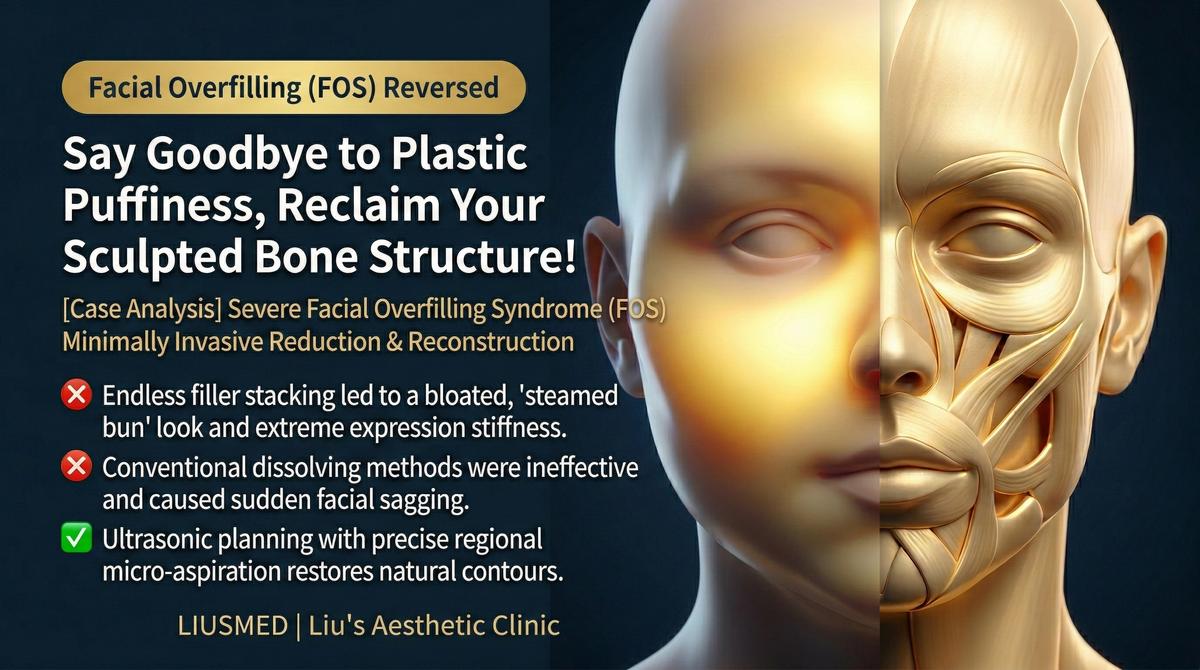
Case Scenario
Patient Background: A woman in her 40s who had received over 10 facial filler injection sessions across multiple clinics over 5 years, including hyaluronic acid, Ellansé, and Sculptra. Initial treatments addressed tear troughs and nasolabial folds, then gradually expanded to the apple of the cheeks, chin, temples, and other areas.
Treatment History:
- Over the past year, began feeling that her entire face appeared "puffy" and "unnatural"
- Friends and family started noticing changes in facial appearance
- Felt increasing disconnect between current and former appearance when looking in the mirror
- Another clinic diagnosed the condition as possible "Filler Overfilled Syndrome" (FOS)
- Attempted partial HA (Hyaluronic Acid — sugar molecule naturally in skin, holds water) dissolution, but overall pillow face appearance showed limited improvement
Presentation at Consultation:
- Classic pillow face characteristics across the entire face: blurred facial contours, proportional distortion
- Palpation revealed multiple areas of filler accumulation
- Some areas had abnormal texture (lumps or foreign body sensation)
- Patient experiencing significant distress about appearance
Deep Analysis
Root Cause Analysis
| Aspect | Finding |
|---|---|
| Cumulative effect | 10+ injections over 5 years, multiple materials layered at different depths |
| Material complexity | At least 3 different fillers (HA, PCL, PLLA) coexisting |
| Full-face ultrasound | Filler residue detected in nearly every common injection zone |
| Tissue reaction | Chronic fibrotic reaction in some areas, particularly Ellansé and Sculptra zones |
| Proportional distortion | Accumulated filler altered normal facial contour balance |
Key Insight: Pillow face (FOS) is not caused by a single injection — it results from long-term accumulation. Each individual injection may appear "acceptable," but the cumulative effect of fillers in tissue gradually alters overall facial contours. Simply dissolving HA only addresses part of the problem because non-dissolvable materials remain.
Related reading: FOS Diagnosis and Treatment Gold Standard
Doctor's Perspective
"This represents a classic FOS case. Full-face ultrasound revealed filler residue of different types across multiple zones, some with significant tissue reactions. The challenge lies in: first, identifying which deposits are HA (can attempt dissolution) versus non-dissolvable materials (require physical extraction); second, strategically staging the treatment rather than extracting everything at once — because the swelling and recovery from a single large-scale surgery would be excessive.
Our strategy was to conduct a comprehensive ultrasound assessment first, creating a complete 'filler map,' then address areas in priority order across staged procedures."
Treatment Plan and Process
Overall Strategy
| Phase | Treatment Content | Timeline |
|---|---|---|
| Phase 1 | Priority treatment of most prominent and distressing areas | First surgery |
| Phase 2 | Secondary areas and deep residual deposits | 4-6 weeks later |
| Evaluation | Assess recovery, determine if Phase 3 is needed | 3 months later |
Phase 1 Surgery
- Ultrasound mapping: Marking all known filler locations and types
- Priority treatment: Addressing areas contributing most to pillow face appearance
- Material-specific strategy:
- HA areas: Hyaluronidase (enzyme that dissolves HA filler) treatment first to reduce subsequent extraction scope
- Ellansé/Sculptra areas: Ultrasound-guided micro-extraction
- Real-time assessment: Immediate scanning after each area extraction
- Safety first: Stop when approaching surgical time or anesthesia limits; defer to next phase
Extraction Results
Phase 1 yielded multiple deposits of different materials, including degraded old HA masses, Ellansé nodules, and Sculptra particles. Some materials showed significant fibrotic tissue reaction.
Key Patient Notes
Special Characteristics of FOS Revision
| Characteristic | Explanation |
|---|---|
| Not a one-time fix | FOS revision almost always requires staged treatment |
| Requires patience | First surgery to final results may take 6+ months |
| Progressive improvement | Each phase shows improvement, but not instant transformation |
| Face will undergo transition | Swelling resolution and tissue remodeling take time |
| Psychological preparation matters | Be ready for a lengthy recovery journey |
Recovery Expectations
| Timeline | Expected Condition |
|---|---|
| Week 1 | Noticeable swelling; patience required |
| Weeks 2-4 | Swelling subsides; initial contours begin to emerge |
| Months 2-3 | Tissue softens; facial contours gradually sharpen |
| Month 6 | After multi-stage treatment, final results stabilize |
Key Insight: FOS revision is a "marathon," not a "sprint." Patients must understand this and maintain realistic expectations for each phase. Impatience may lead to unnecessary risks.
Clinical Takeaways
- Prevention over cure for FOS — regularly review cumulative injection volume; avoid overfilling
- Full-face ultrasound is foundational for FOS management — a complete filler map is essential
- Staged strategy is safe and effective — do not attempt to resolve everything in one session
- Mixed materials increase complexity — different strategies needed for different materials
- Psychological support is essential — the revision journey is long; patients need thorough communication and support
If you are struggling with pillow face, schedule a consultation for a comprehensive ultrasound assessment.
Related reading:
Related Services

Specialties
Credentials
- Kaohsiung Medical University, School of Medicine
- Attending Physician, Dermatology, Kaohsiung Chang Gung Memorial Hospital
- Attending Physician, Aesthetic Center, Kaohsiung Chang Gung Memorial Hospital
- Visiting Physician, Dermatology, Xiamen Chang Gung Hospital
- Visiting Physician, Aesthetic Center, Xiamen Chang Gung Hospital
"For every surgery, I strive to achieve a good outcome through a small incision and refined technique. Minimally invasive surgery is not just a technique — it's a commitment of respect to every patient."
Recovery after any procedure needs peer support too


Want to learn more?
Schedule a consultation for professional evaluation and advice