Cheeks Sagging After Filler? The Science Behind Gravity-Induced Filler Descent
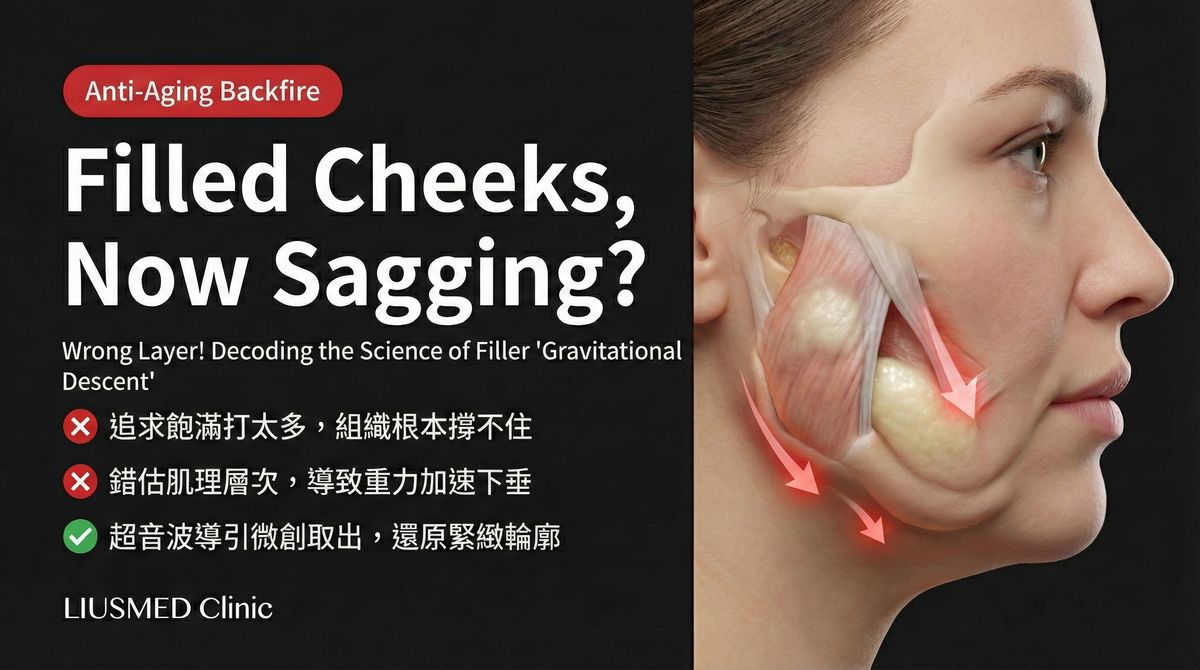
Cheek Filler Was Supposed to Lift—Why Does My Face Look Heavier?
You had mid-face filler to achieve a fuller, more youthful appearance. Initially it looked great—cheeks lifted, cheekbone contours more defined. But months later, things changed: cheeks feel heavy, nasolabial folds deepened, and when you smile the cheeks seem to "sag."
This counterintuitive outcome—filling that worsens sagging—is one of the most underestimated filler complications.
Why Filler Can Make the Face Sag
The Relentless Law of Gravity
Every milliliter of filler has weight. Injecting several milliliters into the cheeks adds grams of load to that area. On young, well-supported faces, skin and ligaments handle this easily. On aging faces with declining support, this extra weight becomes the proverbial straw.
| Factor | Impact on Sagging | Risk Assessment |
|---|---|---|
| Total filler volume | More volume = more gravitational load | >2ml per side requires caution |
| Filler specific gravity | Different products have different densities | Higher density = higher risk |
| Tissue support | Declines with age | Over 40 needs special evaluation |
| Injection plane | Superficial is more stable; deep may slide | Deep large-volume injection is risky |
| Ligament integrity | Lax ligaments mean insufficient support | Pre-existing sagging increases risk |
| Migration tendency | Some products migrate more easily | Low-viscosity products carry higher risk |
Key Insight: Filler is not "lift"—it is "volume." Volume can temporarily simulate a lifting effect, but if the tissue's support structures cannot bear the extra weight, the long-term result may accelerate sagging rather than counteract it.
Three Sagging Patterns
Pattern 1: Weight overload in place — Filler stays put but its weight drags surrounding tissue down. Deepened nasolabial folds, drooping mouth corners, and blurred jawline result.
Pattern 2: Downward filler migration — Filler slides down from the injection point due to gravity (how fillers migrate). "Empty above, swollen below" appearance.
Pattern 3: Filler spread and compression — Filler slowly disperses through tissue, increasing overall mid-face volume and weight. The face looks "swollen" rather than "full" (see pillow face correction).
Ultrasound Assessment
Ultrasound provides critical diagnostic information: current filler position vs. original injection site, filler distribution pattern, tissue support status, and residual volume estimation.
Key Insight: Facial sagging may result from excess filler weight, migration, spread, or a combination. Ultrasound differentiates these—because different causes require different strategies.
Correction Strategies
Strategy 1: Volume reduction — Selectively remove excess filler to reduce gravitational load.
Strategy 2: Repositioning — If filler has migrated but total volume is appropriate, use ultrasound-guided extraction of displaced filler, then re-inject at the correct position.
Strategy 3: Complete removal — If tissue support is insufficient to bear any filler weight, complete removal followed by lifting procedures may be the best approach.
Strategy 4: Support reinforcement — Combine with ultrasound lifting, thread lifts, or other support-enhancing procedures to provide filler with a stable "foundation."
When to Stop Adding More
"Not full enough → inject more → face heavier and sagging → inject even more to mask the sag"—this is a dangerous cycle.
The key insight: when facial tissue support is insufficient, adding more weight only worsens the situation. Address support first (lift, tighten), then consider whether modest volume supplementation is needed.
If your cheeks feel heavier after filler, schedule a consultation. Let us assess filler status with ultrasound and discuss the approach best suited to your facial condition. See also FOS (Facial Overfilled Syndrome) diagnosis and treatment golden standard.
Related Reading
Related Services
Common questions
Why does my face feel heavier and saggier after cheek filler instead of lifted?
It usually comes down to weight. Every milliliter of filler weighs something, so putting several milliliters into the cheek adds grams of load to that area. If your tissue support has already started to loosen, that extra weight can drag the mid-face down rather than hold it up. So instead of looking fuller, the face can end up looking pulled down.
How do I know whether the sagging is from too much filler, migration, or spreading?
You often can't tell these apart just by looking, and they call for different fixes. We usually use ultrasound to see where the filler sits now, whether it has slid down from the original spot, whether it's clumped or dispersed, and how much is still in the cheek. Once the cause is clear, we know whether to reduce, reposition, or remove.
Do I have to remove all the filler if my cheeks are sagging?
Not always. If the problem is simply too much volume, selectively taking out part of it can ease the load; if it has migrated, we can extract the displaced filler and place it back in the right position. Complete removal is really only for when the tissue can no longer support any filler weight, in which case lifting is the better route. It depends on your actual situation.
Can't I just add a bit more filler to cover the sagging?
That's the exact cycle a lot of people fall into—not full enough, so add more, the face gets heavier and droops, then add even more to mask it. When the support structure is already insufficient, adding weight only makes things worse. It makes more sense to address support and tightening first, then decide whether a modest amount of volume is worth adding.
Who is more likely to sag after cheek filler?
Broadly, the risk is higher with larger volumes (more than 2ml per side calls for caution), from around age 40 onward as tissue support declines, or when there are already some early signs of laxity. Injecting deep and in large amounts also slides down more easily. That's why the assessment before treatment matters.
Specialties
Credentials
- Kaohsiung Medical University, School of Medicine
- Attending Physician, Dermatology, Kaohsiung Chang Gung Memorial Hospital
- Attending Physician, Aesthetic Center, Kaohsiung Chang Gung Memorial Hospital
- Visiting Physician, Dermatology, Xiamen Chang Gung Hospital
- Visiting Physician, Aesthetic Center, Xiamen Chang Gung Hospital
"For every surgery, I strive to achieve a good outcome through a small incision and refined technique. Minimally invasive surgery is not just a technique — it's a commitment of respect to every patient."
Recovery after any procedure needs peer support too


Want to learn more?
Schedule a consultation for professional evaluation and advice