How Collagen Stimulators Work: Why Stimulating Collagen Can Also Go Wrong
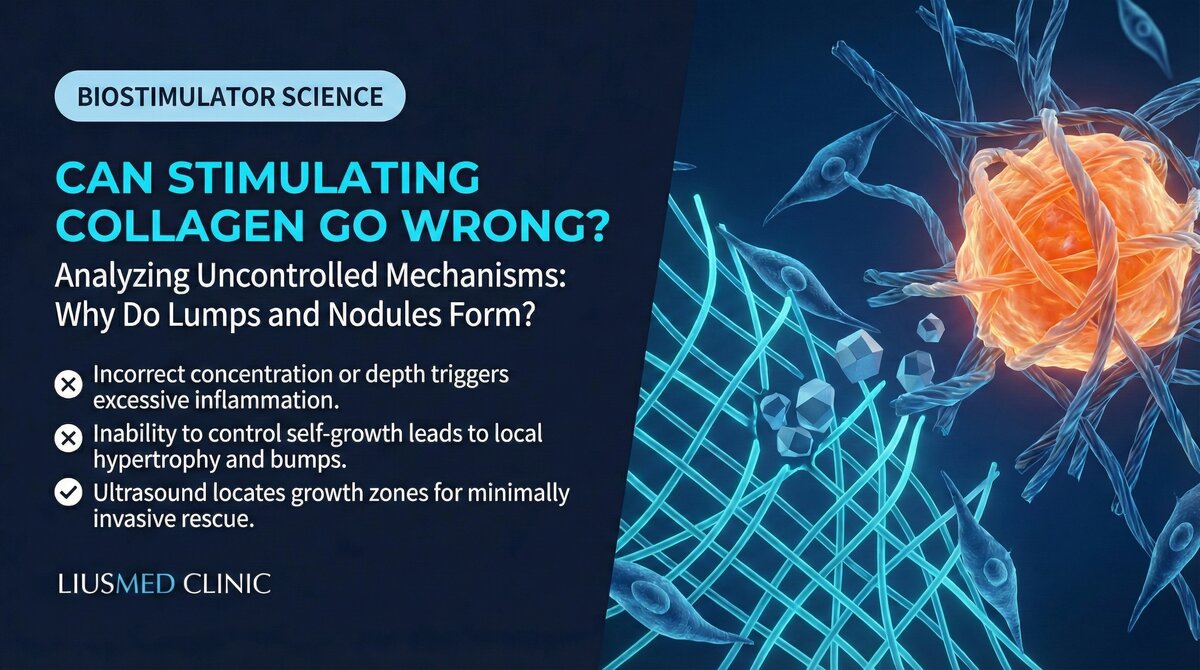
Is "Growing Your Own Collagen" Really Safer?
Collagen biostimulators have become one of the most popular product categories in aesthetic medicine. Unlike traditional fillers that directly inject foreign substances, collagen stimulators claim to "stimulate your own collagen production" — which sounds both natural and safe.
The most common collagen biostimulators on the market include:
- Poly-L-lactic acid (PLLA): Such as Sculptra
- Polycaprolactone (PCL): Such as Ellanse
- Calcium hydroxylapatite (CaHA): Such as Radiesse (provides both immediate volume and collagen stimulation)
These products do offer unique value. But "your own collagen" does not mean "controllable collagen." When the stimulation response exceeds expectations, the problems can be harder to manage than those from traditional fillers.
Key Insight: The "natural" label of collagen stimulators can create a false sense of security. The truth is, you cannot precisely control how much collagen your body generates, where it generates it, or how it is structured. Once overgrowth occurs, you are dealing with a problem your own body created — and that is often harder to fix than a foreign substance.
The Molecular Mechanism of Collagen Neogenesis
Foreign Body Reaction-Driven Collagen Production
The mechanism of collagen biostimulators is essentially a "controlled foreign body reaction." It harnesses the immune system's response to foreign particles to drive new collagen synthesis.
The specific process is as follows:
-
Microsphere injection and dispersion: Collagen stimulators are injected as microspheres suspended in a carrier gel. The carrier gel is absorbed within days to weeks, leaving microspheres distributed throughout the tissue.
-
Macrophage recruitment: The immune system identifies these microspheres as foreign bodies, and macrophages are recruited to surround the microspheres, attempting to engulf and degrade them.
-
Cytokine signaling cascade: As macrophages interact with microspheres, they release a series of cytokines including TGF-beta (transforming growth factor), PDGF (platelet-derived growth factor), and VEGF (vascular endothelial growth factor).
-
Fibroblast activation: These growth factors activate surrounding fibroblasts, which begin synthesizing large amounts of type I and type III collagen.
-
Collagen deposition and cross-linking: New collagen deposits around the microspheres, gradually forming a structured collagen network.
Ideal vs. Reality
| Characteristic | Ideal State | Possible Reality |
|---|---|---|
| Collagen production volume | Moderate, uniform | Unpredictable, possibly excessive |
| Distribution pattern | Evenly dispersed | May cluster locally |
| Collagen arrangement | Orderly network structure | May form disordered fibrosis |
| Production timeline | Gradual, controllable | Enormous individual variation |
| Resolution possibility | Natural absorption | May persist permanently |
Why Collagen Stimulation Can Go Wrong
Problem One: Unpredictable Individual Responses
Each person's immune system responds to microspheres with different intensity. Some people's fibroblasts respond mildly, producing an appropriate amount of collagen; others respond too aggressively, resulting in collagen overgrowth.
Factors affecting response intensity include:
- Genetic background: Certain genotypes have inherently stronger fibrotic tendencies
- Immune status: Autoimmune diseases or immune dysregulation may amplify the response
- Injection depth and technique: Superficial placement or uneven microsphere distribution leads to localized overreaction
- Microsphere aggregation: If microspheres are not adequately dispersed, clusters trigger excessively intense local immune responses
Problem Two: Nodule Formation
Nodules are the most common complication of collagen biostimulators. The formation mechanism is:
Localized microsphere aggregation → concentrated immune response → concentrated collagen synthesis → palpable hard lump
In cases of Sculptra nodules and steroid treatment failure, many nodules respond poorly to conventional treatment because the core of the nodule is dense collagen fiber, not the foreign material itself.
Problem Three: The "Irreversible" Nature of Collagen
This is the most critical risk factor of collagen stimulators. Traditional HA (Hyaluronic Acid — sugar molecule naturally in skin, holds water) fillers have hyaluronidase to dissolve them; but newly generated collagen is your own body tissue, and there is no "dissolver" that can selectively eliminate it.
Once collagen overgrowth forms nodules:
- Steroid injection: Can partially suppress fibroblast activity, but effects are limited with potential side effects
- 5-FU injection: Can inhibit fibroblast proliferation, but cannot eliminate existing collagen
- Surgical excision: May leave scars, and if microspheres remain, regrowth may occur after excision
Key Insight: When HA goes wrong, you can dissolve it with enzymes. When silicone goes wrong, you can attempt to extract it. But when your own collagen overgrows, you face a situation with no "undo button." This is the core paradox of collagen stimulator risk — its "naturalness" is precisely why it is the hardest to reverse.
Specific Risks of Different Collagen Stimulators
PLLA (Poly-L-Lactic Acid (Sculptra) — particle injection stimulating collagen) (Sculptra)
There is no single nodule percentage that covers every PLLA injection. In one retrospective aesthetic series reconstituting with 7–10 mL sterile water and reaching a final 8–10 mL after anesthetic was added, 4 of 1,002 patients developed nodules (0.4%; Palm et al., Journal of Drugs in Dermatology, 2021, PMID 33400413). Another two-year study of 106 aesthetic facial patients reported 4.7% (Schierle and Casas, Aesthetic Surgery Journal, 2011, PMID 21239677). The treatment and follow-up conditions differ, so I won't take either figure and use it to predict the risk for the person sitting in front of me. A nodule may also appear later.
PLLA-specific risk factors:
- Inadequate hydration and mixing before injection
- Injection in thin-skin areas such as the periorbital region
- Excessive single-session volume
- Insufficient post-injection massage to disperse microspheres
PCL (Polycaprolactone (Ellansé) — longer-lasting collagen stimulator) (Ellanse)
PCL microspheres degrade more slowly than PLLA, meaning the immune stimulation lasts longer. Can Ellanse be removed? is a question many patients ask.
PCL-specific risk factors:
- Longer-lasting product variants (S-type and above) keep microspheres present for longer
- The "uncontrollable" period of collagen generation is extended
- If problems arise, the waiting period for natural resolution is longer
CaHA (Calcium Hydroxyapatite (Radiesse) — mineral-based filler) (Radiesse)
CaHA microspheres provide both immediate volume and collagen stimulation. Microspheres degrade into calcium and phosphate ions, which are metabolized normally by the body.
CaHA-specific risk factors:
- Superficial injection causes white nodules (Tyndall-like effect)
- Uneven microsphere degradation may cause localized overstimulation
- Vascular occlusion risk in vascular-dense areas
The Role of Ultrasound in Collagen Stimulator Complications
When collagen stimulators go wrong — nodules, asymmetry, persistent swelling — accurate imaging assessment is the foundation for treatment planning.
High-resolution ultrasound can:
- Locate residual microspheres: Identify whether undegraded microspheres remain and where they have clustered
- Assess collagen overgrowth extent: Differentiate between microsphere nodules and collagen overgrowth nodules
- Characterize nodule type: Distinguish between fibrotic nodules, granulomas, and infectious lesions
- Guide precise treatment: Perform microsphere extraction or nodule injection under ultrasound guidance
This "see before you treat" principle avoids the additional damage that blind treatment can cause. Learn more about the filler repair evaluation process.
Treatment Strategy: A Layered Approach
When collagen stimulator complications require treatment, a layered strategy is rational:
Layer 1: Target the microspheres If ultrasound confirms residual microspheres are the source of ongoing immune stimulation, precise microsphere removal is the priority. Ultrasound-guided minimally invasive extraction can remove clustered microspheres through a tiny pinhole without skin incision.
Layer 2: Target overgrown collagen After microsphere removal, existing collagen overgrowth may require adjunct pharmacotherapy (5-FU or steroids) to promote remodeling. With the ongoing stimulus removed, medical treatment is typically more effective.
Layer 3: Follow-up and repair Tissue needs time to remodel. After microsphere removal and pharmacotherapy, periodic ultrasound follow-up can assess collagen remodeling progress and determine whether further intervention is needed.
Learn more from case analysis of collagen stimulator nodules with failed 5-FU treatment.
Common questions
Is stimulating my own collagen actually safer than a hyaluronic acid filler?
Not necessarily. The "natural" label makes it easy to let your guard down, but you can't precisely control how much collagen your body makes, where it forms, or how it's arranged. If the reaction goes further than expected and you get overgrowth, you're dealing with something your own body built — which can be harder to manage than a foreign filler.
If something goes wrong, why is a collagen stimulator harder to fix than an HA filler?
When HA goes wrong there's hyaluronidase to dissolve it, and silicone can at least be extracted. But newly formed collagen is your own tissue, and there's no dissolver that selectively breaks it down. That's why overgrowth leaves you in a spot with no easy undo.
How long after treatment do nodules usually show up?
PLLA (Sculptra) has no fixed window for a lump to appear. A series of ten non-HIV patients selected because they already had delayed symptoms—and whose symptoms had to start at least six months after injection to qualify—recorded onset at 6–60 months. That selected range is not a “usual” timeline for everyone treated (Alijotas-Reig et al., Dermatology, 2009, PMID 19797889). A separate PLLA case report described a nodule noticed about nine years after treatment (Seo et al., Skin Research and Technology, 2024, PMID 38563152). If a new lump appears later, get it checked even if everything looked fine at first.
I can already feel a hard lump — can anything be done about it?
Yes, but it's usually handled in layers. We start with high-resolution ultrasound to see whether microspheres are still there and what the nodule actually is — see it before you treat it. If clustered microspheres are still driving the reaction, removing them under ultrasound guidance comes first, and medication to help the tissue remodel comes afterward if needed.
Are longer-lasting stimulators like PCL / Ellanse a bit riskier?
Their microspheres break down more slowly, so the immune stimulation — and the "uncontrollable" phase of collagen production — lasts longer. If a problem does come up, waiting for it to settle on its own also takes longer. So "lasts longer" isn't only an upside; the trade-off comes with it.
Making an Informed Decision
Collagen stimulators are not "bad products" — with the right indications, technique, and patient selection, they can achieve excellent results. But understanding the nature of their risks is a prerequisite for informed decision-making:
- Collagen stimulation is not a fully controllable process
- Once overgrowth occurs, reversal is more difficult than with traditional fillers
- The risk of nodule formation is real and non-zero
- Longer-lasting products mean longer "uncontrollable" periods
If you are currently facing problems related to collagen stimulators, or are considering receiving such injections, please contact us for an ultrasound assessment to understand your options. Learn more about our filler repair services.
Key Insight: True "naturalness" is not immune-reaction-driven excessive collagen synthesis. Understanding this distinction helps explain why "stimulating your own collagen" is not always as wonderful as it sounds.
Specialties
Credentials
- Kaohsiung Medical University, School of Medicine
- Attending Physician, Dermatology, Kaohsiung Chang Gung Memorial Hospital
- Attending Physician, Aesthetic Center, Kaohsiung Chang Gung Memorial Hospital
- Visiting Physician, Dermatology, Xiamen Chang Gung Hospital
- Visiting Physician, Aesthetic Center, Xiamen Chang Gung Hospital
"For every surgery, I strive to achieve a good outcome through a small incision and refined technique. Minimally invasive surgery is not just a technique — it's a commitment of respect to every patient."
Recovery after any procedure needs peer support too


Want to learn more?
Schedule a consultation for professional evaluation and advice