Infected Cyst: Drain or Remove It? When to Treat
The Key Principle for Infected Cysts
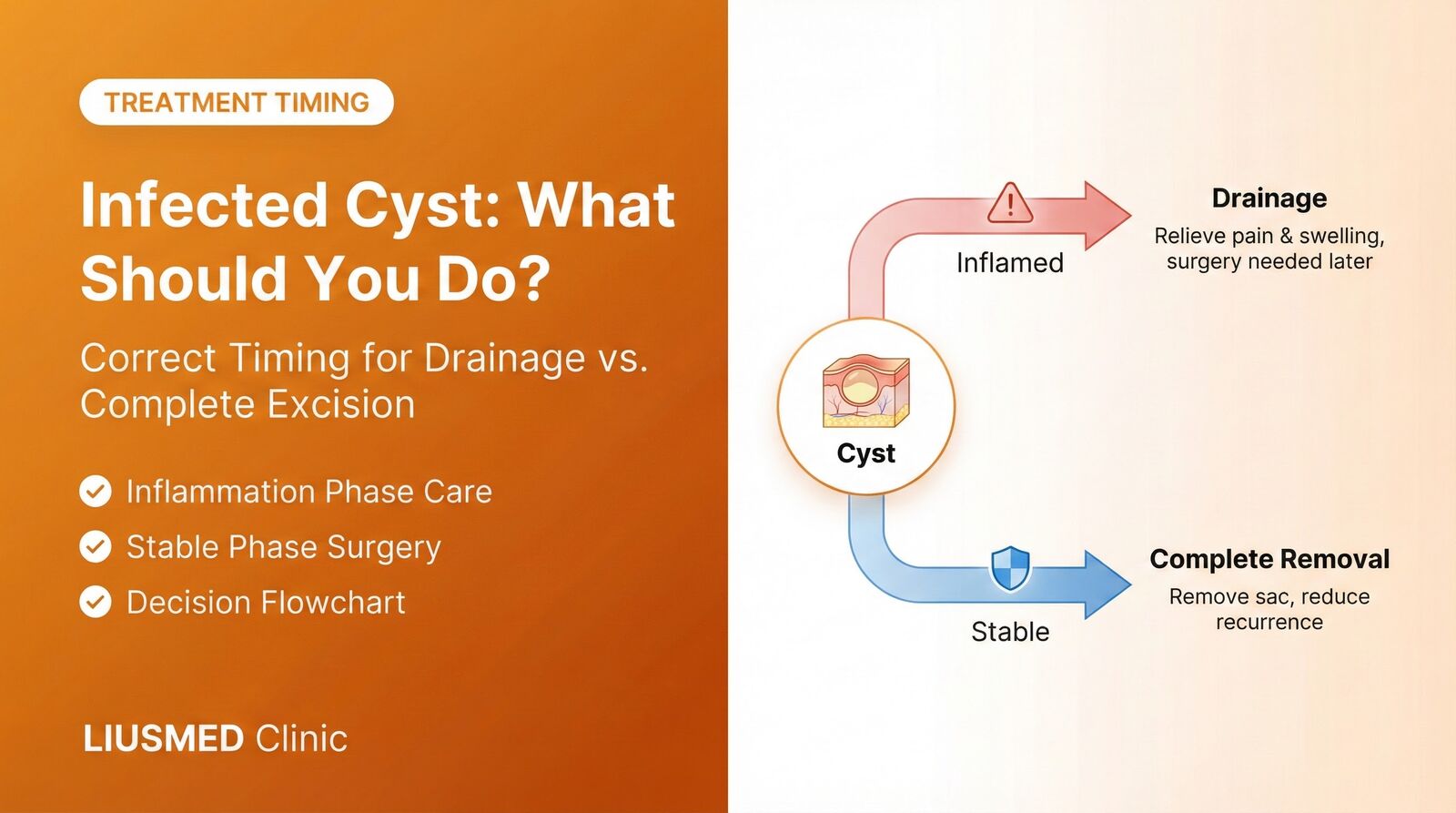
What should you do when a cyst becomes infected? The key is the severity of inflammation. Mild inflammation allows for immediate complete removal, but severe infection with abscess formation requires "incision and drainage" first, followed by complete excision after inflammation subsides (approximately 4-6 weeks). Squeezing or delaying treatment only makes things worse.
Why Do Cysts Become Infected?
Epidermal cysts are filled with keratin debris. When the cyst wall ruptures or bacteria invade, inflammation occurs. Common triggers include:
| Trigger | Description |
|---|---|
| Squeezing | Attempting to express contents, rupturing the cyst wall |
| Friction | Prolonged irritation from clothing or belts |
| Trauma | Impact or cuts damaging the cyst wall |
| Bacterial Infection | Skin bacteria entering the cyst cavity |
| Spontaneous | Rupture without apparent cause |
⚠️ Most Common Mistake: Squeezing the cyst at home! This is the number one cause of infection.
Inflammation Severity Levels and Treatment
Level 1: Mild Inflammation 🟢
Symptoms:
- Mass enlarges slightly, mild redness
- Minor tenderness
- No visible pus
Treatment: Can Proceed with Complete Removal
At this stage, inflammation is limited and tissue adhesion is minimal. An experienced surgeon can perform minimally invasive complete excision, solving the problem in one procedure.
💡 Dr. Liu's View: "Mild inflammation is actually one of the best times for surgery. The patient's attention is already on this cyst—it's the perfect opportunity to remove it completely and prevent future recurrent infections."
Level 2: Moderate Inflammation 🟡
Symptoms:
- Obvious redness and swelling (diameter > 2cm)
- Significant tenderness
- Mass becomes soft, possible fluctuance
- May have slight purulent discharge
Treatment: Case-by-Case Decision
This stage requires physician judgment. Options may include:
- Direct Removal: If inflammation is controllable and tissue can be separated
- Drainage First, Then Removal: If abscess has formed
Seek medical evaluation promptly to determine the best approach.
Level 3: Severe Inflammation/Abscess 🔴
Symptoms:
- Severe redness, swelling, heat, and pain
- Obvious pus
- Possible fever
- Skin thinning, near rupture
Treatment: Incision and Drainage Required First
Attempting complete removal at this stage carries risks:
- Greatly increased wound infection rate
- Unclear tissue boundaries, difficult to remove completely
- Poor wound healing
Correct Treatment Sequence:
Drainage vs Complete Excision: Comparison
| Comparison | Incision & Drainage | Complete Excision |
|---|---|---|
| Purpose | Emergency inflammation management | Cure the cyst |
| Timing | Severe abscess | No inflammation or mild inflammation |
| Procedure Time | 5-10 minutes | 15-30 minutes |
| Incision Size | Small incision | 1:1 minimal incision |
| Is It Curative? | ❌ No (cyst wall remains) | ✅ Yes (complete wall removal) |
| Recurrence Rate | 100% (will definitely recur) | About 1-2%; lower if the cyst has never been inflamed |
| Advantage | Rapid pain relief | Definitive removal of the sac |
| Disadvantage | Requires second surgery later | Must wait if severely inflamed |
⚠️ Important Concept: Incision and drainage is only "temporary management," not "treatment." The cyst wall is still there—the cyst will definitely grow back.
Why Can't Infected Cysts Be Removed Immediately?
Risks of Surgery During Severe Inflammation
| Risk | Explanation |
|---|---|
| Wound Infection | High bacterial load in inflamed tissue increases post-op infection |
| Difficult to Identify Wall | Swelling and adhesions make the cyst wall hard to distinguish |
| Incomplete Removal | Unclear boundaries lead to residual wall fragments |
| Poor Healing | Inflamed tissue has poor circulation, wounds may dehisce |
| Noticeable Scarring | Inflamed tissue repair tends to produce larger scars |
Benefits of Waiting for Inflammation to Subside
- Clear boundaries between cyst wall and surrounding tissue
- Clear surgical field, high complete removal rate
- Low wound infection risk
- Fast healing, minimal scarring
Complete Treatment Process for Infected Cysts
Scenario 1: Mild Inflammation
⚠️ One honest caveat: a cyst that has already been inflamed carries a higher chance of recurrence to begin with — whether it is taken out by minimal-incision or by conventional excision. Removing the whole sac is what pushes that chance as low as it goes; it does not make it zero.
Timeline: Complete within 1-2 weeks
Scenario 2: Severe Inflammation/Abscess
Timeline: 6-8 weeks total
When Should You Seek Medical Care?
Seek Care Immediately 🚨
- Cyst suddenly enlarges, becomes red, painful
- Feels soft, fluctuant
- Skin appears ready to rupture
- Fever (> 38°C / 100.4°F)
- Redness spreading
Schedule a Clinic Visit 📅
- Cyst slowly growing but not inflamed
- Want it removed permanently
- Location affects appearance
💡 Dr. Liu's Advice: "It's best to treat cysts BEFORE they become infected. Once infected, you not only suffer through drainage, but also wait weeks for definitive treatment. Prevention is better than cure!"
Self-Care: What to Do When Inflamed
✅ What You Can Do
- Apply ice to reduce swelling (10-15 minutes at a time)
- Keep the area clean and dry
- Seek medical care promptly
❌ What Not to Do
| Wrong Action | Consequence |
|---|---|
| Squeezing | Worsens inflammation, spreads infection |
| Popping It Yourself | Infection risk, worse scarring |
| Applying Heat | Accelerates inflammation spread |
| Using Unknown Ointments | May delay proper treatment |
| Ignoring It | May progress to cellulitis |
Frequently Asked Questions
Q1: If I squeeze out the contents, is it cured?
A1: Absolutely not! What comes out is only the keratin debris inside—the cyst wall (the "bag") is still under the skin and will definitely refill. Plus, squeezing often ruptures the wall, causing severe inflammation.
Q2: Can antibiotics cure a cyst?
A2: Antibiotics can only "control inflammation," not "cure the cyst." Even if inflammation subsides, the cyst wall remains and will recur. The only cure is surgical removal of the complete cyst wall.
Q3: Can an inflamed cyst be removed immediately?
A3: It depends on severity. Mild inflammation allows direct removal; severe abscess requires drainage first. This needs physician evaluation—there's no one-size-fits-all answer.
Q4: How long after drainage before definitive surgery?
A4: Usually 4-6 weeks. This allows:
- Complete inflammation resolution
- Tissue repair and healing
- Clear boundaries between cyst wall and surrounding tissue
This supports complete removal and lowers the chance of recurrence.
Q5: Why does my cyst keep getting infected repeatedly?
A5: Because the cyst wall is still there. Previous treatment was likely just "drainage" or "partial removal"—the wall wasn't completely removed, so it keeps growing back and getting infected. The only solution is finding an experienced surgeon to completely excise the cyst wall.
Preventing Cyst Infections
- Don't Squeeze: This is the most important rule
- Avoid Friction: Reduce clothing irritation to the cyst
- Keep Clean: But no need for special disinfection
- Early Treatment: Remove cysts while small—smaller wound, faster recovery
- Monitor Regularly: If it grows or becomes uncomfortable, seek care early
Conclusion
The key to treating infected cysts is correct timing assessment:
| Situation | Treatment Approach |
|---|---|
| Not inflamed | Best surgical timing, cure in one procedure |
| Mild inflammation | Can remove directly, cure in one procedure |
| Severe abscess | Drainage first → Wait 4-6 weeks → Then remove to cure |
Regardless of scenario, complete excision of the cyst wall is ultimately required for a cure. Incision and drainage is temporary management, not the end of treatment.
Related Reading
- Will a Cyst Disappear? 10 Common Questions
- Complete Guide to Epidermal Cysts
- Lipoma vs Cyst: How to Tell the Difference
About the Author
Dr. Ta-Ju Liu
- Current Position: Director, Liushi Clinic
- Specialties: Minimal incision surgery (lipoma, cyst), hyperhidrosis surgery, thread lifting
- Experience:
- 15+ years of clinical minimal incision surgery experience
- Over 10,000 successful minimal incision cases
- Board-certified dermatologist
- Philosophy: "The key to cyst treatment is 'complete cyst wall removal.' As long as the bag is completely removed, it won't recur."
Related Services

Specialties
Credentials
- Kaohsiung Medical University, School of Medicine
- Attending Physician, Dermatology, Kaohsiung Chang Gung Memorial Hospital
- Attending Physician, Aesthetic Center, Kaohsiung Chang Gung Memorial Hospital
- Visiting Physician, Dermatology, Xiamen Chang Gung Hospital
- Visiting Physician, Aesthetic Center, Xiamen Chang Gung Hospital
"For every surgery, I strive to achieve a good outcome through a small incision and refined technique. Minimally invasive surgery is not just a technique — it's a commitment of respect to every patient."
Want to learn more?
Schedule a consultation for professional evaluation and advice