Cyst FAQ: 10 Common Questions a Dermatologist Answers
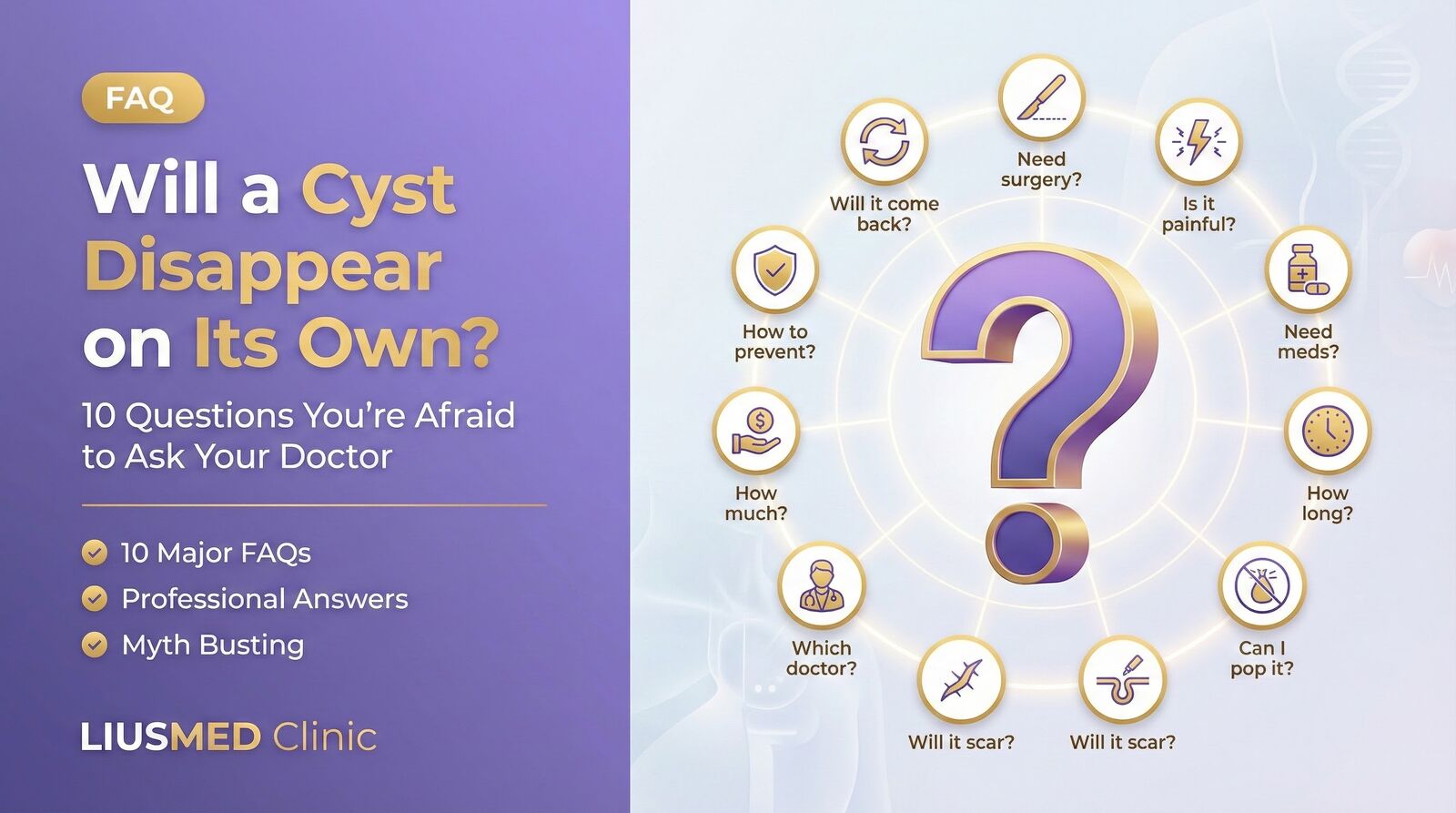
Introduction: The Most Common Cyst Questions
In clinic, Dr. Liu encounters various patient questions about cysts daily. Some questions patients are embarrassed to ask, while others have conflicting answers online. This article compiles 10 of the most common cyst questions with professional answers from a board-certified dermatologist.
The proper name for this kind of cyst is an epidermoid cyst. It is often called a "sebaceous cyst", but that name is misleading: it does not come from the sebaceous (oil) gland. It forms when surface skin cells end up beneath the skin and line a small sac, which fills mainly with keratin. The white paste that comes out when one is squeezed is mostly keratin, not oil.
Q1: Will a Cyst Disappear on Its Own?
Answer: No.
A cyst is a "small bag" (cyst wall) within the skin that continuously produces keratin debris. Once this bag forms, it will never disappear on its own. It will only:
- Keep growing larger (though slowly)
- Become repeatedly infected (when the wall ruptures)
- Stay the same (but never disappear)
💡 Dr. Liu explains: "Think of a cyst as a bag that constantly produces waste. Without removing the bag, waste keeps accumulating. The only way to make it disappear is surgery to completely remove the bag."
What happens if you leave it alone?
It follows one of the three courses above. A small cyst with no symptoms does not need to be removed in a hurry. Once it has been inflamed, though, the surrounding tissue scars onto the wall, the operation becomes harder, and the chance of it coming back after removal goes up. So the timing is something we decide together in clinic, based on size, location and whether it has flared before. Turning malignant is very rare (see Q3).
Q2: Can I Squeeze a Cyst?
Answer: Absolutely not!
Squeezing is the most common mistake, causing:
| Consequence | Explanation |
|---|---|
| Worsened Inflammation | Squeezing ruptures the wall, triggering severe infection |
| Infection Spread | Bacteria may spread to surrounding tissue |
| Worse Scarring | Tissue repair after inflammation leaves more visible scars |
| Sac Stays Behind | Content comes out, but the wall remains—it will regrow |
The Right Approach: If you notice a cyst, schedule a dermatology appointment to evaluate whether surgical removal is needed.
Q3: Can Cysts Become Cancer?
Answer: Extremely rare, but not zero.
Cysts are benign tumors, and the vast majority (> 99%) remain benign throughout life. In very rare cases, long-standing cysts may undergo malignant transformation.
Warning Signs to Watch For:
- Sudden rapid growth (noticeably larger within weeks)
- Repeated infections that won't resolve
- Harder texture, unclear boundaries
- Skin surface ulceration that won't heal
⚠️ Recommendation: If your cyst shows any unusual changes, seek medical examination promptly. Surgically removed specimens are sent for pathology to confirm whether abnormal cells are present.
Q4: Is Cyst Surgery Painful?
Answer: Pain is substantially reduced; most people get through it comfortably.
Cyst surgery uses tumescent local anesthesia, paired with gentle pain-relief anesthesia. What you'll feel:
| Stage | Sensation |
|---|---|
| During Anesthesia Injection | Mild sting (about 3-5 seconds) |
| During Surgery | Pain substantially reduced; most feel only mild tugging (varies by individual) |
| Day of Surgery | Mild soreness after anesthesia wears off (pain medication helps) |
| Next Day | Pain significantly reduced, most don't need pain medication |
💡 Dr. Liu adds: "We use tumescent anesthesia technique, which not only provides excellent pain control but also reduces bleeding for smoother surgery."
Q5: How Long Is Cyst Surgery? Will There Be a Scar?
Answer: Minimal incision surgery takes about 15-20 minutes with minimal scarring.
Surgery Duration:
- Average cyst (1-3cm): 15-20 minutes
- Larger cyst (> 3cm): 20-30 minutes
Scarring:
| Surgical Method | Incision Size | Scar Visibility |
|---|---|---|
| Traditional Elliptical Excision | 2-3x the cyst size | More noticeable |
| Liushi 1:1 Minimal Incision | Same as cyst or smaller | Minimal |
Our minimal incision technique designs incisions along skin tension lines (Langer's lines). With post-operative cosmetic tape care, scars become nearly invisible.
Q6: How Soon After Surgery Can I Shower?
Answer: A waterproof dressing is applied as routine, so you can shower from the next day.
| Timing | Bathing Method |
|---|---|
| Day of surgery | Keep it dry; use a damp towel for other areas |
| From the next day | Shower with the waterproof dressing on; wash gently and replace it yourself if water gets under it |
| After suture removal (face about 7 days, body about 14 days) | Can shower normally |
| Day 14 | Can take baths, go swimming |
Showering Tips:
- Use 3M waterproof transparent dressing to completely cover the wound
- Avoid prolonged hot water directly on the wound area
- Check dressing after showering—replace if wet inside
- If you are allergic to waterproof dressings and use plain gauze instead, keep the wound dry until it has fully healed
Q7: Will Cysts Recur After Removal?
Answer: After complete removal of the cyst wall, recurrence is about 1-2%; a cyst that has never been inflamed is less likely to recur.
What matters most is whether the cyst has ever been inflamed — inflammation makes the wall stick to the surrounding tissue, so a previously inflamed cyst is more likely to recur whichever technique is used. The other cause is a cyst wall that was not fully removed: if even a small piece of the bag is left behind, it can grow back.
| Treatment Method | Recurrence Rate |
|---|---|
| Squeezing / Drainage | 100% (cyst wall left behind) |
| Partial Removal | > 50% |
| Complete Removal (Traditional) | 2-5% |
| Liushi Complete Removal | About 1-2% (lower if the cyst has never been inflamed) |
💡 Dr. Liu emphasizes: "We insist on completely dissecting the cyst wall for every cyst, even with inflammatory adhesions. But part of the recurrence risk is settled before surgery: a cyst that has never been inflamed is less likely to come back, which is why we suggest removing it while it is quiet."
Q8: Does Cyst Surgery Require Hospitalization? How Many Days Off Work?
Answer: Outpatient procedure, go home the same day.
No Hospitalization Needed: Cyst surgery is a minor outpatient procedure using tumescent local anesthesia paired with gentle pain-relief anesthesia. You rest at the clinic for about 2 hours of observation before going home; please have a relative or friend accompany you that day and do not drive or ride yourself.
Time Off Recommendations:
| Work Type | Recommended Days Off |
|---|---|
| Office Work | 0-1 day (rest on surgery day) |
| Light Labor | 1-2 days |
| Heavy Labor | 3-5 days |
Most patients can return to normal work the day after surgery. If the cyst is on your hand or a frequently used area, you may need to adjust work activities slightly.
Q9: How Much Does Cyst Surgery Cost? Is It Covered by Insurance?
Answer: Coverage depends on the situation.
When Insurance May Cover:
- Infected cysts
- Cysts affecting function
- Suspected malignancy requiring pathology
Self-Pay Situations:
- Purely cosmetic reasons
- Requesting special minimal incision technique
- Removing multiple cysts at once
Cost Range:
- With Insurance: Copay + medication costs (varies by plan)
- Self-Pay Minimal Incision: Depends on cyst size, number, and location
📞 Recommendation: Actual costs require physician evaluation. Schedule a consultation for specifics.
Q10: Can Facial Cysts Be Removed? Will It Be Noticeable?
Answer: Yes, and minimal incision technique makes scars nearly invisible.
The face requires the most aesthetic care. Liushi Clinic offers specialized treatment for facial cysts:
Technical Features:
- 1:1 Precision Minimal Incision: Incision same size as cyst or smaller
- Follows Skin Lines: Incision hidden in natural skin folds
- Cosmetic Suturing: Ultra-fine sutures + multi-layer closure
- Post-Op Care: Cosmetic tape + silicone sheets
Common Facial Cyst Locations:
| Location | Incision Design | Scar Visibility |
|---|---|---|
| Forehead | Along hairline or wrinkles | Minimal |
| Near Eyebrow | Hidden within eyebrow | Nearly invisible |
| Around the Eye (incl. Eyelid) | Along the eyelid crease or lash line | Minimal |
| Behind Ear | Along ear contour | Nearly invisible |
| Cheek | Along expression lines | Minimal |
💡 Dr. Liu's Experience: "Facial cysts are among our most common cases. With proper incision design and correct care, scars fade to nearly invisible within 3-6 months."
Bonus Questions
Q11: How Do You Tell a Cyst from a Lipoma?
Quick Comparison:
| Feature | Cyst | Lipoma |
|---|---|---|
| Location | Superficial skin layer | Deeper subcutaneous |
| Texture | Slightly firm, elastic | Soft, dough-like |
| Central Opening | Often has dark spot | None |
| When Squeezed | May have foul-smelling discharge | No discharge |
| Gets Infected? | Easily | Rarely |
⚠️ Note: Self-diagnosis is only for reference—accurate diagnosis requires physician examination.
If it turns out to be a lipoma, treatment differs from a cyst—learn more about minimally invasive lipoma surgery.
Q12: Can Children Have Cyst Surgery?
Yes. If a cyst continues to grow or becomes repeatedly infected, surgery can be performed even in children.
Pediatric Surgery Considerations:
- Cooperation: Children who can tolerate local anesthesia (usually > 6-7 years) can have outpatient procedures
- Location: If in a visible area and causing distress, consider early treatment
- Anesthesia: Tumescent local anesthesia paired with gentle pain-relief anesthesia, not general anesthesia
Summary
| Question | Short Answer |
|---|---|
| Will it disappear on its own? | ❌ No |
| Can I squeeze it? | ❌ Absolutely not |
| Will it become cancer? | Extremely rare (< 1%) |
| Is surgery painful? | Pain substantially reduced (varies by individual) |
| Will it recur? | About 1-2% after complete removal; lower if never inflamed |
| Hospitalization needed? | No |
| Can facial cysts be removed? | ✅ Yes, minimal scarring |
Related Reading
- Infected Cyst: Drainage vs Complete Removal
- Complete Guide to Epidermal Cysts
- Lipoma vs Cyst: How to Tell the Difference
About the Author
Dr. Ta-Ju Liu
- Current Position: Director, Liushi Clinic
- Specialties: Minimal incision surgery (lipoma, cyst), hyperhidrosis surgery, thread lifting
- Experience:
- 15+ years of clinical minimal incision surgery experience
- Over 10,000 minimal incision cases
- Board-certified dermatologist
- Philosophy: "Every patient question deserves to be taken seriously. The more you understand, the more confident you'll be in making decisions."
Related Services

Specialties
Credentials
- Kaohsiung Medical University, School of Medicine
- Attending Physician, Dermatology, Kaohsiung Chang Gung Memorial Hospital
- Attending Physician, Aesthetic Center, Kaohsiung Chang Gung Memorial Hospital
- Visiting Physician, Dermatology, Xiamen Chang Gung Hospital
- Visiting Physician, Aesthetic Center, Xiamen Chang Gung Hospital
"For every surgery, I strive to achieve a good outcome through a small incision and refined technique. Minimally invasive surgery is not just a technique — it's a commitment of respect to every patient."
Related Articles
Epidermoid Cyst Removal: What Actually Happens From Consultation to Walking Out
Most people asking about epidermoid cyst removal want to know if it can be handled in one visit. Here is that day in order, and why each dec
Cyst Surgery Aftercare: Dressing and Warning Signs for Sutured, Drained and Laser Wounds
Cyst surgery aftercare depends on which wound you took home: a sutured line, a drained open wound, or a small laser opening. Each one is dre
A Buttock Cyst That Keeps Growing: Why It Flares Up and When to Remove It
A buttock cyst sits where you sit. That pressure and friction make it flare again and again. How to tell it from a pilonidal sinus, and when
Want to learn more?
Schedule a consultation for professional evaluation and advice