Why You Need a Filler Revision Team with Ultrasound Anatomy Expertise
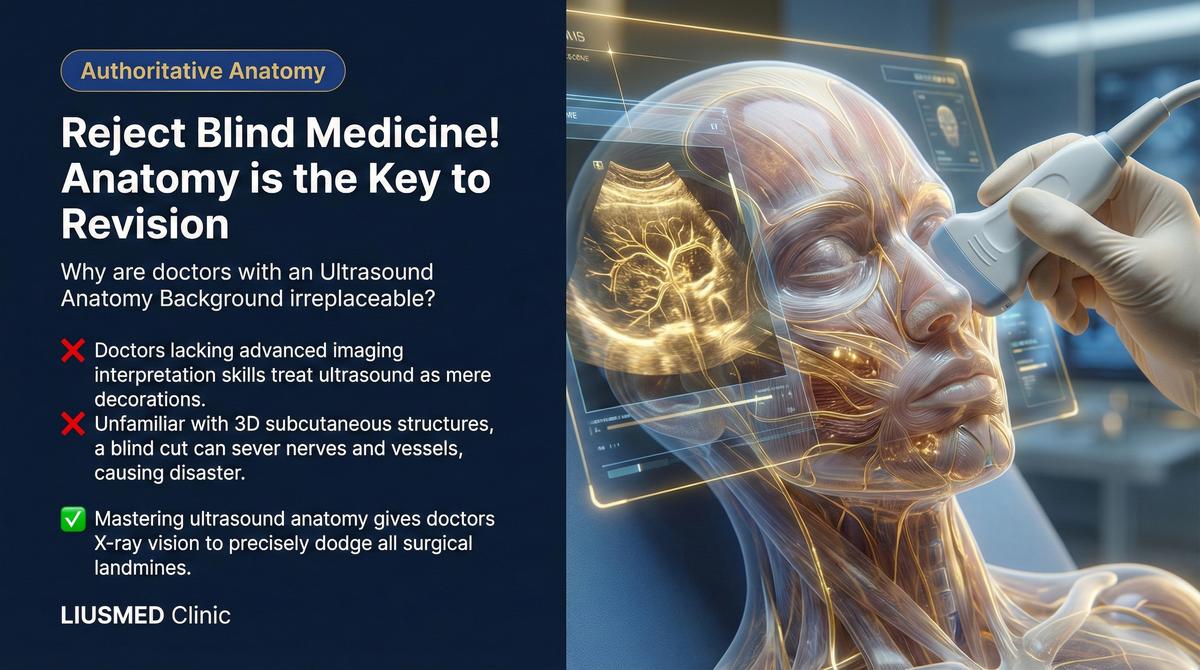
Ultrasound Anatomy: The Hidden Threshold for Successful Filler Revision
In filler revision, advanced equipment matters—but whether the operator has deep ultrasound anatomy training is the core factor that determines outcomes. Having the highest-resolution microscope means nothing if the observer does not know what they are looking at.
This article explains why ultrasound anatomy expertise should be a top consideration when selecting a filler revision physician.
What Is "Ultrasound Anatomy"?
More Than Operating an Ultrasound Machine
Ultrasound anatomy refers to the professional ability to identify human tissue structures through ultrasound imaging. This is not merely "holding a probe and scanning." It requires deep understanding across multiple layers:
| Competency Level | Specific Content | Application in Revision |
|---|---|---|
| Basic operation | Probe selection, frequency adjustment, image optimization | Obtaining clear tissue images |
| Normal anatomy identification | Skin layers, muscles, fascia, vessels, nerves | Establishing normal references to identify abnormalities |
| Foreign body identification | Echo characteristics of different fillers | Distinguishing HA, Ellansé, Radiesse, etc. |
| Pathology interpretation | Inflammation, fibrosis, calcification, abscess | Assessing severity of tissue reactions |
| Dynamic assessment | Blood flow, tissue mobility, compression tests | Determining safe vascular distances |
Key Insight: Ultrasound anatomy is not a skill that can be "quickly learned." It requires long-term foundational anatomy training combined with extensive clinical ultrasound scanning experience to enable correct judgments in complex cases.
Why "Being Able to See" Is Not Enough
The Challenges of Ultrasound Image Interpretation
Many assume that ultrasound allows you to "see everything," but the reality is that ultrasound image interpretation is far more complex than expected:
| Challenge | Description | Required Capability |
|---|---|---|
| Depth artifacts | Deep tissue images may be distorted by superficial echo interference | Distinguishing artifacts from real structures |
| Material similarity | Some fillers have echoes resembling normal tissue | Detecting subtle differences |
| Mixed materials | Multiple fillers overlapping make layered interpretation difficult | Systematic layer-by-layer analysis |
| Tissue changes | Inflammation or fibrosis alters original tissue morphology | Dynamic comparison and experienced judgment |
| Individual variation | Each person's anatomy has subtle differences | Extensive clinical experience |
Common Misinterpretation Scenarios
Clinically, operators lacking ultrasound anatomy backgrounds are prone to these errors:
- Mistaking normal tissue for filler: Misidentifying lymph nodes, glands, or normal fat as foreign material requiring extraction
- Missing deep filler deposits: Seeing only superficial portions while overlooking deep or diffused residual material
- Misjudging vessel locations: Failing to correctly identify important vascular pathways during extraction
- Underestimating lesion extent: Seeing only the most obvious portion while missing surrounding satellite lesions
Key Insight: "Having ultrasound" and "knowing how to use ultrasound" are fundamentally different. The key is not the equipment—it is the depth of the operator's anatomical knowledge.
The Role of Ultrasound Anatomy Across Revision Phases
Pre-operative: Precise Localization and Planning
| Assessment Item | Anatomical Foundation | Clinical Significance |
|---|---|---|
| Filler location | Determining which tissue layer | Dictates extraction pathway and depth |
| Filler extent | Identifying boundaries and spread | Estimates surgical duration and prognosis |
| Surrounding vasculature | Identifying arterial and venous paths | Planning safe operative zones |
| Nerve pathways | Locating motor and sensory nerves | Preventing post-operative sensory changes |
| Tissue reaction | Assessing fibrosis, inflammation, calcification | Adjusting surgical strategy |
Intra-operative: Real-Time Guidance and Safety Monitoring
During surgery, a physician with ultrasound anatomy training can:
- Confirm instrument position in real time: Ensure minimally invasive instruments reach the target zone precisely
- Dynamically avoid critical structures: Continuously monitor vessels and nerves during the procedure
- Verify extraction completeness: Perform real-time scans to confirm no residual material remains
- Address unexpected findings: Immediately assess and manage newly discovered lesions during surgery
Post-operative: Objective Tracking and Assessment
- Residual assessment: Confirming whether remaining material requires secondary treatment
- Healing monitoring: Observing recovery progress at the surgical site
- Early problem detection: Identifying potential issues before the patient experiences symptoms
Related reading: How Ultrasound Imaging Identifies Different Fillers
Ultrasound Identification of Different Fillers
Common Filler Ultrasound Characteristics
| Filler Type | Ultrasound Appearance | Identification Difficulty | Key Identifiers |
|---|---|---|---|
| Hyaluronic acid (HA) | Hypoechoic or anechoic mass | Moderate | Boundary clarity, surrounding tissue compression |
| Ellansé (PCL) | Medium-high echogenicity, irregular borders | High | Distinction from stimulated collagen |
| Sculptra (PLLA) | Scattered hyperechoic particles | High | Particle distribution and tissue reaction extent |
| Radiesse (CaHA) | Hyperechoic, posterior acoustic shadow | Moderate | Calcification degree and distribution pattern |
| Silicone | Distinctive "snowstorm" pattern | Very High | Spread extent and tissue infiltration |
Different materials appear very differently on ultrasound, requiring systematic training for correct identification. In mixed injection cases particularly, multiple materials may coexist in a single area, each requiring individual identification.
How to Evaluate a Physician's Ultrasound Anatomy Capability
Observable Indicators for Patients
During your consultation, the following signs can help you assess whether a physician has solid ultrasound anatomy expertise:
| Observation | Positive Indicator | Warning Sign |
|---|---|---|
| Scanning method | Systematic, methodical scanning of all areas | Only checking where the patient points out problems |
| Explanation ability | Can explain structures visible on the image in real time | Unable to interpret image content |
| Material identification | Can determine filler type and explain reasoning | Only says "there's something in there" |
| Extent assessment | Systematically checks surrounding areas for spread | Only examines the most obvious area |
| Vascular marking | Proactively identifies and records important vessel locations | No mention of vascular safety |
| Report content | Provides detailed imaging reports with annotations | Only brief verbal summary |
Background Verification Suggestions
- Has the physician completed formal ultrasound anatomy courses or certifications?
- Is there evidence of continuing education in ultrasound techniques?
- Is ultrasound used routinely in daily clinical practice (not only for special cases)?
- Does the physician have experience with ultrasound-guided interventional procedures?
Related reading: The Complete Filler Repair Evaluation Process
Dr. Liu's Team: Ultrasound Anatomy Foundation
Dr. Ta-Ju Liu's training and practice in ultrasound anatomy includes:
- Dermatological training foundation in skin ultrasound imaging
- Extensive clinical ultrasound experience, performing daily filler assessments via ultrasound
- Continuous practice of ultrasound-guided minimally invasive surgery
- Established ultrasound imaging database for various filler types, enabling pattern recognition and analysis
These credentials enable the team to deliver more precise diagnoses and safer surgical plans when confronting complex cases.
Related reading: Why You Need a Dual-Specialty Team
Conclusion: Ultrasound Anatomy Is the Cornerstone of Revision Quality
In filler revision, your physician's ultrasound anatomy expertise directly determines the precision and safety of the procedure. Choosing a team with this capability not only increases the probability of successful first-time revision but also significantly reduces complication risks.
If you are considering filler revision, schedule a consultation for an ultrasound-based assessment that provides the most accurate evaluation possible.
Related Services

Specialties
Credentials
- Kaohsiung Medical University, School of Medicine
- Attending Physician, Dermatology, Kaohsiung Chang Gung Memorial Hospital
- Attending Physician, Aesthetic Center, Kaohsiung Chang Gung Memorial Hospital
- Visiting Physician, Dermatology, Xiamen Chang Gung Hospital
- Visiting Physician, Aesthetic Center, Xiamen Chang Gung Hospital
"For every surgery, I strive to achieve a good outcome through a small incision and refined technique. Minimally invasive surgery is not just a technique — it's a commitment of respect to every patient."
Recovery after any procedure needs peer support too


Want to learn more?
Schedule a consultation for professional evaluation and advice