Failed Fat Grafting Revision: Extraction and Reconstruction Strategies
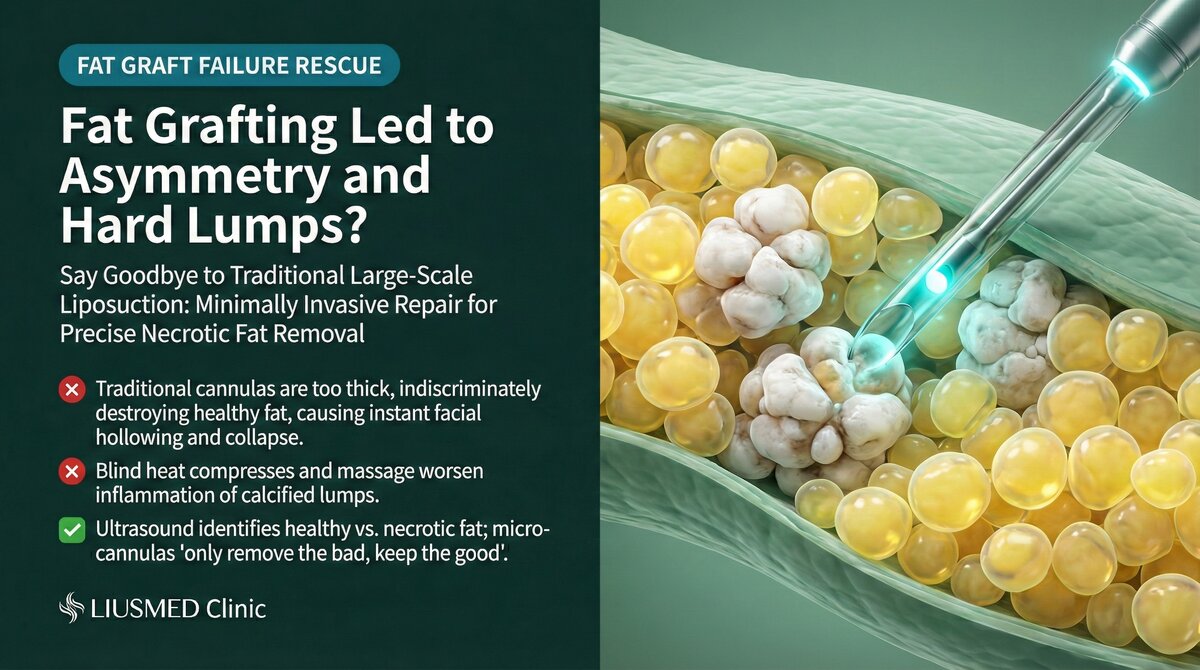
Failed Fat Grafting: A Revision Challenge Unlike Any Other Filler
Autologous fat grafting was once considered the ideal filling material — using one's own tissue, with high biocompatibility and long-lasting results. However, when autologous fat grafting goes wrong, the revision difficulty often far exceeds that of other fillers.
The reason: once autologous fat survives, it integrates with surrounding tissue, and boundaries become indistinct. This creates a fundamental surgical challenge — how to differentiate grafted fat from native tissue.
Key Insight: The core difficulty in fat graft revision is not "extraction" itself, but "identification." The boundary between grafted fat and native tissue is often unclear; only high-resolution ultrasound can provide real-time tissue discrimination during surgery.
Common Problems After Failed Fat Grafting
| Problem Type | Presentation | Cause |
|---|---|---|
| Over-survival (pillow face) | Excessively full face, loss of natural contour | Too much volume injected or survival rate exceeding expectations |
| Uneven survival | Coexisting focal bulges and depressions | Inconsistent survival rates |
| Oil cysts | Soft, palpable lumps | Fat necrosis followed by liquefaction |
| Calcified nodules | Hard nodules | Long-term calcification of necrotic fat |
| Fibrosis | Hard texture, unnatural feel | Tissue reaction causing fibrous encapsulation |
| Asymmetry | Visibly different appearance on each side | Differential survival rates or uneven injection |
For more on pillow face correction, see Pillow Face Correction.
How Fat Graft Revision Differs from Other Filler Revision
| Comparison | Autologous Fat | HA Filler | Permanent Filler |
|---|---|---|---|
| Dissolvability | Cannot be dissolved | Can be dissolved with hyaluronidase | Cannot be dissolved |
| Tissue boundary | Blurred (integrates with native tissue) | Relatively distinct | May have fibrous capsule |
| Ultrasound identification | Requires experienced interpretation | Relatively easy to identify | Varies by material |
| Extraction strategy | Requires meticulous separation | Can be aspirated or curetted | Must be removed with capsule |
| Residual risk | Higher | Lower | Moderate |
| Tissue damage risk | Higher (due to unclear boundaries) | Lower | Moderate |
Key Insight: Fat graft revision cannot use "dissolution" or "washout" approaches. Every milliliter of extraction requires precise operation under ultrasound guidance to avoid damaging normal tissue.
The Critical Role of Ultrasound in Fat Graft Revision
How Ultrasound Differentiates Grafted Fat from Native Tissue
| Ultrasound Feature | Grafted Fat | Normal Fat Tissue |
|---|---|---|
| Echo characteristics | Usually heterogeneous echogenicity | Homogeneous hypoechoic |
| Boundaries | May have fibrous capsule (hyperechoic line) | No distinct capsule |
| Blood flow signal | Surviving fat shows flow; necrotic does not | Normal flow distribution |
| Oil cysts | Anechoic area with posterior enhancement | Not present |
| Calcification | Hyperechoic foci with acoustic shadowing | Not present |
Specific Intraoperative Ultrasound Applications
- Complete pre-operative scan: Establishes a three-dimensional map of grafted fat distribution
- Real-time guidance: Directs instruments precisely to target locations
- Vascular protection: Color Doppler tracks critical vessels
- Extraction confirmation: Real-time verification of extraction progress
- Residual assessment: Confirms no missed fat masses
Regional Considerations for Fat Graft Extraction
Cheeks / Malar Region
| Item | Details |
|---|---|
| Common problems | Excessive fullness, unnatural "moon face" |
| Anatomical risks | Facial nerve, parotid duct |
| Extraction strategy | Layered extraction, preserving appropriate volume to maintain natural contour |
| Incision choice | Intraoral or concealed preauricular location |
Forehead
| Item | Details |
|---|---|
| Common problems | Excessive protrusion or unevenness |
| Anatomical risks | Supraorbital artery, supratrochlear artery |
| Extraction strategy | Superficial-to-deep layered operation |
| Incision choice | Within the hairline |
Temple
| Item | Details |
|---|---|
| Common problems | Unnatural fullness or hard lumps |
| Anatomical risks | Superficial temporal artery, temporal branch of facial nerve |
| Extraction strategy | Extremely cautious layered operation |
| Incision choice | Within the hairline, away from STA |
Chin / Jawline
| Item | Details |
|---|---|
| Common problems | Unclear contour or asymmetry |
| Anatomical risks | Marginal mandibular nerve, facial artery |
| Extraction strategy | Protecting jawline contour integrity |
| Incision choice | Posterior to mandibular angle or intraoral |
Surgical Workflow
Pre-Operative Assessment
| Assessment Item | Method | Purpose |
|---|---|---|
| Fat distribution | High-frequency full-face ultrasound scan | Confirm location and extent of fat deposits |
| Survival status | Color Doppler | Determine fat viability |
| Complication assessment | Ultrasound imaging | Confirm presence of cysts or calcification |
| Vascular mapping | Color Doppler | Plan safe pathways |
| Symmetry assessment | Bilateral ultrasound comparison | Set extraction goals |
Surgical Execution
- Precise marking: Mark target extraction zones based on ultrasound findings
- Micro-incision: Select the most concealed incision location
- Real-time ultrasound guidance: Full-procedure ultrasound monitoring
- Selective extraction: Remove only problematic fat, preserving normal tissue
- Staged procedures: Severe cases may require 2–3 surgeries
- Real-time symmetry assessment: Compare both sides at each stage
Key Insight: Fat graft extraction should follow a "conservative first" strategy. Hollowing from over-extraction is harder to correct than a modest residual amount. Staged extraction allows the physician to assess tissue recovery between procedures and make more precise decisions.
Post-Extraction Reconstruction Strategies
| Scenario | Approach | Timing |
|---|---|---|
| Mild depression | Allow natural tissue recovery | Observe for 3–6 months |
| Significant depression | Precise small-volume HA supplementation | After tissue stabilization (3–6 months) |
| Contour irregularity | Staged contouring | Adjusted based on recovery progress |
| Severe asymmetry | Comprehensive reconstruction plan | Case-by-case assessment |
Post-Operative Care and Recovery
| Timeline | Expected Presentation | Care Recommendations |
|---|---|---|
| Days 1–3 | Swelling, possible bruising | Ice packs, avoid compression |
| Week 1 | Swelling reduced ~50% | Avoid vigorous facial expressions |
| Weeks 2–4 | Most swelling resolved | Gradually resume daily activities |
| Months 1–3 | Tissue gradually stabilizing | Interim evaluation |
| Months 3–6 | Final results emerging | Assess need for secondary procedures |
Conclusion: Fat Graft Revision Demands the Most Meticulous Approach
Revision of failed autologous fat grafting is one of the most technically demanding surgeries in the filler revision field. "See before you treat" — when the boundary between grafted fat and native tissue is unclear, ultrasound guidance is not an option but a necessity.
If you have concerns following fat grafting, contact Liusmed Clinic for a professional evaluation.
Related reading: Pillow Face Correction, Filler Lump Extraction Technique, Filler Repair Evaluation Process
Related Services
Specialties
Credentials
- Kaohsiung Medical University, School of Medicine
- Attending Physician, Dermatology, Kaohsiung Chang Gung Memorial Hospital
- Attending Physician, Aesthetic Center, Kaohsiung Chang Gung Memorial Hospital
- Visiting Physician, Dermatology, Xiamen Chang Gung Hospital
- Visiting Physician, Aesthetic Center, Xiamen Chang Gung Hospital
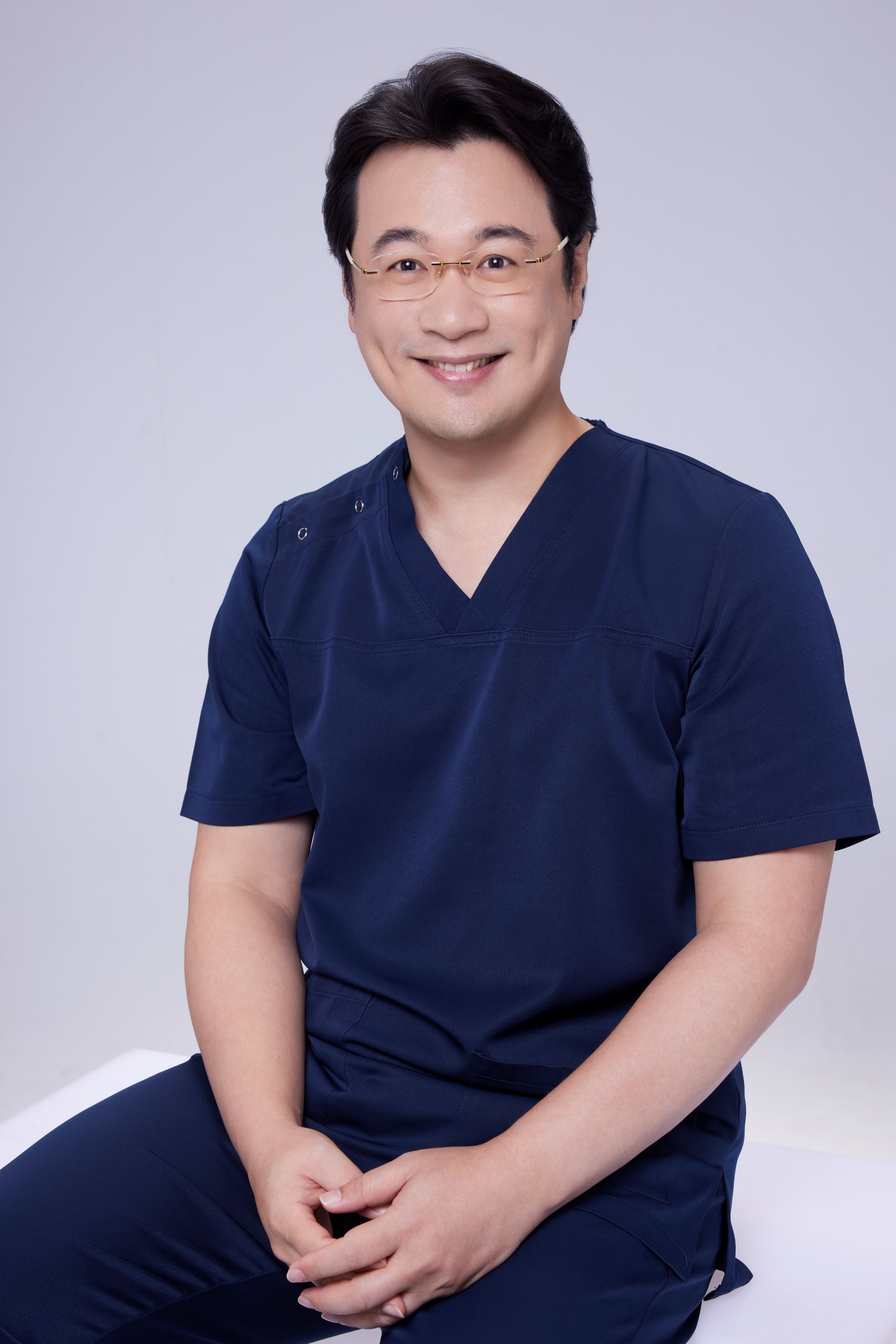
"For every surgery, I strive to achieve a good outcome through a small incision and refined technique. Minimally invasive surgery is not just a technique — it's a commitment of respect to every patient."
Recovery after any procedure needs peer support too

Want to learn more?
Schedule a consultation for professional evaluation and advice