MRI vs. High-Resolution Ultrasound: Which Is More Accurate for Detecting Facial Filler Residue?
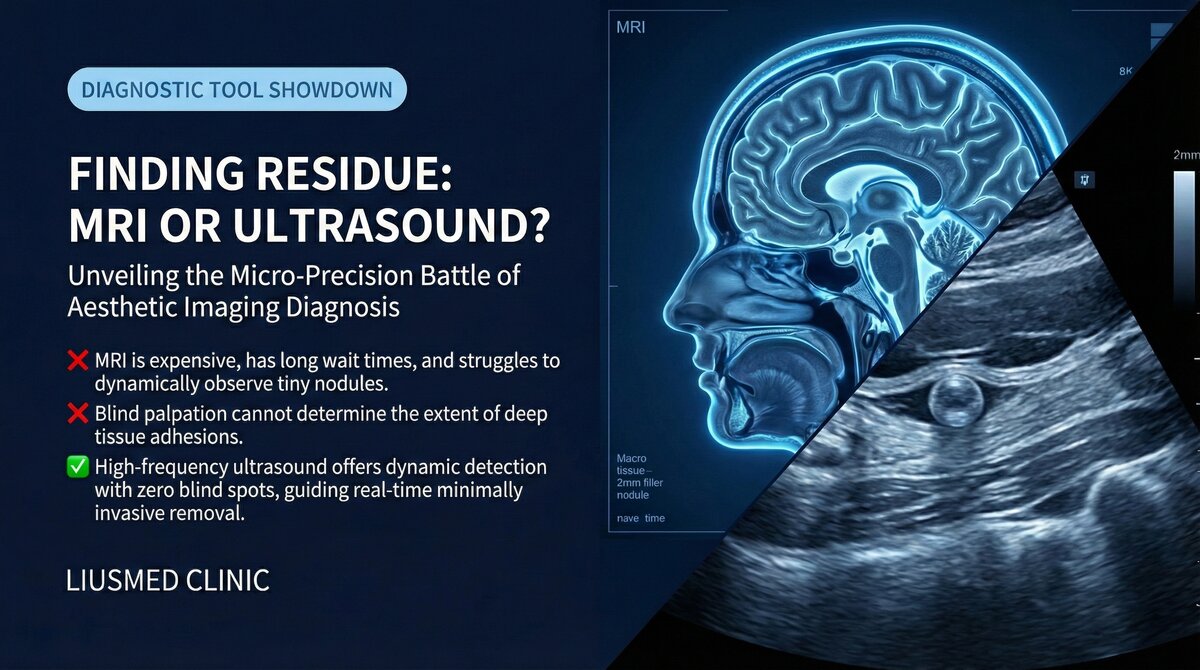
Choosing the Right "Eyes" to See Your Filler
When you suspect your facial filler has developed problems — lumps, swelling, asymmetry — the first question is: what method should you use to see clearly what is happening inside?
The two most commonly used non-invasive imaging tools are MRI (magnetic resonance imaging) and high-resolution ultrasound. Each excels in different areas, and understanding their differences helps you make a better choice.
Key Insight: MRI and ultrasound are not either/or choices but complementary tools with different indications. For most filler-related clinical problems — localization, distribution mapping, real-time treatment guidance — high-resolution ultrasound is typically the first choice. But in certain specific situations, MRI's soft tissue contrast and wide field of view are irreplaceable.
Basic Principles of Each Modality
MRI
MRI uses powerful magnetic fields and radiofrequency pulses to generate signals from hydrogen nuclei in tissue. Different tissues have different hydrogen densities, producing images with exceptional soft tissue contrast.
High-Resolution Ultrasound
Ultrasound uses high-frequency sound waves (15-50 MHz) reflected from tissue interfaces to create real-time structural images. Different density tissues produce different echo patterns.
Comprehensive Comparison
| Comparison | MRI | High-Resolution Ultrasound |
|---|---|---|
| Spatial resolution (superficial) | Moderate (0.5-1mm) | Very high (0.1-0.3mm) |
| Spatial resolution (deep) | High (uniform) | Decreases with depth |
| Soft tissue contrast | Very high | Moderate |
| Filler identification | Good (HA bright on T2) | Good (characteristic echoes per material) |
| Real-time capability | No (scheduled, 30-60 min) | Yes (immediate, 5-15 min) |
| Treatment guidance | Not applicable | Real-time injection and extraction guidance |
| Cost | High | Moderate |
| Accessibility | Hospital/imaging center required | Office-based |
| Repeatability | Lower (cost/time constraints) | High (easy repeat follow-up) |
| Contraindications | Metal implants, claustrophobia | Virtually none |
| Full-face scanning | Single session | Region-by-region examination |
Filler Appearance on Each Modality
Hyaluronic Acid (HA)
MRI: High water content HA (Hyaluronic Acid — sugar molecule naturally in skin, holds water) appears bright on T2-weighted images, providing excellent contrast against surrounding tissue. MRI is particularly sensitive for detecting HA residue.
Ultrasound: HA appears as hypoechoic to anechoic round deposits with clear boundaries. Contrast against surrounding edematous tissue may be lower than MRI.
Silicone/Permanent Fillers
MRI: Unique signal characteristics; special silicone-suppression sequences can confirm presence.
Ultrasound: Strong echogenicity with "snowstorm" effect, usually easily identifiable.
Calcium-Based Fillers (CaHA)
MRI: Calcified material appears as low signal, less intuitive than CT.
Ultrasound: Strongly hyperechoic with posterior acoustic shadowing, easiest to identify on ultrasound.
Clinical Scenario Selection Guide
When to Choose Ultrasound
- Initial assessment: Screening and localization tool
- Filler repair evaluation: Real-time assessment and treatment planning
- Treatment guidance: Image-guided injection or extraction needed
- Follow-up monitoring: Post-treatment periodic assessment
- Before and after filler extraction: Pre-operative localization and post-operative confirmation
When to Choose MRI
- Deep structure assessment: Suspected deep or widespread filler distribution
- Full-face wide field scanning: Need overall distribution overview when filler location is uncertain
- Specific material confirmation: Need to confirm specific materials like silicone
- Legal or documentation purposes
- When ultrasound assessment is inconclusive
Key Insight: In daily clinical practice, high-resolution ultrasound is the preferred tool for filler assessment due to its real-time capability, high resolution, treatment guidance ability, and accessibility. MRI serves as an important complementary modality in specific situations.
Ultrasound's Unique Advantage: Seamless Connection Between "Seeing" and "Treating"
Ultrasound's most irreplaceable advantage: it is both a diagnostic and treatment guidance tool.
In a single session, the physician can:
- Assess filler location, type, and encapsulation status with ultrasound
- Upon discovering a problem, immediately perform precise treatment under ultrasound guidance
- Confirm treatment results in real time
This instant "diagnose-treat-confirm" workflow is something MRI cannot provide.
Learn more about ultrasound in filler identification and our filler repair services. Contact us for an assessment.
Key Insight: The best imaging tool is not the "most expensive" or "most advanced" — it is the one that best helps solve your problem. For the vast majority of filler-related clinical issues, high-resolution ultrasound delivers optimal value because it enables "seeing" and "treating" to happen at the same time, same place, by the same physician.
Common questions
If I suspect a problem with my filler, should I start with ultrasound or MRI?
In most cases you start with high-resolution ultrasound. It shows the filler's location and distribution in real time and can guide treatment on the spot. MRI is usually kept for filler that sits deep, spreads widely, or when you need to view the whole face in one scan.
Which one sees more clearly, MRI or ultrasound?
It depends on what you want to see. Ultrasound has higher resolution for superficial detail, while MRI is stronger on overall soft tissue contrast and uniform depth. Each has its own strengths, and neither wins outright.
Can ultrasound treat the filler during the same exam?
Yes, and that is what makes ultrasound so useful. In a single session the physician can assess the filler's location and degree of encapsulation, treat any problem right there under image guidance, and confirm the result in real time. MRI cannot do all of that at once.
When would you recommend adding an MRI?
When the filler seems deep or widely spread, when the location is uncertain and you want to view the whole face at once, when a specific material like silicone needs confirming, or when the ultrasound findings are not clear enough, MRI is considered as a complement.
Do different fillers look the same on imaging?
No. On ultrasound, hyaluronic acid appears as a low-echo round deposit and looks bright on T2 MRI; silicone shows a "snowstorm" of strong echoes; calcium-based fillers show strong echoes with posterior acoustic shadowing. The physician reads these features to tell them apart.

Specialties
Credentials
- Kaohsiung Medical University, School of Medicine
- Attending Physician, Dermatology, Kaohsiung Chang Gung Memorial Hospital
- Attending Physician, Aesthetic Center, Kaohsiung Chang Gung Memorial Hospital
- Visiting Physician, Dermatology, Xiamen Chang Gung Hospital
- Visiting Physician, Aesthetic Center, Xiamen Chang Gung Hospital
"For every surgery, I strive to achieve a good outcome through a small incision and refined technique. Minimally invasive surgery is not just a technique — it's a commitment of respect to every patient."
Recovery after any procedure needs peer support too

Want to learn more?
Schedule a consultation for professional evaluation and advice