Facial Nerves and Vessels Are Dense — How to Avoid Paralysis and Major Bleeding During Filler Extraction
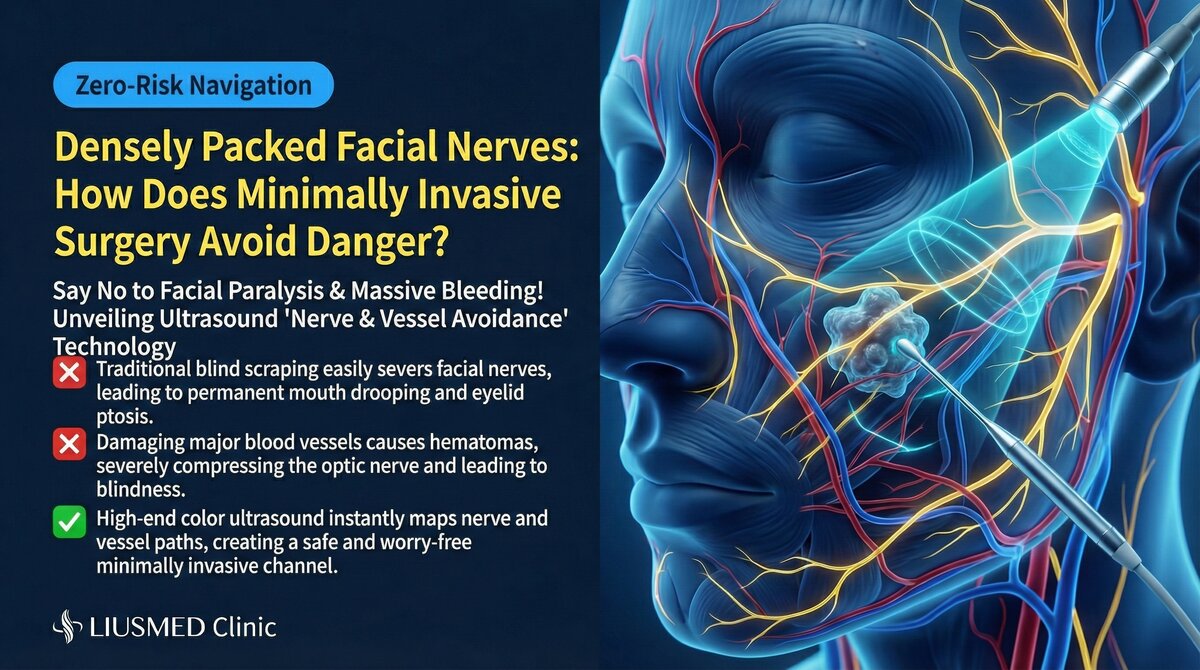
The Greatest Concern in Facial Surgery: Invisible Nerves and Vessels
During filler revision surgery, the concern most patients have is not "can the filler be removed" but "will nerves or blood vessels be damaged during removal." This concern is entirely reasonable — the face is one of the most neurovascularly dense areas of the human body, and any careless maneuver can cause severe consequences.
Traditional surgery relies on the surgeon's anatomical knowledge and experience to "estimate" nerve and vessel positions. However, individual anatomical variations exist, and filler material may alter normal tissue architecture, significantly increasing the risk of blind manipulation.
Key Insight: Nerve and vessel injuries on the face are often irreversible — facial nerve damage can cause permanent paralysis, and arterial injury can lead to massive hemorrhage or tissue necrosis. Therefore, "being able to see" is the prerequisite for "being able to avoid" — this is the core value of ultrasound guidance.
Danger Zone Map of the Face
Major Nerve Distribution
Motor and sensory nerves of the face form a complex network. The following are the nerve regions requiring the most vigilance during filler extraction:
| Nerve | Region Innervated | Consequence of Injury | Common Filler Problem Area |
|---|---|---|---|
| Temporal branch | Frontalis, upper orbicularis oculi | Inability to raise brow, loss of forehead lines | Forehead, temple filler |
| Zygomatic branch | Orbicularis oculi | Incomplete eye closure | Cheekbone, apple of cheek filler |
| Buccal branch | Perioral muscles | Asymmetric smile | Nasolabial fold, cheek filler |
| Marginal mandibular | Lower lip muscles | Drooping mouth corner, asymmetry | Chin, jawline filler |
| Infraorbital nerve | Mid-face sensation | Numbness of nasal side, upper lip | Tear trough, nasolabial fold filler |
| Supraorbital nerve | Forehead sensation | Forehead numbness | Forehead filler |
For more about facial danger zones, see Facial Anatomy Danger Zones.
Major Vessel Distribution
| Vessel | Location | Injury Risk | Related Filler Area |
|---|---|---|---|
| Superficial temporal artery | Temple region | Major hemorrhage, hematoma | Temple filler |
| Facial artery | Mandible → nasal ala | Major hemorrhage | Nasolabial fold, nasal ala filler |
| Angular artery | Beside nasal root | Hemorrhage, retinal embolism risk | Tear trough, nasal root filler |
| Supraorbital artery | Superior orbital rim | Hemorrhage, frontal hematoma | Forehead filler |
| Labial arteries | Upper and lower lips | Hemorrhage, lip necrosis | Lip filler |
How Does Ultrasound "See" Nerves and Vessels?
Ultrasound Identification Techniques
High-resolution ultrasound can display different tissue structures in real time:
| Tissue Structure | Ultrasound Appearance | Identification Method |
|---|---|---|
| Arteries | Pulsatile tubular structures, color Doppler shows flow | Real-time dynamic observation of pulsation |
| Veins | Compressible tubular structures, low flow velocity | Probe compression test |
| Nerves | Honeycomb or fascicular echo pattern | Tracking along the course |
| Filler | Type-specific characteristics | Material-specific recognition |
| Normal tissue | Layered echo pattern | Comparison with contralateral side |
The Critical Role of Color Doppler
Color Doppler ultrasound is the key tool for vessel identification:
- Red signal: Blood flowing toward the probe (typically arterial)
- Blue signal: Blood flowing away from the probe (typically venous)
- Real-time capability: Dynamically displays blood flow, not static images
- Quantitative analysis: Can measure flow velocity to determine vessel type
Key Insight: Ultrasound not only shows vessel location but also displays real-time flow direction and velocity. This means the physician can continuously adjust instrument direction during the procedure, maintaining a safe distance from critical vessels at all times.
Ultrasound-Guided Strategies for Safe Extraction
Pre-Operative Planning: Establishing Safe Pathways
Before surgery, the physician performs detailed anatomical scanning with ultrasound:
- Marking all visible vessels: Including arterial and venous courses
- Identifying nerve pathways: Tracing nerves at known anatomical positions
- Assessing distance between filler and neurovascular structures: Determining safe operating space
- Planning entry paths: Selecting the safest angle that avoids nerves and vessels
- Designing alternative paths: Preparing backup plans for unexpected findings
Intra-Operative Real-Time Monitoring
During extraction, ultrasound continuously provides real-time information:
| Monitoring Item | Frequency | Purpose |
|---|---|---|
| Instrument tip position | Continuous real-time | Confirm operation within safe zone |
| Vessel position changes | Before each maneuver | Account for vessel path shifts due to tissue movement |
| Signs of hemorrhage | Continuous real-time | Early detection of micro-bleeding |
| Tissue integrity | At each phase | Ensure no critical structures are damaged |
Special Strategies for Key Regions
Different facial areas have different safety considerations:
Forehead and temple region:
- Watch for superficial temporal artery and temporal branch nerve
- Entry path should avoid the main trunk of the superficial temporal artery
- Extra caution when operating in the superficial fascial layer
Periorbital region:
- Infraorbital nerve and angular artery are primary risks
- Extremely delicate operating space
- Requires highest resolution ultrasound equipment
Nasal region:
- Dense branches of the facial artery
- Filler may be immediately adjacent to or wrapping around vessels
- See Nasal Filler Extraction and Reconstruction for specialized discussion
Perioral and lip region:
- Labial arteries course beneath lip mucosa
- Buccal and marginal mandibular branches of the facial nerve cross this area
- Limited operating space with rich vascularity
Three Lines of Safety Defense
First Line: Complete Pre-Operative Scanning
- Complete neurovascular mapping of the entire surgical area
- Mark all critical structures to be avoided
- Calculate safe distances between filler and danger structures
Second Line: Intra-Operative Real-Time Guidance
- Ultrasound screen continuously displays live operative imaging
- Instrument direction is immediately adjusted when approaching vessels or nerves
- Color Doppler continuously monitors blood flow status
Third Line: Real-Time Response Capability
- Immediate compression hemostasis if unexpected bleeding occurs
- Hemostatic materials and equipment readily available
- Operation can be paused at any time for reassessment
Safety Differences Compared to Blind Extraction
Risks of Blind Operation
Extraction surgery performed without ultrasound guidance (whether injection dissolution or surgical removal):
| Risk Category | Blind Operation | Ultrasound-Guided |
|---|---|---|
| Nerve injury risk | Higher, relies on experience-based judgment | Lower, real-time identification and avoidance |
| Vascular injury risk | Higher, vessel positions unknown | Lower, color Doppler monitoring |
| Major hemorrhage risk | Moderate, cannot prevent | Very low, pre-emptive avoidance |
| Facial paralysis risk | Present, especially in deep operations | Very low, nerves can be tracked |
| Tissue necrosis risk | Present, from vascular injury | Very low, real-time vessel protection |
For more information, see Ultrasound-Guided Pinhole Extraction Explained.
What If Bleeding or Nerve Injury Occurs?
Managing Intra-Operative Hemorrhage
Even under ultrasound guidance, minor bleeding may occur. Standard management protocol:
- Immediate ultrasound localization of the bleeding point
- Precise compression hemostasis
- Assessment of the type and size of the bleeding vessel
- Use of electrocautery or hemostatic materials if necessary
- Confirm complete hemostasis before resuming operation
Prevention and Management of Nerve Injury
- Prevention first: Complete pre-operative nerve mapping and planning is critical
- Real-time recognition: Immediately stop and verify if the patient reports abnormal sensation during surgery
- Local anesthesia considerations: Local anesthesia may temporarily affect nerve function assessment
- Post-operative follow-up: Regular monitoring of nerve function recovery
Which Situations Carry Particularly High Neurovascular Risk?
| High-Risk Scenario | Reason for Risk | Countermeasure |
|---|---|---|
| Multiple injection history | Altered tissue architecture, increased anatomical variation | More detailed pre-operative scanning |
| Deep-layer filler | Close to deep vessels and nerve trunks | Layer-by-layer approach with continuous monitoring |
| Filler encasing vessels | High separation difficulty, significant vascular injury risk | Conservative strategy, staged treatment if needed |
| Post-infection sequelae | Locally fragile tissue, neovascularization | Control infection before surgery |
| Deep temple filler | Rich superficial temporal and deep vasculature | Highest-level ultrasound monitoring |
Conclusion: Safety Is the Top Priority in Revision Surgery
The primary goal of filler revision surgery is not "remove as much as possible" but to clear the filler as completely as possible while ensuring safety. Ultrasound guidance elevates surgery from "blind operation" to "visualized surgery," enabling the physician to:
- Fully plan safe pathways before surgery
- Monitor every operative step in real time during surgery
- Respond immediately to unexpected situations
If your filler is located in a sensitive facial area, or if you have previously experienced post-surgical nerve numbness, we recommend choosing a specialist with ultrasound guidance capability for your evaluation. Contact Liusmed Clinic to arrange a consultation.
Related reading: Filler Lump Extraction Technique
Related Services

Specialties
Credentials
- Kaohsiung Medical University, School of Medicine
- Attending Physician, Dermatology, Kaohsiung Chang Gung Memorial Hospital
- Attending Physician, Aesthetic Center, Kaohsiung Chang Gung Memorial Hospital
- Visiting Physician, Dermatology, Xiamen Chang Gung Hospital
- Visiting Physician, Aesthetic Center, Xiamen Chang Gung Hospital
"For every surgery, I strive to achieve a good outcome through a small incision and refined technique. Minimally invasive surgery is not just a technique — it's a commitment of respect to every patient."
Recovery after any procedure needs peer support too

Want to learn more?
Schedule a consultation for professional evaluation and advice