How to Spot Overfilling Before It Becomes Pillow Face: Early Warning Signs
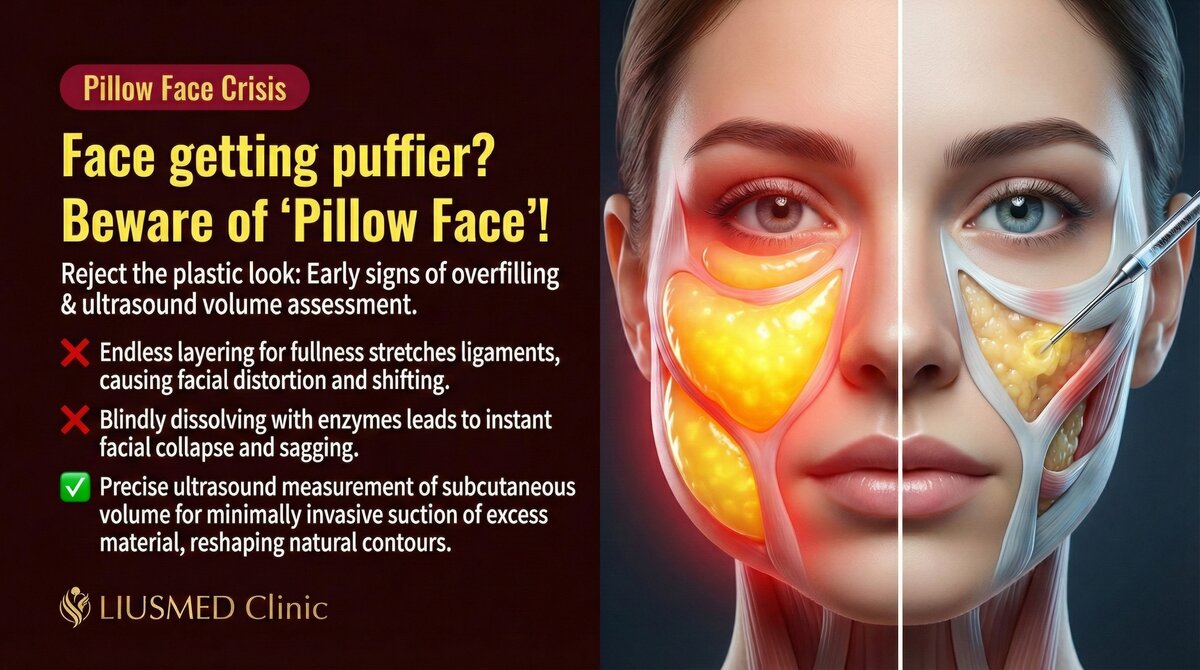
Nobody Sets Out to Get Pillow Face
Overfilling, commonly known as "pillow face," is one of the most common yet most difficult-to-reverse problems in modern aesthetic medicine. Yet virtually no patient develops pillow face from a single session—the process is almost always gradual, spanning multiple injections over months or years, each time "just adding a little."
The greatest trap is this: each individually reasonable top-up, when accumulated, can exceed the face's capacity to look natural. And by the time you look in the mirror and think "something seems off," you have typically passed the stage where correction is simplest.
This article is not meant to instill fear of fillers but to help you identify signals that may indicate a trajectory toward overfilling, so adjustments can be made before the problem becomes severe.
Why Overfilling Happens Gradually
Visual Adaptation Effect
The psychological phenomenon of "adaptation" plays a critical role in aesthetic injections. After each treatment, your eyes adjust to the new appearance within weeks, making it the new "normal." Once adaptation is complete, the sense of change fades, replaced by a feeling of "it seems like it is not enough again."
The cycle: inject → satisfaction → adaptation → feeling of insufficiency → inject again
Consent Bias in the Doctor-Patient Relationship
Many physicians are inclined to fulfill patient requests—when a patient asks for "just a little more," declining may affect the relationship or revenue. Particularly in competitive aesthetic markets, "one more syringe" is often easier to say than "I recommend you stop."
Lack of Cumulative Volume Tracking
Most patients do not remember how much filler they have received over the years. Injections at different clinics mean no cumulative records exist. This means nobody—including physicians—can accurately determine how much filler is currently in the patient's body.
Key Insight: The most dangerous moment in overfilling is not when you "feel it is too much"—by then, it is often too late. The true turning point is when you "feel the effect is fading and want more"—that is precisely when you need to stop and objectively assess.
Early Warning Signs of Overfilling
The following signs may indicate you are on the path toward overfilling. The earlier they are recognized, the easier it is to change course.
Appearance-Based Warning Signs
| Early Sign | Description | Stage |
|---|---|---|
| Face losing natural expression dynamics | Certain areas lag or remain motionless during smiling, frowning | Early |
| Face shape becoming "round" in front view | Simultaneous fullness of chin, cheeks, and temples changing face from V to O | Early |
| Looking "unlike yourself" in photos | Especially in candid, non-posed angles | Early-moderate |
| "Step" appearance in tear trough/nasolabial areas | Unnatural transition between filler and surrounding tissue | Moderate |
| Visible contour irregularity on surface | Bumps visible under side lighting | Moderate |
| Face feels "not like your own" when touched | Texture noticeably different from natural tissue | Moderate-late |
Behavioral Warning Signs
- Accelerating frequency: From once yearly to twice yearly to quarterly
- Changing motivation: From "wanting improvement" to "feeling it faded, not enough"
- Comparison mindset: Constantly comparing to idealized images or others
- Multi-area simultaneous injection: Adding new areas each visit
- Doctor shopping: When one physician suggests stopping, seeking another willing to continue
Key Insight: If a friend or family member who does not see you regularly tells you "you look a bit different" or "your expressions seem stiff," take that feedback seriously. People who see you daily may have "adapted" along with you, while those who have not seen you in a while can notice objective changes.
Which Areas Are Most Prone to Overfilling
| Area | Overfilling Characteristics | Why Excess Is Common |
|---|---|---|
| Cheeks/malar region | Puffy appearance, loss of skeletal definition | Patients pursuing "youthful fullness" |
| Lips | "Duck lip" appearance, disproportionate | Pursuing plumpness |
| Temples | Face becomes round, temple-cheek boundary blurred | Filling concavity but exceeding volume |
| Tear trough | Lower eyelid puffiness, color mismatch | "Just a bit more" each time |
| Chin | Excessively elongated, unnaturally sharp | Pursuing V-line |
| Nose | "Avatar nose"—widened and blurred definition | Repeated filling instead of surgery |
When to Stop Adding More
Objective Indicators
- Annual cumulative volume exceeding reasonable range—full-face volumes exceeding 4-6mL per year are on the high side
- Effects from the last injection are still visible—if previous results are still apparent, adding more creates accumulation
- Friends or family expressing concern—especially observations from people who do not see you frequently
- Photo comparisons showing obvious change—compared to photos from one year and three years ago
Signals That Need Professional Assessment
- Palpable abnormal lumps or ridges in certain areas
- Smile or expressions becoming unnatural
- Worsening trend of facial asymmetry
- More than one physician has recommended stopping
What to Do If You Are Already Overfilled
Step 1: Acknowledge the Problem
This is the most difficult but most important step. Due to visual adaptation, many overfilled patients do not believe they have a problem. Seeking objective professional evaluation is key.
Step 2: Comprehensive Ultrasound Assessment
Understand what currently exists in the body:
- Filler distribution and accumulation across areas
- Filler material types (HA can be dissolved; non-HA requires different approaches)
- Whether encapsulation, migration, or other complications exist
For more on diagnosing and treating overfilled face: Overfilled Face Diagnosis and Treatment Golden Standard. On specific correction methods: Pillow Face Correction.
Step 3: Develop a Staged Volume Reduction Plan
Managing overfilling is not about "removing everything at once"—removing large volumes too quickly can cause severe contour collapse and psychological distress. A staged, region-by-region gradual reduction approach is typically necessary.
For the complete evaluation process: Filler Repair Evaluation Process.
Key Insight: Reversing overfilling is like weight loss—it does not happen in a day, nor should it. Gradual adjustment allows both appearance and psychology to adapt, ultimately achieving a natural, harmonious result.
For Those Considering "Just a Little More"
Before deciding to add more filler, consider:
- Is it truly needed, or have you simply adapted?—Find photos from a year ago for comparison
- What is the long-term effect of this addition?—Each additional injection increases the difficulty of eventual reversal
- Has anyone told you "that is enough"?—If so, seriously consider that feedback
- Has your physician ever suggested waiting?—A good physician will say "no" at the appropriate time
Schedule a consultation for an objective professional assessment—sometimes the best treatment plan is "do nothing for now."
Conclusion
Overfilling is a slippery slope—each step seems minor, but once the cumulative direction goes wrong, the cost of turning back rises steadily. Prevention is always easier than treatment, and the key to prevention is: being honest with yourself, staying alert to the impulse of "wanting more," and finding a physician willing to tell you "that is enough" at the right moment.
Key Insight: In the world of aesthetic injections, the most difficult yet most valuable thing to say is not "a little more" but "enough." Learning to say "enough" at the right time is the best strategy for protecting your natural beauty.
Related Services

Specialties
Credentials
- Kaohsiung Medical University, School of Medicine
- Attending Physician, Dermatology, Kaohsiung Chang Gung Memorial Hospital
- Attending Physician, Aesthetic Center, Kaohsiung Chang Gung Memorial Hospital
- Visiting Physician, Dermatology, Xiamen Chang Gung Hospital
- Visiting Physician, Aesthetic Center, Xiamen Chang Gung Hospital
"For every surgery, I strive to achieve a good outcome through a small incision and refined technique. Minimally invasive surgery is not just a technique — it's a commitment of respect to every patient."
Recovery after any procedure needs peer support too

Want to learn more?
Schedule a consultation for professional evaluation and advice