How Long Before Revision Surgery? Key Timing for Scar Maturation
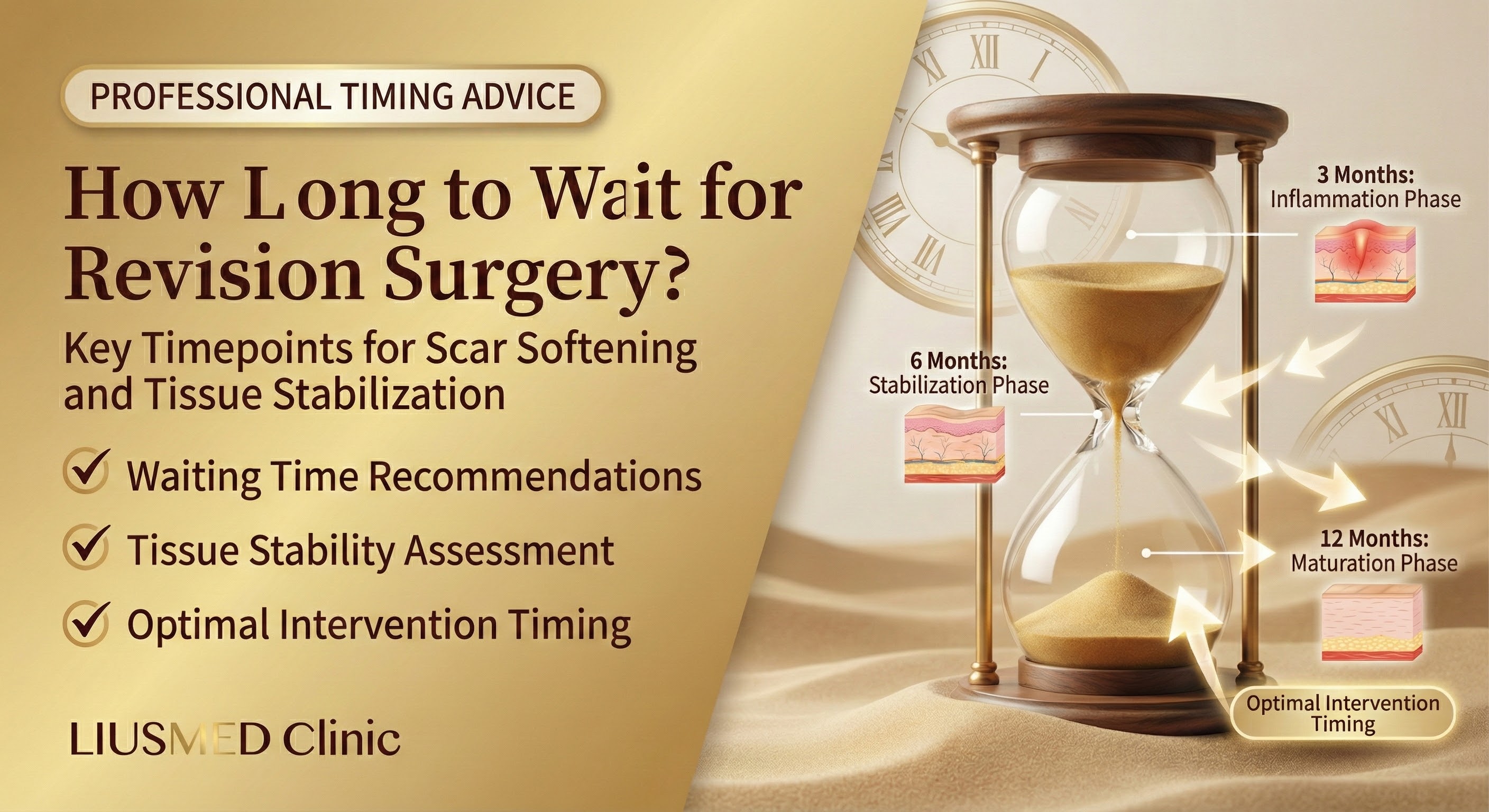
Timing Determines Success
For cosmetic revision surgery, when you do it is just as important as how you do it. Operating too early—when tissue is still inflamed and scars are still changing—not only produces poor results but may cause greater damage. Operating too late, some problems may become harder to address. This article explains the optimal surgical timing for different situations.
Why Wait?
Stages of Tissue Healing
| Stage | Timing | Characteristics |
|---|---|---|
| Inflammatory phase | 0-7 days | Redness, swelling, heat, pain, discharge |
| Proliferative phase | 1-4 weeks | Collagen production, scar formation |
| Remodeling phase | 1-12 months | Scar softening, tissue stabilization |
| Maturation phase | 6-24 months | Final scar state |
Risks of Operating Too Early
| Risk | Reason |
|---|---|
| More bleeding | Inflamed tissue has rich blood vessels |
| Higher infection risk | Tissue resistance is lower |
| More visible scarring | Operating on unstable tissue |
| Unpredictable results | Tissue is still changing |
| May need another revision | Results are unstable |
💡 Dr. Liu explains: "Many patients are eager to fix things, but operating at the wrong time can make the situation worse. Waiting is hard, but it's for the best outcome."
Waiting Times for Different Situations
General Cosmetic Surgery Failure
| Problem Type | Recommended Wait | Reason |
|---|---|---|
| Unsatisfied with shape | 6-12 months | Wait for swelling to fully resolve |
| Asymmetry | 6-12 months | Confirm if caused by swelling |
| Scar issues | 12-18 months | Wait for scar to fully mature |
| Too much/too little tissue | 6-12 months | Wait for tissue to stabilize |
Eye Surgery (Eyelids, Eye Bags)
| Problem | Recommended Wait | Notes |
|---|---|---|
| Double eyelid asymmetry | 3-6 months | Swelling resolves, then reassess |
| Eyelid too high/low | 6-12 months | Tissue tension changes |
| Eye bag recurrence | 6-12 months | Confirm it's actual recurrence |
| Scar hypertrophy | 6-18 months | Treat after scar matures |
Nose Surgery
| Problem | Recommended Wait | Notes |
|---|---|---|
| Unsatisfied with shape | 12-18 months | Nose swelling resolves slowly |
| Nasal tip deformity | 12-24 months | Cartilage needs time to stabilize |
| Implant issues | 6-12 months | May be earlier depending on situation |
| Scar contracture | 12-18 months | Wait for contracture to stabilize |
Breast Surgery
| Problem | Recommended Wait | Notes |
|---|---|---|
| Shape/position issues | 6-12 months | Wait for implant to settle |
| Capsular contracture | 6-12 months | Confirm contracture severity |
| Size dissatisfaction | 6+ months | Confirm if adjustment truly needed |
Facelift Surgery
| Problem | Recommended Wait | Notes |
|---|---|---|
| Unsatisfactory results | 3-6 months | Wait for full recovery |
| Asymmetry | 6-12 months | Tissue readjusts |
| Scar issues | 12-18 months | Treat after scar matures |
Emergencies That Don't Require Waiting
Problems Needing Prompt Treatment
| Situation | Urgency | Explanation |
|---|---|---|
| Infection | Immediately | Antibiotics, drainage if needed |
| Hematoma | Within 24-48 hours | May need drainage |
| Skin necrosis | As soon as possible | Prevent expansion |
| Implant exposure | As soon as possible | Prevent infection |
| Vascular crisis | Within hours | Rescue tissue |
| Breathing difficulty | Immediately | Nose/neck surgery |
⚠️ Emergencies require immediate medical attention—no waiting needed.
Judging Scar Maturation
Indicators of Scar Maturity
| Indicator | Immature | Mature |
|---|---|---|
| Color | Red/purple | Light pink/white |
| Firmness | Hard, raised | Soft, flat |
| Feel | Tight | Supple |
| Changes | Still changing | Stable |
| Blanching | Turns white when pressed | No obvious change |
Scar Maturation Timeline
| Time | Scar State |
|---|---|
| 0-3 months | Red, hard, raised |
| 3-6 months | Starting to fade and soften |
| 6-12 months | Continuing to improve |
| 12-18 months | Mostly mature |
| 18-24 months | Fully mature |
💡 Note: Individual variation is significant—some people's scars mature faster, others need more time.
What to Do While Waiting
Promote Tissue Stabilization
| Method | Explanation |
|---|---|
| Scar care | Silicone sheets, massage |
| Avoid irritation | Sun protection, avoid friction |
| Healthy lifestyle | Adequate sleep, balanced diet |
| Quit smoking | Improve blood circulation |
Psychological Adjustment
| Suggestion | Explanation |
|---|---|
| Set reasonable expectations | Understand revision limitations |
| Gather information | Research options and doctors |
| Psychological support | Talk with family and friends |
| Focus on life | Don't let the problem consume everything |
Consultation Assessment
| Action | Timing |
|---|---|
| Initial consultation | 1-3 months post-op (understand options) |
| Formal evaluation | 6+ months post-op |
| Schedule surgery | After confirming tissue stabilization |
Case Timeline Examples
Case 1: Asymmetric Eyelids
Case 2: Unsatisfied with Nose Tip After Rhinoplasty
Case 3: Hypertrophic Surgical Scar
Frequently Asked Questions
Q1: The doctor says results are normal, but I think something's wrong—who to believe?
A1: You can:
- Give yourself more time to observe (swelling may mislead judgment)
- Seek second opinions from other doctors
- Compare pre-op photos
If multiple doctors say it's normal, you may need to adjust your expectations.
Q2: Will scars become harder to treat if I wait?
A2: The opposite—treating scars after maturation produces better results. Treating immature scars often leads to regrowth. Usually 12-18 months is a good time to treat scars.
Q3: If it's the doctor's mistake, shouldn't it be fixed quickly?
A3: Even for medical errors, rushing revision still increases risks. You can:
- Document the problem and seek legal advice
- Meanwhile, safely wait for tissue stabilization
- Both can proceed in parallel
Q4: Is waiting a year really necessary? That's too long!
A4: I understand waiting is hard, but:
- Operating too early may require "another revision," making it even longer
- Surgery after tissue stabilization has better results and lower risks
- This time can be used for psychological adjustment and choosing a doctor
A year of waiting is for better results.
Q5: How do I know if I should wait or act?
A5: Wait if:
- Less than 6 months post-op
- Tissue still changing (swelling, scar changes)
- Problem may improve on its own
Act earlier if:
- Infection, hematoma, skin necrosis
- Functional issues (breathing, vision)
- Implant exposure
Revision Timing Summary by Area
| Surgery Area | Recommended Wait | Notes |
|---|---|---|
| Eyelids | 6-12 months | Eye swelling resolves faster |
| Nose | 12-18 months | Nose swelling resolves very slowly |
| Breast | 6-12 months | Depends on problem type |
| Facelift | 6-12 months | Scar issues need longer |
| General scars | 12-18 months | Wait for full maturation |
| Filler issues | Varies | Some can be treated immediately |
Conclusion
| Key Point | Explanation |
|---|---|
| Waiting is necessary | Better results after tissue stabilizes |
| Generally 6-12 months | Depends on area and problem type |
| Scars need longer | 12-18 months to mature |
| Emergencies are exceptions | Infection, hematoma, necrosis need immediate treatment |
| Use waiting time well | Psychological adjustment, gather information |
Related Reading
- Revision Surgery Psychology: Mental Prep Guide
- Complete Cosmetic Repair Guide
- Scar Treatment Guide: Classification & Strategies
About the Author
Dr. Ta-Ju Liu
- Current Position: Director, Liushi Clinic
- Specialties: Minimal incision surgery (lipoma, cyst), hyperhidrosis surgery, thread lifting
- Experience:
- 15+ years of clinical minimal incision surgery experience
- Over 10,000 successful minimal incision cases
- Board-certified dermatologist
- Philosophy: "Choosing the right timing for revision surgery is accumulated experience. I recommend the most suitable time based on each patient's specific situation, rather than rushing into surgery."
Related Services
Specialties
Credentials
- Kaohsiung Medical University, School of Medicine
- Attending Physician, Dermatology, Kaohsiung Chang Gung Memorial Hospital
- Attending Physician, Aesthetic Center, Kaohsiung Chang Gung Memorial Hospital
- Visiting Physician, Dermatology, Xiamen Chang Gung Hospital
- Visiting Physician, Aesthetic Center, Xiamen Chang Gung Hospital
"For every surgery, I strive to achieve a good outcome through a small incision and refined technique. Minimally invasive surgery is not just a technique — it's a commitment of respect to every patient."
Recovery after any procedure needs peer support too


Want to learn more?
Schedule a consultation for professional evaluation and advice