Plastic Surgery Repair Expert: Liposuction Contour Rescue, Implant Adjustment & Autologous Fat Refinement
Plastic Surgery Repair: Professional Solutions for Post-Op Concerns
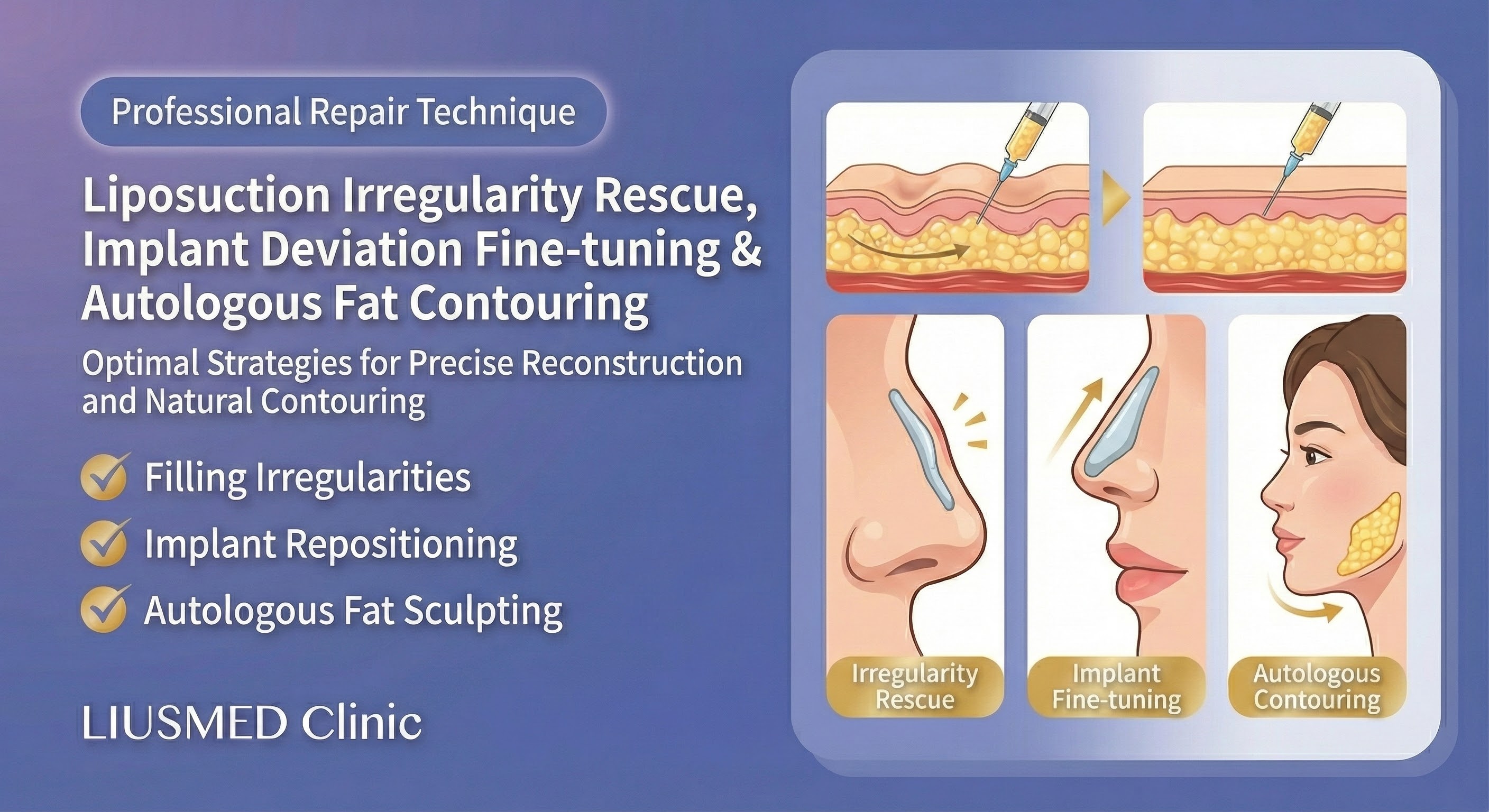
Unsatisfactory results after plastic surgery often cause anxiety and frustration. Liposuction contour irregularities, implant displacement, and uneven autologous fat transfer are the most common post-operative problems. This article introduces Dr. Liu's three major professional repair techniques to help you understand how to resolve these concerns.
1. Liposuction Contour Rescue
What Are Liposuction Contour Irregularities?
Uneven skin surfaces after liposuction is one of the most common post-operative problems.
| Presentation | Description |
|---|---|
| Depressions | Over-suctioning causing insufficient fat and visible hollows |
| Bulges | Uneven suctioning leaving residual fat lumps |
| Rippling | Wavy, uneven skin surface appearance |
| Worsened Cellulite | More visible skin dimpling after liposuction |
| Asymmetry | Uneven suctioning causing left-right imbalance |
Causes of Liposuction Irregularities
| Cause | Description |
|---|---|
| Uneven suctioning | Technical issues causing irregular fat removal |
| Over-suctioning | Excessive removal in one area causing depressions |
| Poor skin elasticity | Skin unable to contract and conform post-surgery |
| Adhesion issues | Post-op tissue adhesions causing dimpling |
| Improper aftercare | Not wearing compression garments or wearing incorrectly |
Liposuction Contour Rescue Methods
| Method | Suitable For | Effect |
|---|---|---|
| Autologous fat filling | Filling depressed areas | Long-term improvement (surviving fraction) |
| Micro-fat sculpting | Addressing residual fat bulges | Smoothing |
| Adhesion release | Depressions caused by adhesions | Release adhesions |
| RF/Ultrasound tightening | Mild irregularities + skin laxity | Tightening improvement |
💡 Dr. Liu explains: "Liposuction contour repair requires precise assessment of depression depth and extent. Mild cases can be addressed with autologous fat filling, while severe cases may need staged treatment. Most importantly, we identify the root cause and address it specifically."
Liposuction Contour Rescue Case Types
| Area | Common Problems | Repair Method |
|---|---|---|
| Abdomen | Uneven contours, saddle-shaped depressions | Fat filling + micro-sculpting |
| Thighs | Inner/outer asymmetry, depressions | Precise filling + sculpting |
| Arms | Skin laxity, contour lines | Skin tightening + minimal filling |
| Buttocks | Depressions, poor shape | Fat filling for reshaping |
| Flanks | Asymmetry, residual fat | Micro-adjustment |
2. Implant Displacement Adjustment
Types of Implant Displacement
Position shifts after implant placement affecting appearance and symmetry.
| Type | Description |
|---|---|
| Breast implant displacement | Implant position shift, uneven heights |
| Nasal implant deviation | Nasal bridge implant deviating from midline |
| Chin implant displacement | Chin implant left-right asymmetry |
| Implant rotation | Teardrop implant rotation causing deformity |
| Capsular contracture | Tissue hardening and deforming around implant |
Causes of Implant Displacement
| Cause | Description |
|---|---|
| Improper pocket creation | Implant space size or position not precise |
| Post-op trauma | Impacts, improper massage causing displacement |
| Muscle pull | Muscle contraction pulling implant off position |
| Capsular contracture | Scar tissue contraction squeezing implant |
| Improper implant selection | Wrong size or type for patient |
Implant Adjustment Methods
| Method | Suitable For | Description |
|---|---|---|
| Position adjustment | Simple implant displacement | Repositioning the implant |
| Pocket revision | Pocket too large or mispositioned | Suturing to reduce or rebuild pocket |
| Capsulectomy | Contracture causing deformity | Removing hardened capsule |
| Implant exchange | Implant-related issues | Replacing with appropriate implant |
| Autologous fat augmentation | Need for additional refinement | Fat filling to assist shaping |
💡 Dr. Liu explains: "Implant adjustment requires precise assessment of displacement degree and cause. Mild cases can be improved with position adjustment, while severe cases may need pocket reconstruction or implant replacement. Pre-operative 3D simulation and precise planning are very important."
Common Implant Problem Solutions
| Problem | Treatment Approach |
|---|---|
| Breast implant height asymmetry | Adjust pocket position, endoscopic-assisted adjustment |
| Nasal implant deviation | Re-fixation, implant replacement if necessary |
| Visible implant edges | Autologous fat coverage or repositioning |
| Capsular contracture hardening | Capsulectomy + implant replacement |
| Implant rupture/leakage | Removal and replacement with new implant |
3. Autologous Fat Refinement
What Is Autologous Fat Refinement?
Using autologous fat for precise filling and sculpting to improve post-surgical dissatisfaction or natural aging concerns.
| Application | Description |
|---|---|
| Depression filling | Filling depressions from liposuction or surgery |
| Contour refinement | Improving unevenness, asymmetry |
| Body sculpting | Natural buttock or breast enhancement |
| Facial filling | Temples, cheeks, nasolabial folds |
| Scar improvement | Filling depressed scars |
Advantages of Autologous Fat Refinement
| Advantage | Description |
|---|---|
| Autologous material | No rejection reactions, high safety |
| Natural feel | Soft and natural, unlike implants |
| Long-term results | Surviving fat cells remain permanently |
| Two-in-one benefit | Harvest site becomes slimmer, fill site becomes fuller |
| Repeatable | Can be supplemented again if needed |
Autologous Fat Refinement Process
| Step | Description |
|---|---|
| 1. Assessment & planning | Evaluate depression extent, fat source |
| 2. Fat harvesting | Extract fat from abdomen, thighs, etc. |
| 3. Purification | Centrifuge to purify, remove impurities and oil |
| 4. Precise injection | Multi-layer injection to target areas |
| 5. Post-op follow-up | Assess survival rate, supplement if necessary |
Keys to Fat Cell Survival
| Factor | Description |
|---|---|
| Harvesting technique | Low-pressure extraction minimizes cell damage |
| Purification method | Proper purification maintains fat viability |
| Injection technique | Multi-layer injection increases blood supply |
| Volume control | Not over-injecting per site ensures survival |
| Post-op care | Avoid pressure, maintain blood circulation |
💡 Dr. Liu explains: "The key to autologous fat refinement is fat survival rate. I use special low-pressure extraction and purification techniques combined with multi-layer injection to achieve higher fat survival rates. Usually the first session improves 60-70%, with touch-ups if needed to achieve ideal results."
Pre-Repair Assessment and Preparation
When Is the Right Time for Repair?
| Situation | Recommended Timing |
|---|---|
| Liposuction irregularities | 6+ months post-surgery |
| Implant displacement | 3-6 months observation |
| Uneven autologous fat | 6+ months post-surgery |
| Acute issues (infection, etc.) | Immediate treatment |
Pre-Surgery Preparation
| Preparation | Description |
|---|---|
| Complete assessment | Detailed examination of problem areas |
| Medical history disclosure | Explain previous surgery details and recovery process |
| Expectation communication | Confirm achievable improvement level |
| Risk understanding | Understand additional risks of revision surgery |
| Psychological preparation | Accept improvement, not perfection |
Frequently Asked Questions
Q1: Can liposuction irregularities be completely smoothed out?
A1: Most cases can show significant improvement, but achieving "perfect smoothness" is difficult. Autologous fat filling can improve 70-80% of depression issues. Severe irregularities may require multiple treatments.
Q2: Does implant displacement always require reoperation?
A2: Mild displacement can be observed; only severe cases affecting appearance or function need surgery. Sometimes conservative approaches like massage or compression garments can help.
Q3: Will transferred autologous fat be absorbed?
A3: Yes, typical survival rate is about 50-70%. Observe 3-6 months after first filling, then decide if touch-up is needed.
Q4: Is revision surgery riskier than the first surgery?
A4: Yes, secondary surgery involves existing scar tissue and adhesions, altered anatomy, and relatively higher risk. This is why finding an experienced surgeon is even more important.
Q5: How is repair cost calculated?
A5: Depends on severity and repair method. An in-person evaluation is needed before the appropriate repair approach and its cost can be explained for your case. For issues caused by the original surgeon, negotiate with the original clinic first.
Q6: How long should I wait before revision surgery?
A6: Generally recommend waiting 6+ months for tissues to fully stabilize. However, acute issues like infection or implant rupture need immediate attention.
Choosing the Right Repair Surgeon
Professional Capability Assessment
| Assessment Item | Description |
|---|---|
| Repair experience | Has handled similar cases |
| Pre-op communication | Willing to explain risks and limitations in detail |
| No over-promising | Doesn't guarantee perfect results |
| Case portfolio | Has before/after comparison photos of repairs |
| Patient reviews | Satisfaction from repair case patients |
Questions to Ask During Consultation
- How many similar repair cases have you handled?
- What level of improvement can I expect for my issue?
- What are the risks of this repair surgery?
- How many sessions are needed to achieve results?
- How long is the recovery period?
Conclusion
| Repair Type | Main Methods | Improvement Level |
|---|---|---|
| Liposuction irregularities | Autologous fat filling, micro-sculpting | 70-80% |
| Implant displacement | Position adjustment, pocket revision | 80-90% |
| Autologous fat refinement | Multi-layer filling, precision sculpting | 60-70% (touch-ups possible) |
💡 Dr. Liu's message: "Plastic surgery repair requires more refined technique and greater patience. I carefully assess each patient's issues and develop individualized repair plans to help everyone regain confidence in themselves."
Related Reading
- How Long to Wait for Revision Surgery? Key Timing for Scar Softening and Tissue Stabilization
- Complete Guide to Plastic Surgery Repair
- How to Prevent Post-Surgical Scar Hyperplasia?
About the Author
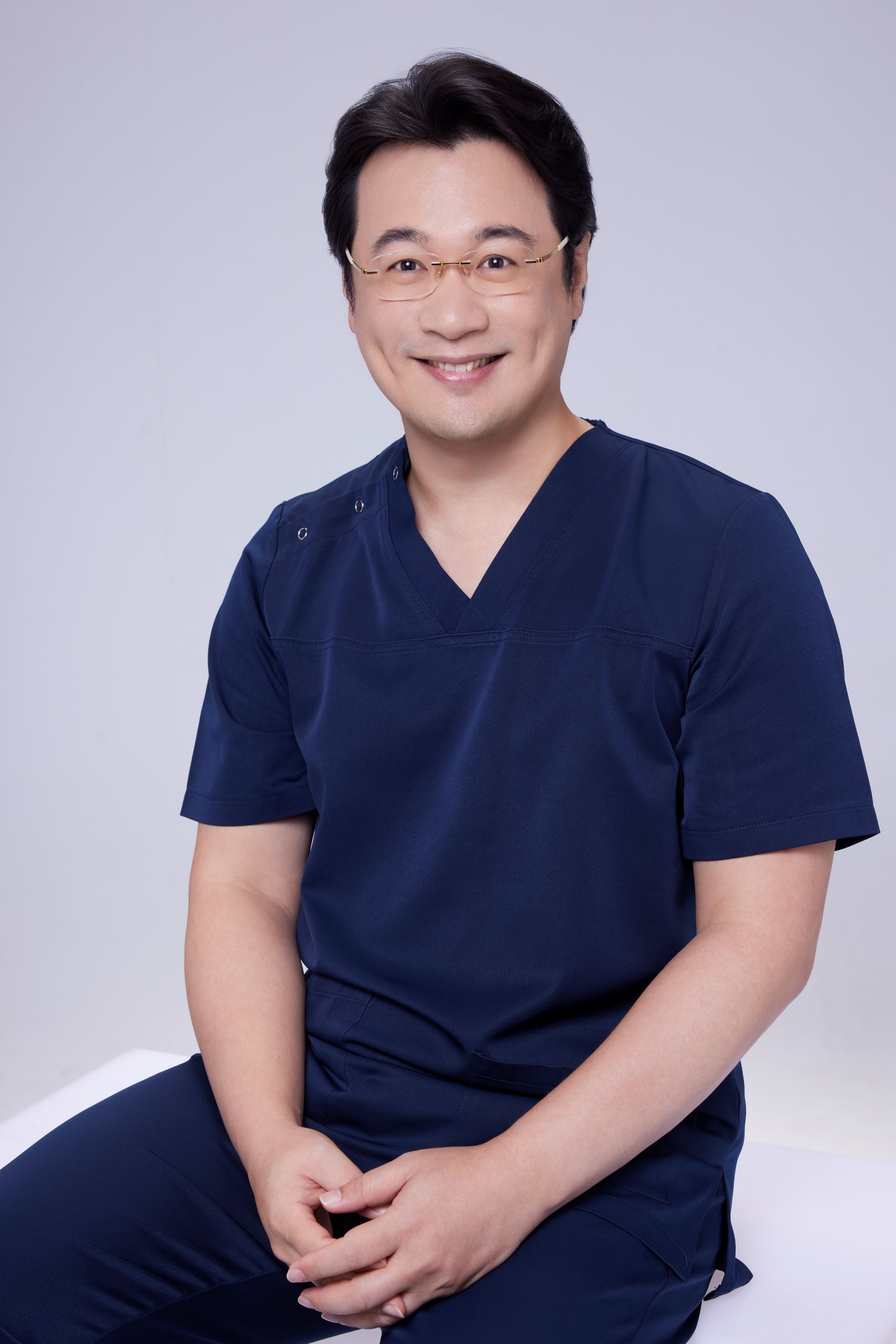
Dr. Ta-Ju Liu
- Current Position: Director, Liushi Clinic
- Specialties: Minimal incision surgery (lipoma, cyst), hyperhidrosis surgery, thread lifting, plastic surgery repair
- Experience:
- 15+ years of clinical minimal incision surgery experience
- Over 10,000 successful minimal incision cases
- Board-certified dermatologist
- Philosophy: "The goal of plastic surgery repair is to help patients go from dissatisfied to acceptable, and ultimately rebuild confidence. Every case needs a customized solution."
Related Services
Specialties
Credentials
- Kaohsiung Medical University, School of Medicine
- Attending Physician, Dermatology, Kaohsiung Chang Gung Memorial Hospital
- Attending Physician, Aesthetic Center, Kaohsiung Chang Gung Memorial Hospital
- Visiting Physician, Dermatology, Xiamen Chang Gung Hospital
- Visiting Physician, Aesthetic Center, Xiamen Chang Gung Hospital
"For every surgery, I strive to achieve a good outcome through a small incision and refined technique. Minimally invasive surgery is not just a technique — it's a commitment of respect to every patient."
Recovery after any procedure needs peer support too


Want to learn more?
Schedule a consultation for professional evaluation and advice