36-Hour HA Filler Vascular Embolism Rescue (Full Case at FILLER REVISION)
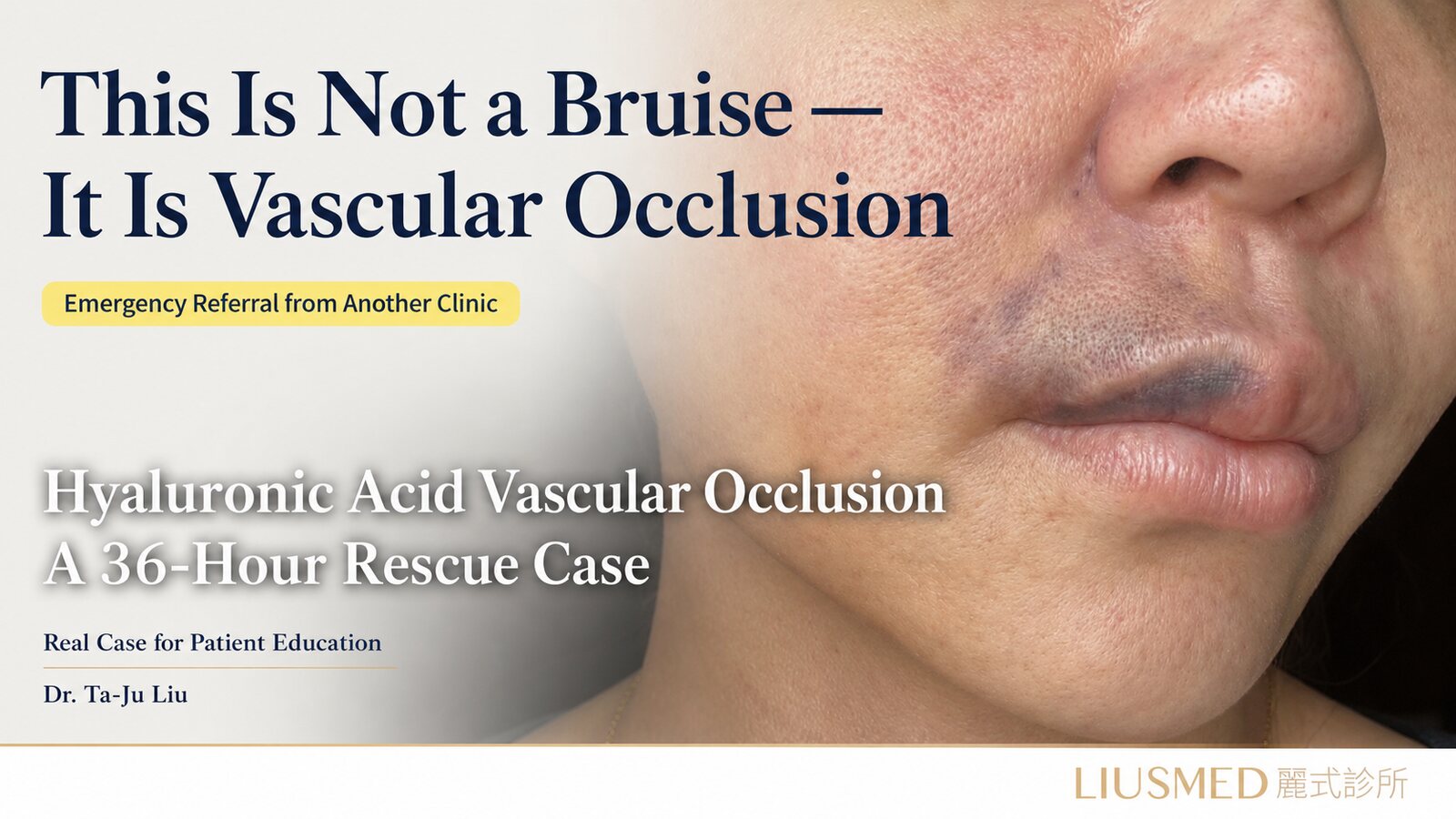
36-Hour Filler Vascular Embolism Rescue — Full Case at FILLER REVISION
When emergency vascular rescue succeeds, surgical revision is avoided
At MINIMAL CUT SURGERY we routinely treat patients who arrive months — sometimes years — after a filler vascular event. By the time they reach us, the acute rescue window has long closed; what remains is scarring, tissue atrophy, residual filler, and the question of how to surgically restore what's been lost.
But a successful early rescue can change that trajectory entirely.
Dr. Liu's 36-hour vascular embolism rescue case
Vascular embolism after HA filler injection developed signs of livedo reticularis, disproportionate pain, and numbness. After two days of failed high-dose extravascular hyaluronidase (Hyaluronidase) and hyperbaric oxygen therapy (HBOT) at another clinic, the patient was finally referred to Dr. Ta-Ju Liu at the 36-hour mark. Ultrasound-guided intra-arterial hyaluronidase (IAHA) was injected directly into the obstructed facial artery branch, precisely dissolving the intraluminal HA filler plug. Full skin recovery at two weeks — a rarely documented late-window rescue success.
This kind of outcome is what every filler vascular emergency should aim for. It demonstrates three things:
- The rescue window is wider than traditional teaching suggests — the ischemic penumbra (the salvageable tissue around a vascular blockage where blood flow is reduced but not zero) can survive longer than the textbook 6–24 hour figure in some patients
- Technique matters more than dosage — flooding tissue with extravascular hyaluronidase doesn't dissolve filler inside an artery. You need to deliver enzyme into the arterial lumen directly under ultrasound guidance — what we call IAHA
- Successful rescue avoids surgical revision later — full recovery means no atrophic scarring, no chronic granuloma, no need for the kind of minimal-cut extraction surgery we routinely perform on cases that didn't get this kind of rescue in time
When surgical revision IS needed
Even with the best emergency protocols, some patients still arrive at MINIMAL CUT SURGERY because:
- They didn't receive timely IAHA rescue and now have residual filler causing chronic problems
- Tissue damage from delayed rescue (or repeated rounds of extravascular dissolving) requires reconstruction
- Years-old filler has become encapsulated, fibrotic, or otherwise resistant to dissolving
For these cases, surgical extraction through 1–2 mm pinhole incisions — Dr. Liu's minimal-cut technique — offers a definitive solution where dissolving enzymes cannot reach. But our preference is always that patients never need us in the first place.
Read the full 36-hour rescue case at FILLER REVISION
The complete case record — including the 36-hour timeline, ischemic penumbra theory deep-dive, anatomical detail of facial artery branch mapping, 9 patient-focused FAQ, and 5 multilingual patient education posters — lives at our sister clinic site:
📖 Read the Full 36-Hour Vascular Embolism IAHA Rescue Case Record →
If you are currently experiencing post-filler skin changes, do not wait — see the case study's emergency self-check section, or contact FILLER REVISION immediately for vascular rescue evaluation.
This page is a brief overview of the main version on FILLER REVISION. Detailed case analysis, ultrasound imagery, and patient recovery timeline are available at the main version.

Specialties
Credentials
- Kaohsiung Medical University, School of Medicine
- Attending Physician, Dermatology, Kaohsiung Chang Gung Memorial Hospital
- Attending Physician, Aesthetic Center, Kaohsiung Chang Gung Memorial Hospital
- Visiting Physician, Dermatology, Xiamen Chang Gung Hospital
- Visiting Physician, Aesthetic Center, Xiamen Chang Gung Hospital
"For every surgery, I strive to achieve a good outcome through a small incision and refined technique. Minimally invasive surgery is not just a technique — it's a commitment of respect to every patient."
Recovery after any procedure needs peer support too

Want to learn more?
Schedule a consultation for professional evaluation and advice