Safety Limits of Removing Cheek Filler: The Parotid Gland & Facial Nerve
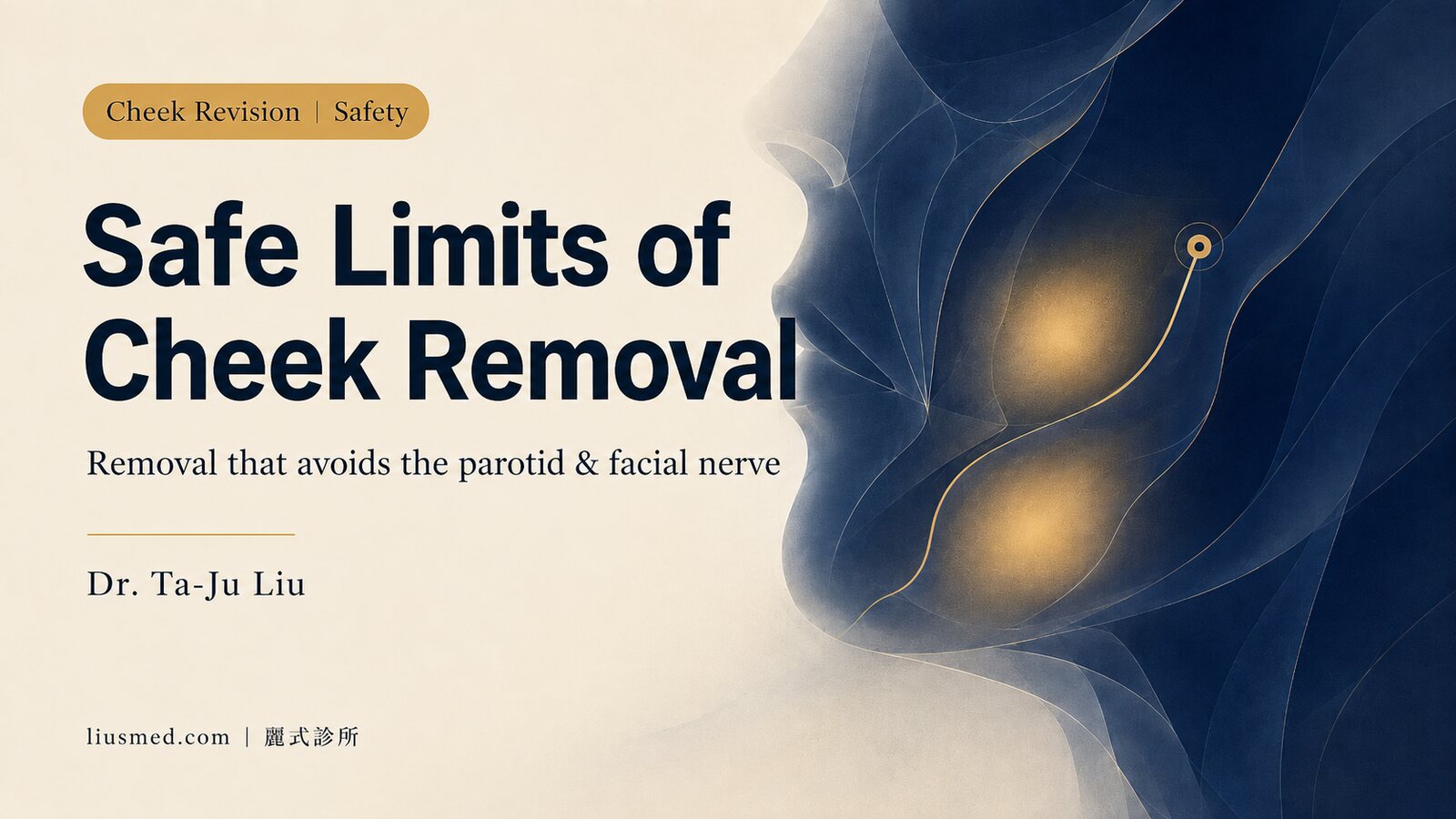
When it comes to removing filler from the apple cheek and the side of the face, the first thing people ask me is, “will you get it all out?” But what I want to raise first is something else: in this area, more important than “getting it all out” is “not harming the things next to it that shouldn’t be touched on the way out.”
The apple cheek, the zygomatic arch, the side of the face — this is one of the areas where removing anything from the face needs the most care. Let me lay out what’s here, so you understand why I’m so careful.
What important structures lie in the zygomatic and lateral cheek
Out from the apple cheek and down toward the front of the ear, a few untouchable things sit beneath:
- The parotid gland (the large salivary gland in front of and below the ear): right in the lateral cheek, in front of the ear. Injure it and you can get saliva leakage, local swelling, even a pocket of collected saliva — troublesome to deal with.
- Branches of the facial nerve: the nerve that drives your facial expression emerges from within the parotid and fans out across the cheek. Injure it and at best a region of expression weakens or goes asymmetric; at worst the mouth pulls crooked and the smile is uneven — recovery of this kind of nerve is hard to predict.
- The vessels feeding the face: vessels are plentiful here too. Tear one during removal and at best it’s a large bruise, at worst a haematoma.
- The zygomatic ligament: that hard, taut ligament pulling the skin down (the very root of the Indian line). On removal you have to recognise where it is and follow the planes — not bull through it.
Key point: Removing in this area, the hard part isn’t “digging the filler out” — it’s working in the gaps between the parotid gland, the facial nerve, and the vessels, moving only what should move and not touching what shouldn’t.
Why blind suction and laser melting are especially dangerous here
Common ways this area’s filler gets treated: a suction cannula forced in, fat-dissolving shots, or a laser probe slid in to melt things away.
What they share is that you can’t see inside. In a place dense with parotid, nerve, and vessels, blind suction, blind injection, blind burning is operating beside vital structures with your eyes closed. Laser melting especially calls for care — it relies on heat to break things down, heat spreads to the surroundings, you can’t see how far it travels or how close it runs to a nerve, and nerves are particularly heat-sensitive. Once injured, the expression problem may not come back.
I’m not saying nobody else does it well; I’m saying this place should never be done “by feel.” Only when you can see can you talk about avoiding.
How I remove within safe limits
My principle is one line: see clearly first, then move.
Before removal, I survey the whole area on ultrasound: which layer the filler is in, how big the mass is, its distance from the parotid, roughly where the nerves and vessels run. I build a map in my head first — where the no-go zones are, where to stop.
When I operate, I go in through a very small port and, under ultrasound guidance, remove while watching the image, following the correct planes and staying clear of the deep parotid and nerve zone. Near a dangerous boundary I’d rather be conservative — stop when I should stop. Eighty to ninety percent is a realistic and safe goal. Forcing every last bit out in a place like this, pushing toward the nerve or gland for that little extra, isn’t worth it. This is exactly why I keep stressing that the goal is to remove most of it safely, not to promise not a trace left. This is usually reached over two or three sessions; the first typically removes about 30–50%.
The procedure is under local anaesthesia plus gentle pain-relief anaesthesia, not general anaesthesia. That matters especially here: you’re awake, and I can ask you to move an expression at any point to confirm the nerve is working and that I’m operating in a safe plane. Asleep under general anaesthesia, you lose that real-time check.
Key point: Removing filler at the zygomatic arch and lateral face, “being willing to do it” isn’t the skill. Seeing clearly and knowing when to stop is the key to safety.
Safety on the removal side differs from the injection side
A quick clarification of a common mix-up. Online talk of “facial danger zones” and “injecting into a vessel” mostly refers to the injection side — risks like injecting filler into a vessel and causing occlusion or even blindness; that’s from the putting-in angle. The danger-zone anatomy and why the Indian line / zygomatic ligament can’t be levelled with filler have a full page on our filler-revision specialty site.
This article is about the removal side: the material is already in there, and how to avoid the parotid and nerve while taking it out. The priorities differ between the two directions, but the bottom line is the same — this area must be done with the ability to see.
Thinning subcutaneous fat for facial slimming follows the same safety thinking, which I cover in “Skin on bone” done right.
To remove filler from this area, let someone see clearly first
If you have filler in the apple cheek or lateral face you want removed — whether it won’t dissolve or has already migrated — the first step isn’t rushing to book the procedure, it’s letting someone look on ultrasound: where it is, how close to the parotid and nerve, whether it’s safe to remove. For non-dissolvable filler see Apple-cheek filler that won’t dissolve; for migration and ridges see Migrated, ridge-like apple-cheek filler — removal.
Apple-cheek and mid-face revision is gathered in Apple-cheek filler revision & thinning. To find out whether the filler in this area is safe to remove and how, you’re welcome to book a consultation so I can look under ultrasound first.
Medical note: This is educational information, not individual medical advice. The results of filler removal vary from person to person; physical removal cannot guarantee one-hundred-percent clearance — no outcome is guaranteed. The apple cheek, zygomatic arch, and lateral face lie near the parotid gland, facial nerve, and important vessels, and removal may carry bruising, swelling, salivary-gland-related issues, temporary or lasting expression asymmetry, and nerve- or vessel-related risks; these are usually temporary but zero risk cannot be promised. Whether removal is safe in your case, the approach, and the pain-relief plan are determined by in-person and ultrasound assessment.
Specialties
Credentials
- Kaohsiung Medical University, School of Medicine
- Attending Physician, Dermatology, Kaohsiung Chang Gung Memorial Hospital
- Attending Physician, Aesthetic Center, Kaohsiung Chang Gung Memorial Hospital
- Visiting Physician, Dermatology, Xiamen Chang Gung Hospital
- Visiting Physician, Aesthetic Center, Xiamen Chang Gung Hospital
"For every surgery, I strive to achieve a good outcome through a small incision and refined technique. Minimally invasive surgery is not just a technique — it's a commitment of respect to every patient."
Recovery after any procedure needs peer support too


Want to learn more?
Schedule a consultation for professional evaluation and advice