Still Smell After miraDry or Laser? The Salvage Clearing After Energy-Based Treatment
One patient had had miraDry, drawn originally by "no wound, no surgery, quick recovery." At first he felt it had eased a little, but after a while the smell slowly came back, which left him frustrated: "Weren't they supposed to be able to treat bromhidrosis? How is the smell back? Did I do it for nothing?"
Let me say one thing first: this doesn't mean you were cheated, and it doesn't mean energy treatment is useless. It simply takes a different route from surgery. So today let's talk about energy-based treatment (like miraDry and laser) for bromhidrosis — why some people still smell afterward, and whether surgery can take over as salvage and what to consider.
Energy treatment is "heat damage," not "removal"
Start with the most crucial difference, one that often gets overlooked.
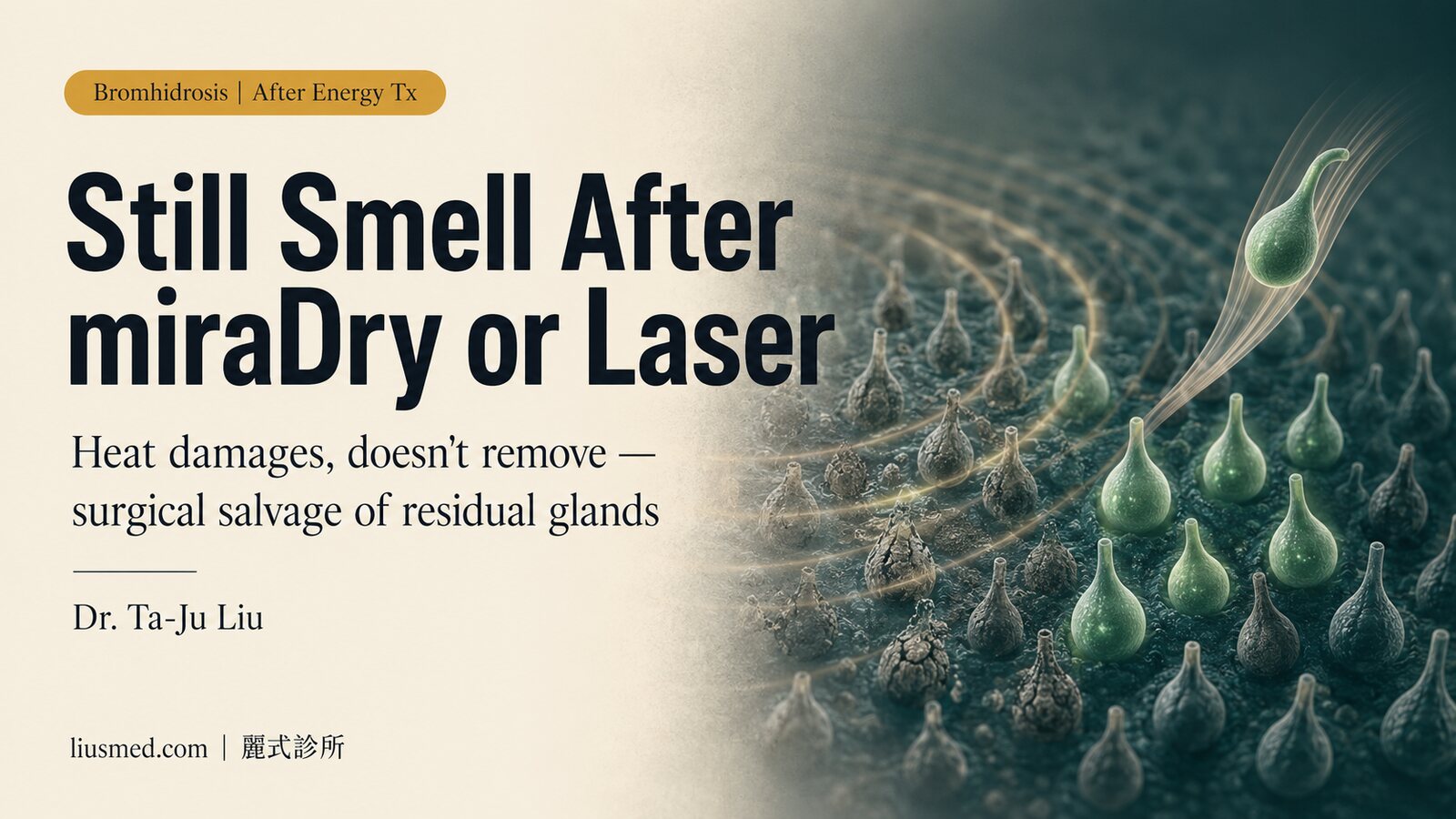
Devices like miraDry (microwave) or laser rely on heat generated by energy to damage the glands in the underarm. Their appeal is real: no surgery, no wound, quick recovery — attractive for anyone wanting to avoid an operation. But note this — they damage a portion of the glands, rather than, as surgery does, physically clearing and removing the glands under direct vision.
Getting heat to land evenly and in sufficient dose across apocrine glands that are spread over a fair area and sit at varying depths isn't easy to begin with. So afterward, a portion of the glands are often still there and still working. Those surviving glands keep secreting — which is why some people feel it "only eased a little," or find it worked at first and then the smell slowly returned. It's the same logic as the "residue" from the last piece: the glands are still there, so the smell is still there.
This doesn't mean energy treatment is useless — it just takes a different route from surgery
Let me be fair about this. The advantages of energy treatment are genuine — no surgery, no wound, quick recovery — an acceptable choice for many. Its tradeoff is this: because it's heat damage rather than physical removal, how thoroughly it clears has an inherent ceiling.
So "energy treatment or surgery" is really a decision that depends on individual needs — there's no absolute better or worse. How the two compare, and who each suits, is covered clearly in a dedicated piece on our sister site: Bromhidrosis surgery vs miraDry — how to choose. How different methods compare on clearing and recovery I've also laid out on the axillary bromhidrosis page. What I want to carry on to here is a different question: you've already had energy treatment but the smell is still there — can it be salvaged?
Still smell after energy treatment — can it be salvaged?
Yes. If it's confirmed that there are still glands left producing smell, surgery can take over and clear those surviving, still-working apocrine glands under direct vision. That's the biggest difference between surgery and energy treatment — surgery deals with genuinely removing the glands that are left.
Again, I won't say "guaranteed cure." For everyone, how many glands remain after energy treatment, where they're distributed, and whether the underarm tissue was affected by the heat all differ, so I always speak of results as "greatly improved," varying from person to person. Nor will I say energy treatment is bad; it suits certain people — it just didn't take the smell as far as you needed, so the question is whether surgery can fill that gap.
What to consider with surgery after energy treatment
Compared with the severe fibrosis liposuction can cause, the underarm after energy treatment usually has less drastic tissue change. But it has still been through heat, so there may be some adhesions or tissue change, and it's best to look clearly first.
The principle is the same as the earlier pieces: first look clearly at how many glands are still left and where they're concentrated, then clear the areas that still have glands — clearing the area wide enough and confirming nothing's missed before closing the wound. At the same time, judge the balance between "cleared thoroughly enough" and "keeping enough healthy skin." How I actually judge and clear is something I decide region by region on the operating table.
If you've had miraDry or laser and still smell
Don't assume your constitution is especially difficult or that you wasted the effort. Still smelling after energy treatment is often because it's heat damage by nature and leaves residue — not a problem with you.
To find out how much is still left and whether surgery is a suitable salvage, come in for an in-person assessment and look clearly before deciding. And if you're still weighing "energy treatment or surgery," read the sister-site comparison piece above first to understand the difference between the two routes before going further.
This article is educational. Individual situations require in-person consultation; actual treatment and results vary from person to person.

Specialties
Credentials
- Kaohsiung Medical University, School of Medicine
- Attending Physician, Dermatology, Kaohsiung Chang Gung Memorial Hospital
- Attending Physician, Aesthetic Center, Kaohsiung Chang Gung Memorial Hospital
- Visiting Physician, Dermatology, Xiamen Chang Gung Hospital
- Visiting Physician, Aesthetic Center, Xiamen Chang Gung Hospital
"For every surgery, I strive to achieve a good outcome through a small incision and refined technique. Minimally invasive surgery is not just a technique — it's a commitment of respect to every patient."
Want to learn more?
Schedule a consultation for professional evaluation and advice