Tear Trough Won't Smooth Out, Cheek Getting Puffier — Surgery or More Filler?
A hollow under one eye, a bag bulging under the other — and the whole face reads tired and flat. You haven't slept that badly, yet people keep asking if you're worn out. In photos the shadow under the eyes shows up and suddenly you look years older.
Almost everyone's first thought is the same: just put a little filler in the tear trough.
Honestly, the under-eye is not a place you fix by topping it up. Plenty of people fill it with hyaluronic acid and end up with a caterpillar ridge, or the whole bolus slides under the eye bag and bulges when they smile. Others use a collagen stimulator and feel a hard lump a few months later that looks less and less natural. And then they're stuck in the loop: fill it and it bulges, dissolve it, can't dissolve it, fill more to cover it — stiffer and puffier every round.
A tear trough isn't a groove — it's a ligament
Let me clear up something a lot of people get wrong. The tear trough looks like a sunken line, so people assume it's "missing volume" and that filling it in fixes it.
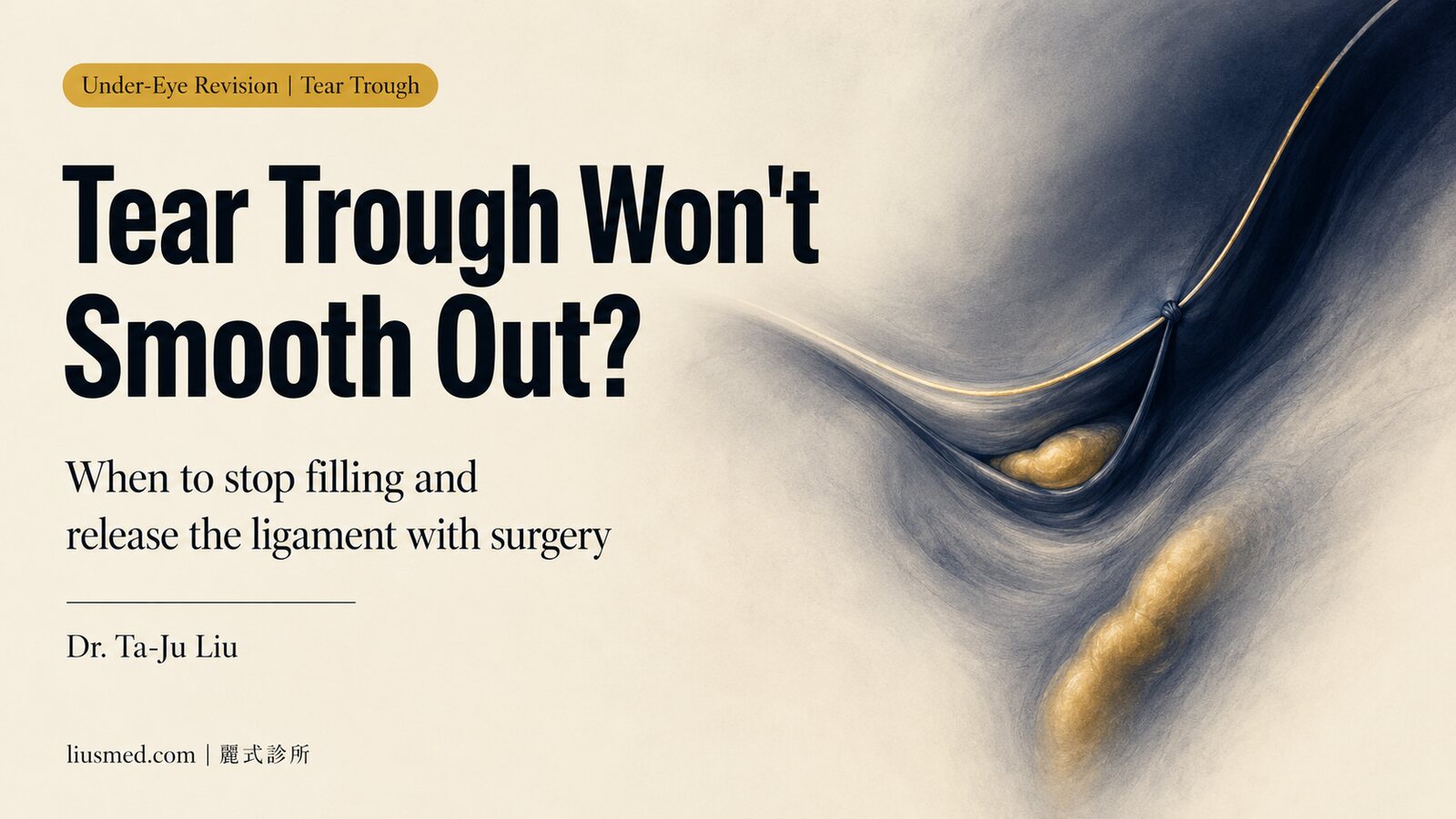
It isn't. Underneath the tear trough there's a ligament tethering the skin toward the bone, and the dip you see is what that tether pulls down. So the tear trough is really about being held down — not about a shortage of material.
Picture that ligament as a rope cinched tight. While the rope is still tied, pushing filler in is like stuffing something into a shirt that's already pulled taut — there's no room, so what you put in gets squeezed sideways. Up, and it bulges into the eye-bag area; down, and it drops into the cheek. The trough stays hollow, and now there are two awkward caterpillar ridges on the face instead.
Key point: The tear trough is a hollow pulled down by a ligament. Without releasing that ligament first, plain filler mostly won't stay put — it gets pushed off to the side.
Why filling again and again leaves the trough hollow but the area beside it puffier
The most common story I see in clinic is exactly this: the tear trough has been filled again and again, the hollow is still hollow, but the area beside it keeps getting puffier, harder, less like the person's own face.
The reason is what I just described — the material doesn't stay. It isn't sitting where you wanted it; it slowly slides down and piles up around the cheek. Every time you fill the trough, you're basically feeding that pile a little bigger. The trough stays sunken while the cheek grows rounder.
For anyone who's had eye-bag surgery, this gets even more obvious. After eye-bag surgery, the layers, fascia, and fat pads that used to support filler under the eye are all different now. Material placed there is even less likely to stay anchored, and slides down more readily. "After eye-bag surgery the tear trough actually got deeper, and filling it over and over never smooths it" — I've seen that a great many times.
In that situation, the problem really isn't that you haven't filled enough. The direction was wrong from the start.
Eye bags, tear trough, and hollowing are often three problems at once
Another key point: under-eye trouble is rarely just one thing.
Often it's all of these together — eye-bag fat pushing forward, the tear-trough ligament pulling down, and some genuine hollow and shadow underneath. Something bulging, something sunken, at the same time. If you only address the sunken part with filler, the bulging part is still there and the whole thing still looks uneven. That's why filling alone, however much you do, never quite cleans it up.
An under-eye with both bulge and hollow doesn't need "a bit more filler." It needs all three sorted out together.
What I more often recommend: one surgery that handles all three
So when someone has eye bags plus a tear trough, bulge and hollow together, I usually suggest considering surgery rather than endless filling. That runs against the way a lot of places push filler, but I think it gets closer to the root of the problem.
The important thing is that this surgery isn't simply "taking the eye bag out." What it actually does is three things:
First, release the tear-trough ligament. Let go of that rope that's been pulling and cinching, ease the tethered feeling under the eye, and the space opens back up.
Second, transpose the eye-bag fat to fill the hollow. The extra fat from the eye bag isn't all thrown away — it's moved down to sit under the tear-trough hollow. You fill the dip with your own fat, instead of pushing another foreign material in.
Third, reinforce the structure. Tidy up the capsule and the layers that need support, so the result is stable and the chance of it coming back is lower.
See how the point was never "how much fat to remove" — it's about redistributing it. So afterwards the under-eye doesn't have that hard, propped-up, forcibly-filled look; it's more natural, more even, and the rested look comes back. Handling the eye bag and the tear trough together in one surgery is usually steadier and ages better than repeated filling.
As for transconjunctival versus external — transconjunctival goes in through the inside of the lid with no visible scar; external is an incision just under the lower lashes. Which one suits you depends on your skin laxity and your actual situation, and that's better decided after an in-person assessment.
Already filled, already lumpy? Clear it out first, then talk about rebuilding
If you've already been filled many times, maybe even feel a hard lump, then the order flips — clear out the old material first, then talk about how to rebuild.
I saw one patient whose tear trough got deeper after eye-bag surgery, and who was then advised to fill with HA, switch to Ellansé, and add a collagen stimulator to "grow it back" gradually. After nearly two years the trough hadn't grown back, but the cheek had grown two very hard lumps — sharp-edged, barely moving when pressed. She'd later had several rounds of Onda microwave, because she'd heard it dissolves stiffness, and almost nothing changed.
When she sat in front of me, one look on ultrasound answered it fast. Those two lumps weren't fat — they were HA, Ellansé, and stimulator mixed together, the whole mass slid down to the cheek, then wrapped layer by layer by the body into a fibrous capsule. The reason it felt so hard was that capsule. Why didn't Onda help? Because Onda works on fat, and her lumps weren't fat at all — they were a mass of filler bound up in fibrous tissue. Treating that with a fat-melting approach was always going to do very little.
In a situation like this, a bit more filler won't help, and switching products won't help. You have to clear out the material that shouldn't be there before the under-eye is in any state to be handled again.
Why ultrasound-guided removal, not another round of dissolving or energy
For clearing out, I use ultrasound-guided minimally invasive removal. Through a very small port, under live ultrasound, I work while watching: open the capsule, then take out the mixed-together material that shouldn't be staying there, bit by bit.
Why not just dissolve it again? Because HA can still be dissolved with hyaluronidase, but a collagen stimulator (the Ellansé and AestheFill type) is not like HA — there's no matching enzyme for it. Once a fibrous capsule has formed around it, a dissolving injection or scar injection from the outside simply can't reach it. Injecting blindly doesn't solve the problem and may damage the healthy tissue around it, breeding a fresh batch of trouble. So material that's already lumped and encapsulated mostly has to be found and precisely removed — that's the more fundamental fix.
Why ultrasound? Because ultrasound shows the borders, and it shows the vessels. That's how I know where to take and where not to touch, keeping the trauma as low as possible. Under-eye skin is thin and the vessels are dense, so this matters a lot.
How clean can the removal be? For that patient, the two lumps came down by about eighty percent. I'll be honest: physical removal can't promise one-hundred-percent clearance, and results vary from person to person. But compared with enduring it and the repeated swelling, dealing with the body of the problem is usually more direct, and gives the under-eye a better chance of settling back toward a stable, natural state. It isn't done under general anesthesia — it's done under local anesthesia plus gentle pain-relief anesthesia, and through the procedure you and I can still talk and adjust in real time, so there's no need to keep putting it off out of fear of pain.
What about people with no eye bags, just a tear trough?
Some people don't really have eye bags — just a sunken tear trough they want smoothed. They don't necessarily need the full eye-bag surgery; releasing the tear-trough ligament on its own can be enough. Let go of that pulling rope and the hollow eases, with a small amount of well-chosen material to reinforce it if needed.
A word on material while we're here: for the under-eye and the aegyo-sal, this constantly moving thin tissue, I tend not to recommend the growth-type collagen stimulators. These are designed to stimulate your own collagen, and placing one in one of the most mobile spots on the whole face means stimulating it nonstop — it easily forms a lump that won't dissolve. If a little reinforcement really is needed, I'd choose small-particle HA or nanofat — fine, conforming, better suited to a spot that moves, and easier to keep natural. Filler isn't off the table; it just has to be used sparingly, with the right material, in the right place.
Common questions
Q1: Does a tear trough always need surgery?
No. If you have a mild tear trough, no eye bags, and the tissue hasn't been disrupted by repeated filling, a small amount of well-chosen filler can still work. But when there's an eye bag plus a tear trough — bulge and hollow together — or when you've filled many times and it won't stay, surgery is usually steadier than endless filling. Let someone see your actual structure clearly first, then decide.
Q2: Can eye-bag surgery treat the tear trough at the same time?
Yes — that's the whole point. A good under-eye surgery isn't just removing the eye-bag fat; it simultaneously releases the tear-trough ligament, transposes the eye-bag fat to fill the trough hollow, and reinforces the structure. Sorting the eye bag and the tear trough together in one surgery is flatter and ages better than treating them separately with repeated filling.
Q3: I've already had HA or a stimulator — can I still have eye-bag surgery?
Yes, but it's usually best to "clear it out" first. If old filler is still inside, or has formed a capsule and lump, it interferes with both the surgical judgment and the result. The more sensible order is to see it clearly on ultrasound, remove what needs removing, and once the under-eye is clean, discuss whether and how to rebuild.
Q4: Can a collagen stimulator lump be dissolved with hyaluronidase?
No. Hyaluronidase only works on HA. A collagen stimulator has no matching enzyme, and once it's wrapped in a fibrous capsule, injecting from the outside can't reach it either. These lumps mostly have to be precisely removed under ultrasound guidance — it isn't something more dissolving or more energy can solve.
Q5: How clean can under-eye lump removal be?
Honestly, physical removal can't promise one-hundred-percent clearance. How much comes out depends on the material type, the location, how encapsulated it is, and how long it's been in — it varies from person to person. In practice it's common to clear most of it, with the under-eye noticeably improved and back to a steadier state, but "completely back to zero" isn't achievable for everyone. That can only be judged accurately after an ultrasound assessment.
A lot of people aren't short on money, and they weren't careless about treatment. It's that from start to finish, no one looked clearly at what was actually happening inside before telling them to fill a little more, inject a little more, wait a little longer. Let me put it bluntly: the person advising you to fill again doesn't have to live with the face if it goes wrong; the person advising another round of treatment doesn't have to carry the cost when it doesn't work. The consequences end up on your face.
So if you're stuck in "the tear trough has been filled many times and it's still hollow, but the area beside it keeps getting puffier," what you really need probably isn't another product. It's to find out where the material under your eye has actually gone, and what the structural problem really is. You're not stuck filling forever — there's a more complete way through.
Medical note: This is educational information, not individual medical advice. The results of eye-bag surgery, tear-trough ligament release, fat transposition, and filler removal vary from person to person; HA cannot always be fully dissolved, and physical removal cannot guarantee one-hundred-percent clearance — no outcome is guaranteed. Periocular surgery and procedures carry risks including bruising, swelling, temporary asymmetry, and nerve- or vessel-related complications; these are usually temporary but zero risk cannot be promised. Whether surgery or filler suits you, the actual approach, and the pain-relief plan are all determined by in-person and ultrasound assessment.

Specialties
Credentials
- Kaohsiung Medical University, School of Medicine
- Attending Physician, Dermatology, Kaohsiung Chang Gung Memorial Hospital
- Attending Physician, Aesthetic Center, Kaohsiung Chang Gung Memorial Hospital
- Visiting Physician, Dermatology, Xiamen Chang Gung Hospital
- Visiting Physician, Aesthetic Center, Xiamen Chang Gung Hospital
"For every surgery, I strive to achieve a good outcome through a small incision and refined technique. Minimally invasive surgery is not just a technique — it's a commitment of respect to every patient."
Recovery after any procedure needs peer support too


Want to learn more?
Schedule a consultation for professional evaluation and advice