Male AGA Early Intervention: Norwood Staging & Timing
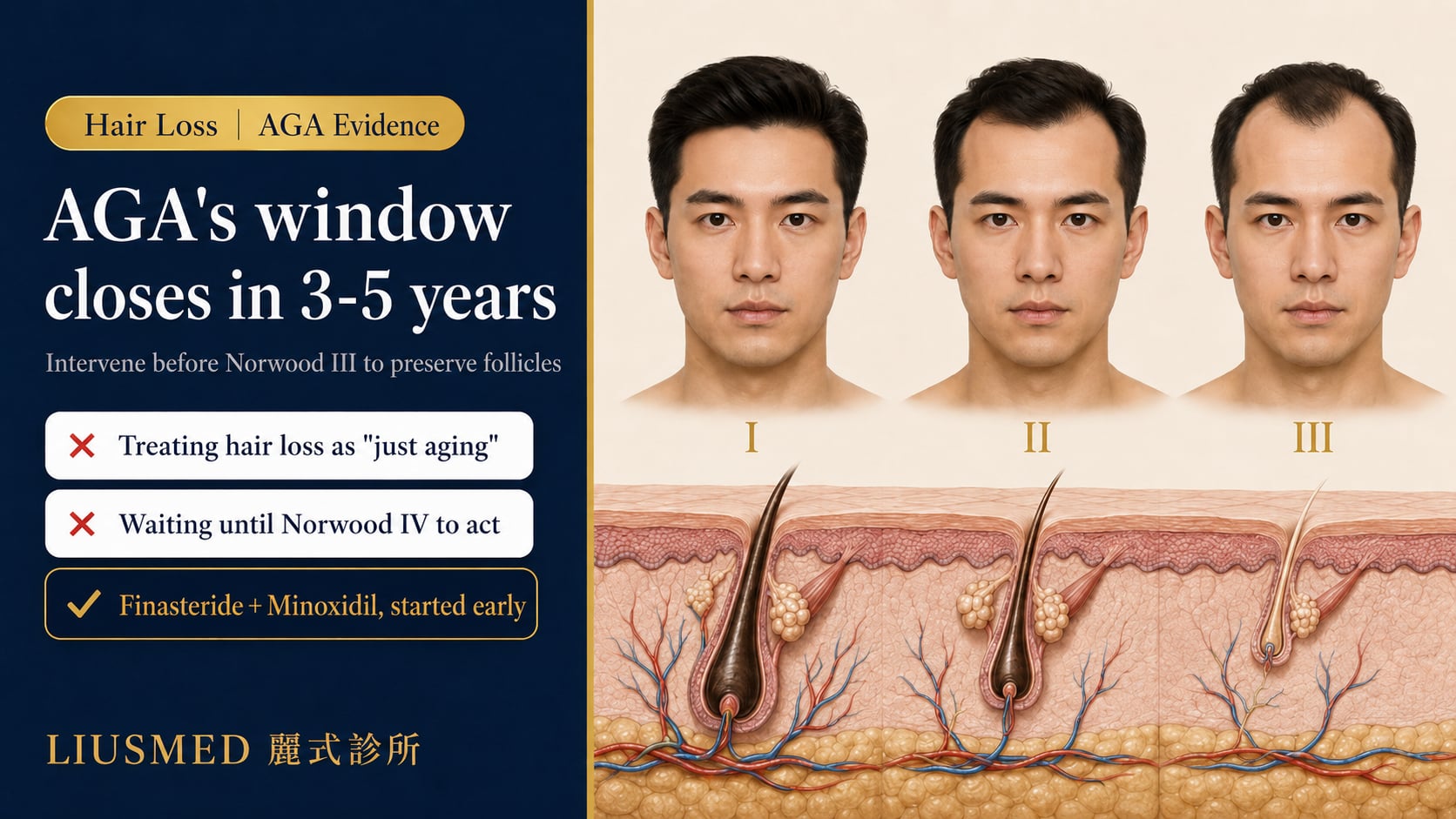
One-Minute Summary
Key Conclusions:
- AGA (Androgenetic Alopecia — male-pattern hair loss) is a progressive, non-self-resolving disease. Early intervention (Norwood I–III) preserves substantially more follicles than late intervention.
- 2025 Network Meta-Analysis (statistical pooling of multiple studies): Finasteride + Minoxidil combination therapy adds 29.68 hairs/cm² at 24 weeks, the most efficacious of all tested protocols.
- 2024 real-world data on 502 men: combined therapy yielded 92.4% stable or improved, with 57.4% showing marked improvement.
- The "golden window" lies in the 3–5 years between recession onset and Norwood III. Miss this window and follicle miniaturization enters the irreversible phase.
- International guidelines recommend at least 1 year of therapy before evaluating; failure to stabilize or improve warrants transplant evaluation.
AGA Is Not "Just Aging"
Many men accept hair loss as fate. But AGA is fundamentally DHT (dihydrotestosterone) attacking genetically susceptible follicles, shrinking them by one tier each growth cycle until activity ceases entirely.
Key insight: AGA does not "spontaneously improve." Watchful waiting = consenting to ongoing follicle degradation. Earlier intervention rescues more follicles.
Norwood Staging: Where Are You?
The Norwood-Hamilton scale is the international standard for male AGA assessment:
| Stage | Presentation | Intervention |
|---|---|---|
| I | Normal hairline | Preventive management (lifestyle, scalp care) |
| II | Mild bitemporal recession | Optimal intervention window: best response to medications |
| III | Marked bitemporal recession (M-pattern) | Still good window; combination therapy recommended |
| III vertex | III + crown thinning | Active intervention: medications + adjunct therapies |
| IV | M-pattern + obvious crown thinning, separating belt | Medications + PRP / LLLT, consider transplant evaluation |
| V | M + expanded crown, narrowing connecting hair | Transplant + ongoing medication maintenance |
| VI–VII | Extensive baldness, only sides and posterior remain | Transplant primary, medications preserve remaining follicles |
Quick self-assessment:
- Stand in natural light, place index fingers above the brow peaks
- Look 4–6 cm above the fingertips, where hair should be
- If scalp is clearly visible → already at II–III, recommend prompt consultation
Why Early? The One-Way Process of Follicle Miniaturization (Follicle Miniaturization — follicle shrinkage in AGA progression)
Shortened Follicle Cycle
Healthy follicles have a 2–7 year anagen (growth) phase. Under AGA, anagen shortens with each cycle while telogen (rest) lengthens proportionately. Eventually anagen may drop below 6 months — hair sheds before reaching shoulder length.
Decreasing Follicle Diameter
Healthy follicles: 80–100 μm diameter. AGA follicles after multiple cycles shrink to 30–40 μm — visually "vellus" hairs. Below a critical threshold, stem cell activity also drops; even removing DHT pressure may not recover them.
Key insight: Miniaturization is a stepwise and largely irreversible process. Finasteride and Minoxidil slow or halt the process and may partially recover miniaturized follicles, but for fully atrophied follicles (typically Norwood V+), drug response is limited and transplantation should be considered.
Evidence-Based Core Therapies
1. Finasteride (oral 1mg / day)
Mechanism: Inhibits 5α-reductase, reducing scalp DHT by ~65%.
Efficacy:
- Stabilizes hair in ~80–90% of patients within 2 years
- 5-year follow-up shows sustained maintenance
- Most effective on crown thinning, less on hairline recession
Side effect notes:
- Sexual side effects (libido, erectile): 1–2% of patients
- Most reverse on discontinuation
- 0.5mg/day may be considered if concerns; some studies show comparable efficacy
2. Minoxidil (topical 5% / low-dose oral)
Mechanism: Vasodilates scalp vessels, prolongs anagen, stimulates follicular epithelial proliferation.
Topical vs Oral:
- Topical 5%: standard first choice, 1ml × 2 daily
- Low-dose oral (2.5–5mg/day): emerging option; 2024 502-patient series showed strong outcomes; watch for edema, hypertrichosis
Time to effect: Typically 3–6 months; peak effect at 12 months.
3. Combination Therapy: 1 + 1 > 2
The 2025 Network Meta-Analysis compared monotherapy and combination:
| Therapy | Hair density gain at 24 weeks (hairs/cm²) |
|---|---|
| Placebo | 0–2 |
| Minoxidil 5% alone | ~14 |
| Finasteride 1mg alone | ~18 |
| Finasteride + Minoxidil combination | 29.68 (highest) |
Key insight: Finasteride and Minoxidil have entirely different mechanisms (DHT blockade vs follicular metabolism). Their stacking effect substantially exceeds either alone. This is the gold standard for male AGA.
4. PRP (Autologous Platelet-Rich Plasma)
Mechanism: PRP (Platelet-Rich Plasma — concentrate of your own blood platelets rich in growth factors) contains high-concentration growth factors (PDGF, VEGF, IGF-1) promoting peri-follicular angiogenesis and follicular stem cell activation.
Evidence level: 2024 systematic reviews show PRP has positive effects as adjunct therapy, but evidence is insufficient as a "drug replacement."
Indications:
- Patients sensitive to Finasteride side effects (partial reduction with adjunct)
- Wishing to accelerate early-phase results (drugs take 3–6 months; PRP can shorten)
- Pre/post-transplant adjunct to improve follicle survival
Protocol: Typically monthly × 3–4 then maintenance every 6 months.
5. Low-Level Laser Therapy (LLLT)
Home LLLT caps and combs are widely available. 2024 evidence shows mild efficacy in mild-moderate AGA — best as adjunct, not primary therapy.
When to Start? Four Intervention Signals
Don't wait until obvious balding. Any one of these warrants consultation:
- >100 hairs/day shedding (persisting >1 month)
- Visible hair accumulation on combs, pillows, shower drains
- Visible scalp in crown or temples
- Family history (father, maternal grandfather, uncles bald) + any of the above
Key insight: For men with strong family history, annual self-monitoring from age 25 beats waiting for problems. Low-dose preventive use may delay AGA presentation by 5–10 years.
Treatment Timeline and Follow-Up
0–3 Months: Adaptation
- Possible "shedding phase" (Minoxidil shedding): synchronized cycle reset causes temporary increase in shedding before new growth — normal and transient
- No expectation of visible improvement; focus on building medication adherence
3–6 Months: Stabilization
- Shedding decreases noticeably
- Fine new hairs appear, especially at hairline and crown
- Some sensitive patients begin to see reduced scalp visibility
6–12 Months: Improvement
- Density and shaft diameter increase
- Photographic comparison shows visible style differences
- Take standardized comparison photos at this point
12 Months: Evaluation Point
- Compare with baseline; evaluate "stable or improved"
- If still progressing → consider transplant
- If stable → maintenance therapy, follow-up every 6 months
Five Common Mistakes to Avoid
- Inconsistent dosing — Stopping Minoxidil for 3 months can shed all newly grown hairs. Therapy requires "lifelong management" mindset.
- Expecting "3-month results" — AGA therapy needs at least 6 months to assess and 1 year to conclude.
- Relying on shampoos / supplements alone — Saw palmetto, biotin, etc. have weak evidence for moderate AGA; should not be primary therapy.
- Avoiding prescriptions and missing the golden window — Excessive worry about Finasteride leads many to delay 3–5 years; by then miniaturization is irreversible.
- Transplanting without medication — Native hairs continue to recede after transplant; without medication, the "transplanted island in a receding sea" outcome occurs.
Four Consultation Preparations
- Three standard photos: front, top-down crown, both sides
- Document family history: father, grandfathers, uncles, brothers
- List current products and medications: avoid interactions
- Define your timeline expectations: target hair density in how many years? Willing to commit to long-term medication?
Common questions
Will male-pattern hair loss get better on its own?
No. AGA is a progressive condition — it doesn't resolve by itself, and watchful waiting basically means letting the follicles keep degrading. The earlier you step in, the more follicles you get to keep, so it's worth getting assessed sooner rather than later.
When should I actually start treatment?
You don't need to wait until you're obviously balding. If you're shedding more than about 100 hairs a day for over a month, noticing a lot more hair on your comb and pillow, seeing scalp at the crown or temples, or you've got a family history plus any of those signs, it's worth coming in. The article points to Norwood I through III as the stage where treatment tends to respond best.
Is using Finasteride and Minoxidil together better than one alone?
By the evidence, yes. The two work in completely different ways — one lowers DHT's attack on the follicle, the other boosts follicular metabolism and extends the growth phase — so combining them adds noticeably more hair density than either drug on its own. That's why the pair is often used as the standard approach.
How long before I see results after starting?
Usually you're looking at three to six months before changes show, with clearer improvement around the twelve-month mark. The first zero to three months is an adjustment phase, and some people even shed a bit more early on — that's the growth cycle resetting, and it's normal and temporary. So give it at least six months to a year before judging.
Does Finasteride have side effects?
It can, but not for most people. Roughly one to two percent notice a dip in libido or erectile function, and in most of them it settles after stopping the drug. If that worries you, the article notes you can start at a lower dose, and talking it through with your doctor beforehand helps.
Conclusion: Time Is the Scarcest Resource in AGA
There is no "decide later" in AGA — miniaturization continues every day. The good news: with rational intervention, most men can maintain satisfactory hair density long-term and avoid severe baldness.
Recommend prompt consultation if:
- Hair loss is noticeable after age 25
- Family history + early signals already present
- Shampoos / supplements have failed
- You want to evaluate whether Finasteride / Minoxidil suit your case
See our hair regrowth and scalp repair service or book a consultation.
Medical References
- Treatment of Androgenetic Alopecia: Current Guidance and Unmet Needs. PMC10239632. 2023.
- Comparing minoxidil-finasteride mixed solution with minoxidil alone for male AGA: meta-analysis. Frontiers in Medicine. 2025. PMC12537375.
- Relative efficacy of minoxidil in combination with other treatments for AGA: network meta-analysis. Frontiers in Medicine. 2025.
- Effectiveness of Combined Oral Minoxidil and Finasteride in Male AGA. PMC11829753. 2024.
- Comparative Efficacy of Minoxidil and 5-Alpha Reductase Inhibitors. PMC12207719.
- Evidence-based (S3) guideline for AGA treatment in women and men. PubMed PMID (PubMed Identifier — unique paper ID in PubMed database): 29178529.
- Consensus Recommendations for the Management of AGA. PMC12533493. 2024.
Editorial review: Reviewed by Dr. Ta-Ju Liu. Last reviewed 2026-04-27. Educational content; does not constitute personalized medical advice.
Related Services

Specialties
Credentials
- Kaohsiung Medical University, School of Medicine
- Attending Physician, Dermatology, Kaohsiung Chang Gung Memorial Hospital
- Attending Physician, Aesthetic Center, Kaohsiung Chang Gung Memorial Hospital
- Visiting Physician, Dermatology, Xiamen Chang Gung Hospital
- Visiting Physician, Aesthetic Center, Xiamen Chang Gung Hospital
"For every surgery, I strive to achieve a good outcome through a small incision and refined technique. Minimally invasive surgery is not just a technique — it's a commitment of respect to every patient."
Want to learn more?
Schedule a consultation for professional evaluation and advice