Post-Operative Compression Care and Activity Restriction Guide
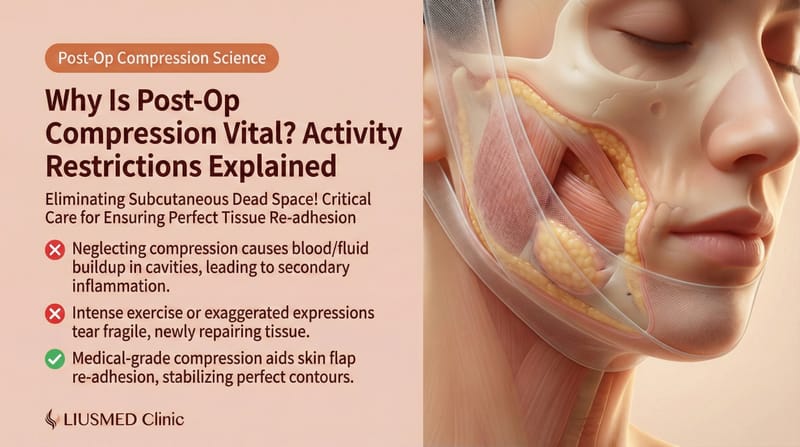
Why Is Post-Operative Compression So Important?
After minimally invasive ultrasound-guided filler extraction, tissue is left with a space where the filler was removed. Proper compression helps tissues adhere, reduces bleeding and swelling, and accelerates healing. It is one of the aftercare steps that most directly affects recovery quality.
The Science and Purpose of Compression
| Purpose | Explanation |
|---|---|
| Reduce bleeding | Applies pressure to small bleeding points, promoting hemostasis |
| Prevent hematoma | Prevents blood from pooling in tissue spaces |
| Reduce swelling | Minimizes tissue fluid extravasation and edema |
| Promote tissue adhesion | Helps skin and deeper tissue layers reattach |
| Shaping effect | Guides tissue to heal in the correct position |
Key Insight: Proper compression care can shorten recovery by 20-30% and significantly reduce the risk of post-operative complications. This seemingly simple step is a critical factor in determining the final outcome.
Compression Methods and Tools
Commonly Used Compression Tools
| Tool | Suitable Area | Features |
|---|---|---|
| Elastic bandage | Jawline, cheeks | Adjustable tightness |
| Compression garment/mask | Full face or large areas | Even pressure distribution |
| Medical tape | Small localized areas | Convenient for targeted compression |
| Elastic headband | Head, jawline | Secure fixation |
How to Apply Compression Correctly
| Guideline | Details |
|---|---|
| Moderate pressure | Feel compression but not pain; should not affect breathing or swallowing |
| Even distribution | Avoid excessive pressure on one spot causing indentation |
| Regular checks | Verify every 2-3 hours that nothing is abnormal |
| Maintain cleanliness | Keep compression tools clean |
| Watch circulation | If numbness or discoloration appears, loosen immediately |
Compression Schedule
Recommendations by Treatment Area
| Area | Recommended Duration | Notes |
|---|---|---|
| Cheeks / midface | 48-72 hours continuous | Then switch to nighttime only |
| Chin / jawline | 48-72 hours continuous | Ensure swallowing is not impaired |
| Tear trough / periorbital | 24-48 hours light compression | Avoid pressure on the eyeball |
| Nose | As directed (may require a nose clip) | Ensure comfortable breathing |
| Forehead / temples | 48-72 hours | Use an elastic headband |
Compression Phases
| Phase | Timing | Method |
|---|---|---|
| Intensive phase | Days 0-3 post-op | Continuous (except for cleaning and eating) |
| Transition phase | Days 3-7 | Intermittent daytime, continuous nighttime |
| Maintenance phase | Weeks 1-2 | Nighttime compression |
| Observation phase | Week 2+ | As directed by physician |
Key Insight: Compression duration needs to be adjusted based on individual circumstances. Patients with larger surgical areas, more bleeding, or a tendency toward hematoma may need extended compression. Your physician will provide specific guidance based on your recovery at follow-up visits.
Activity Restriction Guide
Post-Operative Activity Levels
| Level | Timing | Allowed | Not Allowed |
|---|---|---|---|
| Level 1 (bed rest) | Surgery day | Lying down, sitting up, using bathroom | Walking around, lifting |
| Level 2 (light activity) | Days 1-3 | Indoor movement, basic self-care | Going out, exercise, bending |
| Level 3 (daily activity) | Days 3-7 | Light outings, desk work | Exercise, swimming, heavy lifting |
| Level 4 (general activity) | Weeks 1-2 | Normal work, walking | Vigorous exercise, sauna |
| Level 5 (full recovery) | Weeks 3-4 | Most exercise and activities | Extreme sports (case-dependent) |
Specific Movements to Watch
| Movement | Why Avoid | When to Resume |
|---|---|---|
| Bending/looking down | Increases facial blood pressure, worsens swelling | After 3-5 days |
| Straining during bowel movements | Increases abdominal pressure, may cause bleeding | Maintain regularity |
| Loud talking/laughing | Engages facial muscles, affects healing | After 3-5 days |
| Chewing hard foods | Jaw movement disturbs surgical site | After 1 week |
| Vigorous exercise | Elevated blood pressure, sweating, impact risk | Per follow-up review |
| Swimming/bathing | Wound submersion and infection risk | After wound closure |
| Sauna/steam | Vasodilation worsens swelling | After 3-4 weeks |
| Facial massage | Displaces recently healed tissue | After 4+ weeks |
Sleep and Rest Recommendations
Sleep Position
| Recommendation | Details |
|---|---|
| Elevate head | Prop pillows at 15-30 degrees to help reduce swelling |
| Avoid sleeping on surgical side | Do not compress the treated area |
| No face-down sleeping | Puts pressure on the surgical site |
| Maintain compression | Keep compression device in place during sleep |
Tips for Comfortable Sleep
- Use a travel neck pillow to keep your head positioned
- Place pillows behind your back to maintain a semi-reclined posture
- Consider resting in a recliner for the first few days
- Take prescribed pain medication to assist with sleep
Frequently Asked Questions
Q: What if the compression feels too tight?
If you feel pain, numbness, or notice skin turning purple, loosen the compression immediately. Proper compression should feel firm but not painful.
Q: Can I eat while wearing compression?
Yes. You can temporarily remove the compression device during meals, then reapply afterward. Choose soft foods and avoid anything requiring vigorous chewing.
Q: When can I resume gym workouts?
When to resume moderate and high-intensity exercise is decided at your follow-up review; the exact timing depends on the extent of surgery and your individual recovery.
Q: How do I wash my face and hair?
During the first few days, gently wipe your face with a damp cloth, avoiding the surgical area. Tilt your head back when washing hair to prevent water from running over the face. After wound closure, normal cleansing is fine with gentle technique.
Conclusion: Follow Compression Protocol for Faster Recovery
Post-operative compression care may seem inconvenient, but it is an essential component for achieving excellent recovery outcomes. A few days of discipline translates to faster swelling resolution, fewer complications, and better final results.
For more recovery details, see our week-by-week recovery timeline and swelling and bruising care guide.
If you have any aftercare questions, contact us at any time. Our team is here to support you through every step of recovery. Learn more about our minimally invasive extraction technique to understand how our approach minimizes post-operative discomfort.
Related Services

Specialties
Credentials
- Kaohsiung Medical University, School of Medicine
- Attending Physician, Dermatology, Kaohsiung Chang Gung Memorial Hospital
- Attending Physician, Aesthetic Center, Kaohsiung Chang Gung Memorial Hospital
- Visiting Physician, Dermatology, Xiamen Chang Gung Hospital
- Visiting Physician, Aesthetic Center, Xiamen Chang Gung Hospital
"For every surgery, I strive to achieve a good outcome through a small incision and refined technique. Minimally invasive surgery is not just a technique — it's a commitment of respect to every patient."
Recovery after any procedure needs peer support too


Want to learn more?
Schedule a consultation for professional evaluation and advice