Why Tear-Trough Filler Turns Into 'Caterpillars' — How to Avoid It, and How to Fix It
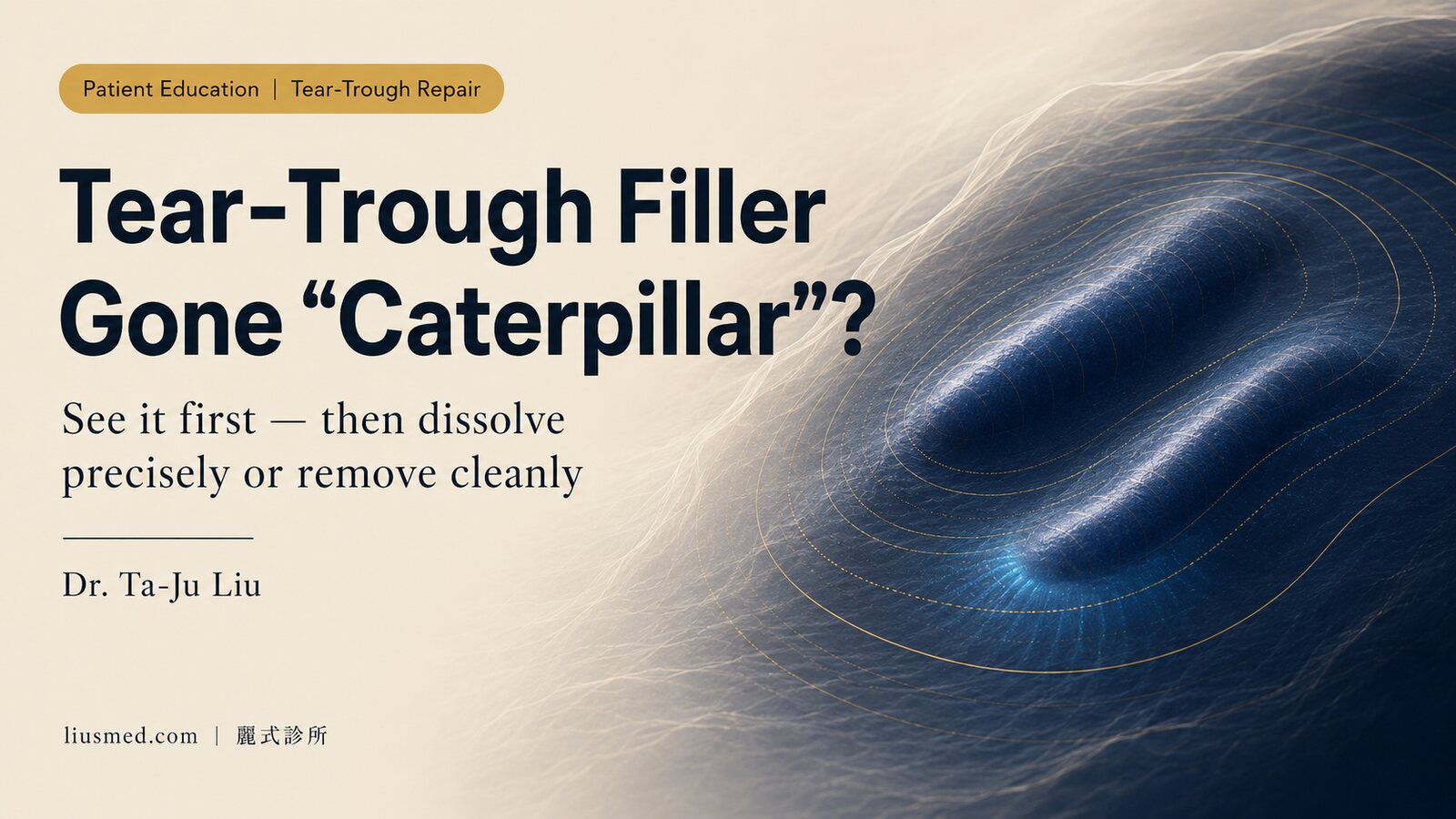
When tear trough filler ends up looking like two little caterpillars, most of the time it isn't because the hyaluronic acid (HA) was bad. It's because it was placed too shallow, in too large an amount, in the wrong layer. Eyelid skin is the thinnest skin on the body, and it can't hide anything underneath it, so this area is especially prone to going wrong, and it especially tests whether the person injecting knows when to stop.
Let me tell you, the line I hear most often in my clinic is this: "I had my tear troughs done before, and they turned into caterpillars, and every morning I see them and want to cry." So I'll be straight with you in this piece: how caterpillars happen, how to inject so you don't end up this way, and if it's already happened, what you actually have to do to clear it properly.
Why does tear-trough filler turn into "two caterpillars"?
First, the most important thing. The skin under your eyes is, on average, somewhere around half a millimetre thick, thinner than anywhere else on your body. How thin is that? Thin enough that whatever you put under it, it almost can't hide.
The cause of caterpillars, stripped down, is simply this: the product went into the wrong layer, and too much of it went in. You're trying to fill in the hollow of the tear trough, but it gets injected too superficially with too much volume, and the HA piles up into ridges under the skin. Most of the time you don't really notice. But the moment you smile or squint, the orbicularis oculi muscle contracts, pushes that pad of HA upward, and out come two bulging ridges. People call that shape a caterpillar.
There's another version where, given enough time, the product slowly "wanders." HA draws in water, and the under-eye is the area that blinks all day and carries the most expression, so what you injected gets nudged along by the muscle, over and over, until it shifts and deforms. You set out to fill the tear trough, and the whole pad slides down onto the cheek, or each side drifts off in its own direction, and it just looks uneven. I've written a separate piece on how this kind of migration happens, Why fillers migrate, if you'd like to read it.
Key point: Caterpillars aren't bad luck. They're the result of two things together: placed too shallow, placed in too large an amount.
If it looks bluish under the eye after filler, is that the Tyndall effect?
Yes. If you notice a faint blue-grey cast over that filled area, especially obvious under certain lighting, that's very likely the Tyndall effect (a bluish discoloration from too-shallow filler).
The principle isn't hard to follow. HA is a colloid, and when it's placed very superficially, light shining down scatters off these colloidal particles, and blue light, with its short wavelength, is the most easily reflected back. So what you're seeing isn't the HA actually turning blue. It's a trick of the light, showing through only because the product was placed too close to the skin surface.
Put another way, the root of the Tyndall effect and the root of caterpillars are really the same thing: placed too shallow. The only difference is that one makes you see the wrong colour and the other makes you see the wrong shape. I go into this mechanism in more detail in What the tear-trough Tyndall effect really is, so I won't unpack all of it here.
One thing I should add: a bluish tinge under the eye isn't always Tyndall. Some people naturally have the vascular-type bluish look of dark circles, which has nothing to do with HA. These two things need to be told apart during the consultation, otherwise you spend ages dissolving and you've dissolved the wrong target.
So how do you inject it so it doesn't turn into caterpillars?
Honestly, most caterpillars and Tyndall cases can be avoided before the product ever goes in. The key isn't which brand of HA you use. It's whether the person injecting reads your face and decides how to place it accordingly.
A few things I personally care a lot about:
- The layer has to be deep enough. The tear trough should be filled in the deep plane right against the periosteum, not in the superficial subcutaneous layer. Placed deep enough, that thin layer of skin on top can cover it, so it won't show colour and won't bulge.
- Use less, and prefer doing it in stages. In this under-eye area, a little extra is a lot extra. I'd rather be conservative the first time and leave some room to see how it looks once it has drawn in water, than pack it all in at once and have it become a lump later.
- Choose the right texture of product. The under-eye suits a gel-type HA with high cohesivity that doesn't draw in water and spread much. The kind that swells easily by drawing in water might be fine elsewhere, but placed under the eye it tends to cause trouble.
- Inject only when you can see. This is what I care about most. The under-eye is full of blood vessels, and injecting blind is gambling on luck.
I want to say a couple more words about that last point. The real risk of tear-trough filling was never just looking unattractive. It's those vessels underneath that you can't see. If the needle accidentally goes into a vessel during injection, or compresses one, the worst case can progress to tissue ischaemia, skin necrosis, and even an effect on vision. I'm not saying this to scare you. It's an anatomical risk that simply comes with this area.
What we at Liushi have always done is you can only handle it safely when you can see it. I use ultrasound-guided imaging to first see clearly where the vessels under your eye run, and where any previously injected material might be stuck, then decide where the needle goes in and how deep to place it. Injecting while looking versus injecting by feel makes a big difference to safety.
Key point: The key to not getting caterpillars isn't more expensive HA. It's having someone willing to read your anatomy, hold back on the volume, and get the layer right.
It's already turned into caterpillars — can't you just dissolve it and redo it?
A lot of people think caterpillars are easy to deal with: one shot of hyaluronidase (the enzyme that dissolves HA filler) to dissolve it, then redo. Done.
In theory, yes. In practice, it's not that simple.
Hyaluronidase does dissolve HA, that's true, but it isn't an all-powerful eraser. What it can dissolve is the HA it can actually reach. If that pad under your eye has already been walled off, or sits very deep and very concentrated, the enzyme can't seep into the core of that pad from the outside, so it only dissolves a surface layer. The result is often that it looks a bit reduced after dissolving, then after a while it surfaces again, because the block inside was never touched.
There's a more troublesome situation too: too many sessions, and material of unknown origin mixed together, so it's no longer plain HA. It may have formed a foreign-body reaction, a nodule. Hyaluronidase can't budge that kind of thing at all.
That's why I say "dissolve it and redo it" sounds simple but often gets stuck in practice. Stuck where? Stuck on not being able to see where that pad actually is, or what it is.
Why do some people dissolve theirs several times and the caterpillars are still there?
This is the one thing I most want to tell you.
When it's dissolved several times and still there, it's almost always the same reason: the person injecting the enzyme also can't see that pad. Can't see it, so they can only inject the enzyme by feel into the rough area, hitting the edges and corners while the core stays completely unmoved. So you've spent money over several sessions, your eye has been repeatedly irritated, and the caterpillar is still right where it was. There are actually several reasons hyaluronidase often fails, which I've gathered in Why hyaluronidase fails: 7 reasons you should know.
What I do is the reverse order.
See it first, then handle it. I use ultrasound to image that pad under your eye: how big it is, how deep it's hiding, where it sits relative to the vessels. Once I can see it clearly, I know whether it should be dissolved with hyaluronidase, or whether it simply can't be dissolved and has to be taken out.
If it's HA that can be dissolved, ultrasound guides the enzyme precisely into the core of that pad, not scattershot. If it's a firm lump or nodule that can't be dissolved, then I fall back on Liushi's old trade: physical removal through a single needle hole. Going in through one very small needle hole, under ultrasound, I take that pad out whole, not relying on luck and not relying on repeated enzyme shots to gamble on whether it'll go down. As for how this kind of under-eye firm lump or granuloma is removed, I explain it more fully in Removing under-eye filler granulomas.
To put it plainly, where others say "if it won't dissolve, dissolve it again," I say "first see clearly what it is, dissolve well what's dissolvable, and take out what isn't." The difference comes down to whether you can see.
Key point: Dissolved several times and still there isn't because your constitution is especially stubborn. It's because no one first looked clearly at where that pad is and what it is.
With tear-trough filling, see clearly first, then decide
If you're thinking about tear-trough filler, here's the one thing I'd suggest you get clear on first: the person you want isn't the fastest hand, the one most willing to inject freely. It's the one willing to read your face, hold back on volume, and know where to stop.
And if you've already been damaged and you're stuck miserable inside caterpillars and Tyndall, don't rush to dissolve it one more time either. First let someone image that pad clearly, see whether it's dissolvable or has to be taken out, then decide your next step. Repeatedly dissolving blind, most of the time, only means more money spent and more suffering.
As for how much should be filled, whether to dissolve the old material first before handling it, how the whole treatment is arranged, and how the cost works out, all of this depends on your actual under-eye situation and is planned individually. I'll go over it with you face to face during the consultation, and you can also ask individually via LINE. If you'd like to know what's really going on with that ridge under your eye and whether it can be saved, you're welcome to book and let me take a look for you in person.
Medical note: This article is health-education information, not individual medical advice. The results and duration of HA filling and subsequent repair vary from person to person; there is no "permanent" effect, and results are not guaranteed. Whether something can be dissolved with hyaluronidase or removed minimally invasively must be assessed by consultation and ultrasound. Tear-trough filling may be accompanied by bruising, swelling, lumps, migration, and the Tyndall effect, and in severe cases carries risks of vascular occlusion, tissue necrosis, and even effects on vision; most are temporary but zero risk is not guaranteed. Pregnancy and an active infection at the injection site are usually not suitable; the actual indications and approach are determined by in-person assessment.

Specialties
Credentials
- Kaohsiung Medical University, School of Medicine
- Attending Physician, Dermatology, Kaohsiung Chang Gung Memorial Hospital
- Attending Physician, Aesthetic Center, Kaohsiung Chang Gung Memorial Hospital
- Visiting Physician, Dermatology, Xiamen Chang Gung Hospital
- Visiting Physician, Aesthetic Center, Xiamen Chang Gung Hospital
"For every surgery, I strive to achieve a good outcome through a small incision and refined technique. Minimally invasive surgery is not just a technique — it's a commitment of respect to every patient."
Want to learn more?
Schedule a consultation for professional evaluation and advice