The Nasolabial Filler Dilemma: Too Soft to Hold, Too Firm and It Lumps
A patient sat down and the first thing she said was: "Doctor, how many times do I have to do this before my nasolabial folds are fixed? This is my third round." She told me that for the first week after each treatment the fold really did look flat, and she was happy — but a week or two later it sank right back, and every time she went back she was told the same thing: "not quite enough, add a little more."
By the third round she started to feel something was off. The fold wasn't really better, but the area around her mouth felt fuller and heavier than before.
I have heard this story many times in clinic. What I want to talk about today isn't "how many rounds you need," but why the nasolabial fold keeps people stuck in this loop — flatten, sink, top up, flatten again. Put plainly, this has far more to do with which filler you chose and with the nature of this particular spot than with the amount.
Why is a soft filler "not enough to hold" the nasolabial fold?
Start with something that often gets overlooked: the nasolabial fold isn't simply a groove. It's a tight zone that is also constantly moving. The area around the mouth smiles, talks, and chews all day; the muscles here barely stop.
A softer filler, like most hyaluronic acid products, doesn't really stay put when it's placed in a moving, tight zone like this. Right after the injection there is still some swelling, so it looks flat; but every expression that follows slowly pushes the material toward wherever there is less resistance. So a week or two later the fold is back — not because the HA was absorbed, but because it migrated, drifting off to the side.
If that gets read as "maybe it wasn't enough" and another round is added, all you are really doing is feeding more material into that same migration.
What about something "firmer"? The other problem with collagen stimulators
Some people think, then why not use something with more support? Collagen stimulators — such as Ellansé, AestheFill, or Sculptra — do give better support than HA and, in theory, are less easily pushed out of place.
The problem is that the area around the mouth is exactly where collagen stimulators are especially prone to forming lumps. Again it comes back to "always moving": in areas with a lot of motion, the material tends to clump together and get walled off by the body, and over time you feel firm lumps and ridges.
What makes it more difficult is that, unlike HA, it can't be dissolved. When HA goes wrong there is at least an enzyme that can help break it down; once a collagen stimulator has formed a nodule, that enzyme does nothing. When it genuinely can't be managed, often the only route left is to find it and remove it.
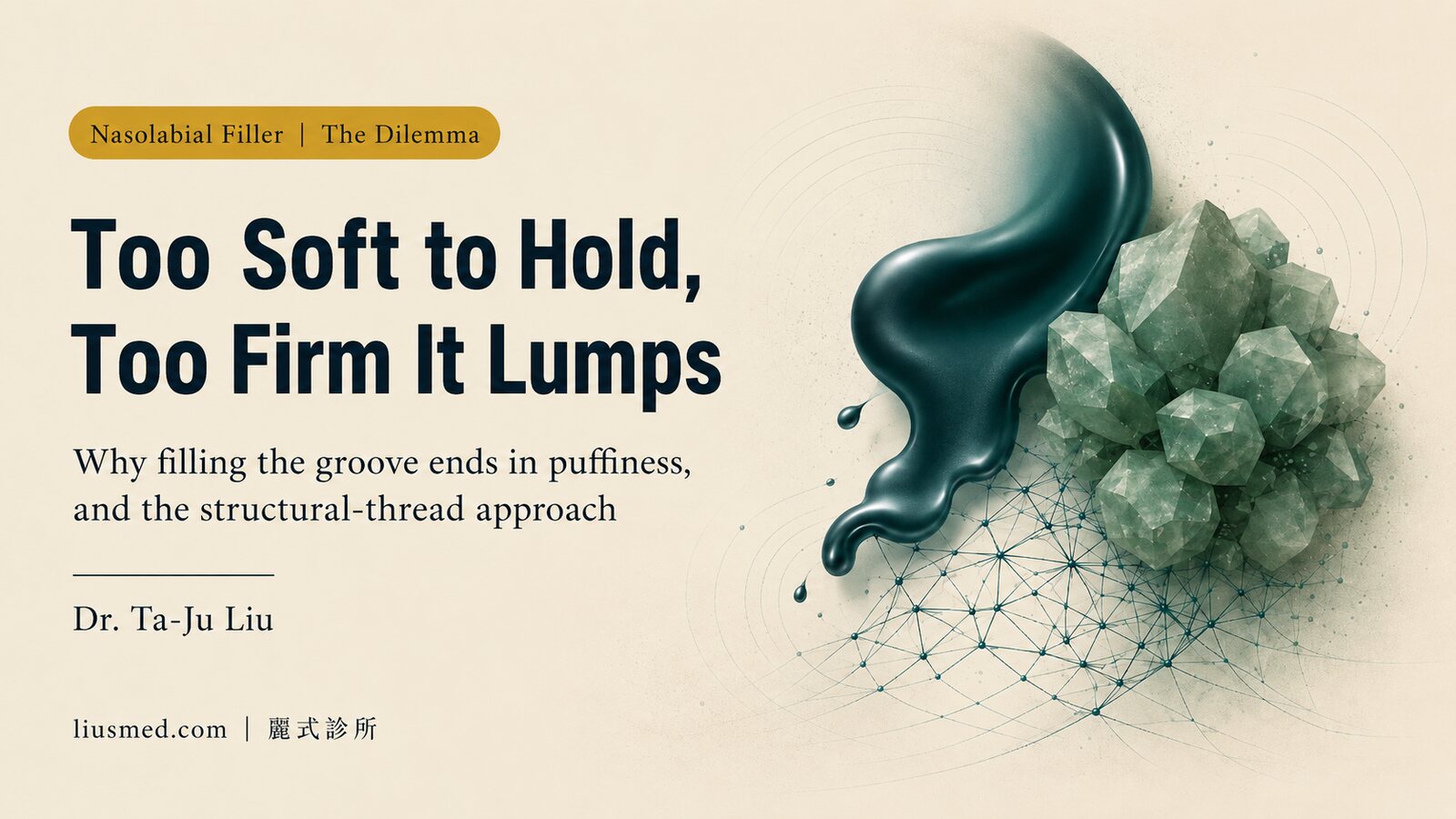
So you can see the dilemma of the nasolabial fold: the soft one won't hold and drifts; the firm one supports but lumps easily and can't be taken back.
Keep filling the groove — why does it end in a puffy, doughy look?
Put those two things together and you can see where that "worse the more you fill" loop comes from.
Each top-up looks like it flattens the groove, but really it adds another layer on top of material that has already migrated and already accumulated. Nasolabial filler tends to travel to three places most often: up above the fold, sideways into the jowl, and down toward the marionette lines. So you find that after all that filling, the fold itself isn't genuinely better — instead the jowl has thickened, the marionette lines have become more obvious, and the whole lower face looks heavier.
By this stage many people assume they have "gained weight" or "aged," when in fact it's years of accumulated filler, layered in a spot that keeps moving, ending up puffy and doughy. This isn't a question of more or less volume; the direction was slightly off from the start.
Is the nasolabial fold about "lost volume," or "collapsed structure"?
When I look at a nasolabial fold, I ask a more upstream question first: is this groove there because volume is missing, or because the structure has loosened and is pulling this area downward into a fold?
For most nasolabial folds that deepen after middle age, it's closer to the latter. The support of the lower and mid-face loosens and sags, dragging this tight zone around the mouth into a groove. If that's the case, then endlessly packing material into the bottom of the groove is like pouring filler into a pit whose floor keeps collapsing — no amount holds, because what needs addressing is the face that has fallen, not the pit itself.
That's why I often say the nasolabial fold is more a structural problem than a volume one. Once that's clear, the direction of treatment looks very different.
My approach: look clearly first, and support with something that won't migrate
So what do I do? My order runs roughly like this.
The first step is always to look clearly with ultrasound. For anyone who has already had injections, we first need to see the current state inside: which layer the material drifted into, where it is caught, whether there are lumps, and how close it runs to vessels. Rushing to inject again, or rushing to dissolve, without seeing clearly, usually just makes things messier.
If the assessment points to loosened structure that needs to be supported back up, I lean toward support that won't migrate — that is, structural thread lifting. Its biggest difference from filler is that the effort goes into pulling the collapsed structure back up, rather than packing material into a moving groove, so you are far less likely to be stuck migrating and topping up over and over.
If there is already migration, lumps, or even a puffy result inside, then the area has to be cleared first. This step is ultrasound-guided minimally invasive removal — a small port, watching the real-time image, checking margins and vessels, taking out what should come out a little at a time. Honestly, removal usually reaches about eighty or ninety percent, not a hundred, and it varies from person to person; but at least it puts what comes next on a clean footing, rather than laying another layer over a pile of old material. As for how to tell whether a ridge you can feel is normal or a complication, I wrote about that separately in the piece on feeling a hard ridge in the nasolabial fold. This is usually reached over two or three sessions; the first typically removes about 30–50%.
One note about safety
There is one more thing I have to mention. In the nasolabial region, branches of the facial artery run fairly close, making it one of the higher-risk spots to inject, with a possibility of vascular occlusion if it's handled poorly. That's exactly why I stress seeing where the vessels are before injecting and before removing. The full mechanism and management of occlusion I've put on the vascular occlusion revision page, so I won't repeat all of it here.
So, back to the patient on her third round
What I told her was this: you are not stuck only being able to keep filling the groove. Rather than adding a fourth round and thickening the jowl further, it's better to stop, look clearly at what's actually inside right now, and then decide whether to remove what has drifted and start over, or to support the structure that has loosened back up.
The nasolabial fold isn't a question of "how much to fill." It's a question of whether this constantly moving tight zone can hold anything at all, and whether the structure can be held up. The soft one drifts, the firm one lumps; rather than filling repeatedly into a doughy result, it's better to look clearly first, remove what should be removed, and support with something that won't migrate.
If you're caught in this loop too, book an assessment — we'll look clearly with ultrasound first, then decide the next step together.
This article is educational. Individual situations require in-person consultation and imaging assessment; actual treatment and results vary from person to person.
Specialties
Credentials
- Kaohsiung Medical University, School of Medicine
- Attending Physician, Dermatology, Kaohsiung Chang Gung Memorial Hospital
- Attending Physician, Aesthetic Center, Kaohsiung Chang Gung Memorial Hospital
- Visiting Physician, Dermatology, Xiamen Chang Gung Hospital
- Visiting Physician, Aesthetic Center, Xiamen Chang Gung Hospital
"For every surgery, I strive to achieve a good outcome through a small incision and refined technique. Minimally invasive surgery is not just a technique — it's a commitment of respect to every patient."
Recovery after any procedure needs peer support too


Want to learn more?
Schedule a consultation for professional evaluation and advice