Post-Op Skincare: Growth Factors, Ceramides & Ingredients to Avoid
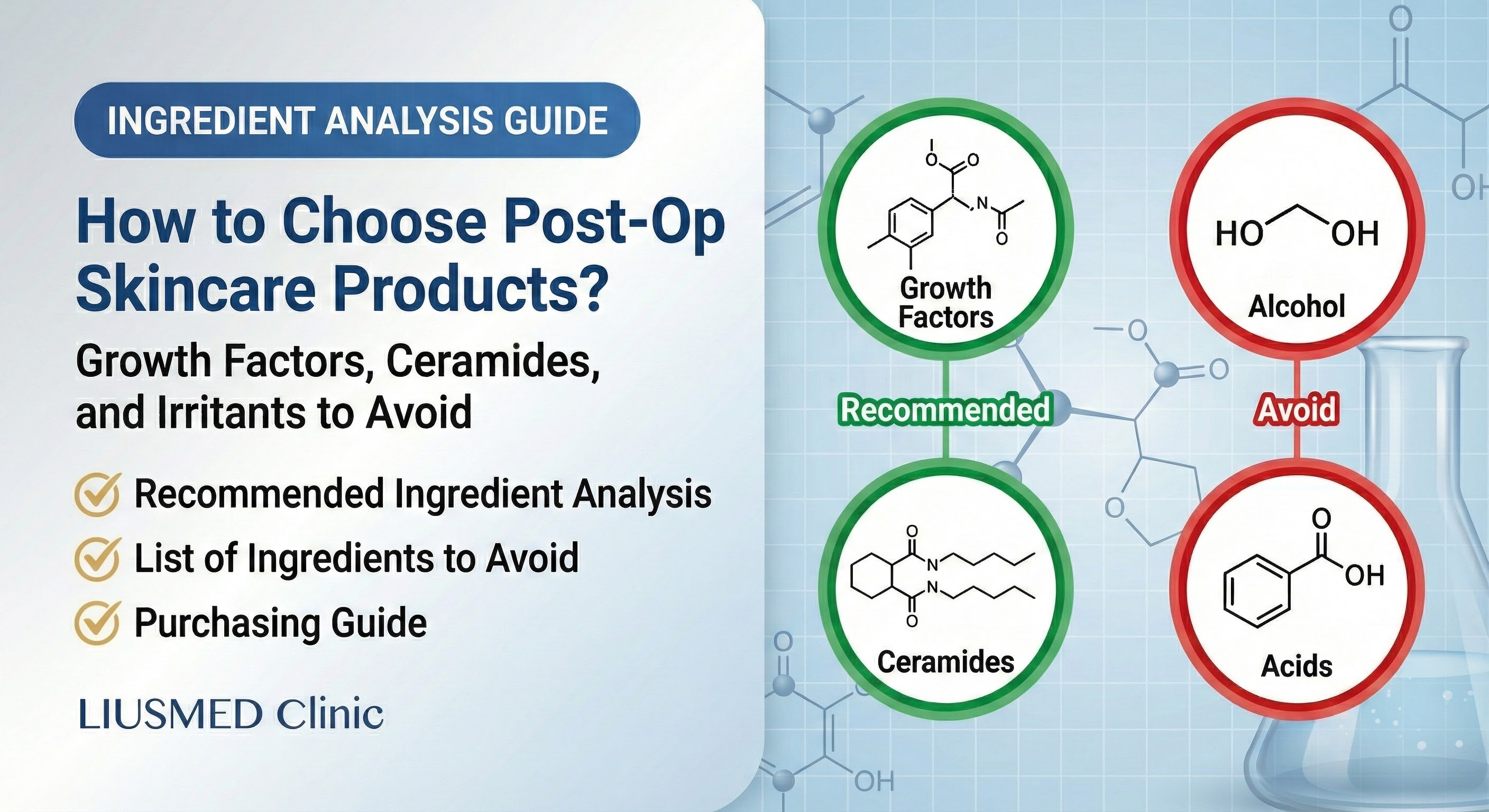
Ingredients Determine Repair Results
Post-op skincare product selection isn't about brands—ingredients are key. The right ingredients accelerate repair, reduce inflammation, and prevent scarring; wrong ingredients can irritate wounds, delay healing, and cause pigmentation. This article analyzes post-op skincare ingredients from a dermatologist's perspective.
Three Post-Op Repair Needs
| Need | Explanation | Corresponding Ingredients |
|---|---|---|
| Anti-inflammatory soothing | Reduce inflammatory response | Centella, aloe, chamomile |
| Promote healing | Accelerate tissue repair | Growth factors, peptides, hyaluronic acid |
| Barrier repair | Rebuild skin protective layer | Ceramides, squalane, fatty acids |
Recommended Ingredients Explained
Growth Factors
Functions:
- Stimulate cell proliferation
- Promote collagen synthesis
- Accelerate wound healing
| Common Type | Full Name | Features |
|---|---|---|
| EGF | Epidermal Growth Factor | Promotes epidermal cell regeneration |
| FGF | Fibroblast Growth Factor | Stimulates collagen |
| TGF-β | Transforming Growth Factor | Regulates repair process |
| IGF | Insulin-like Growth Factor | Promotes cell division |
Usage Tips:
- Suitable starting Day 3-5 post-op
- Choose stable formulations (liposome-encapsulated)
- High concentration isn't necessary—appropriate amount is enough
💡 Dr. Liu explains: "Growth factors do accelerate repair, but choosing a stable formulation is important. Unstable growth factors lose effectiveness upon air exposure."
Ceramides
Functions:
- Repair skin barrier
- Lock in moisture
- Reduce transepidermal water loss
| Type | Description |
|---|---|
| Ceramide NP | Most common, balanced effects |
| Ceramide AP | Stronger anti-aging benefits |
| Ceramide EOP | Better penetration |
Usage Tips:
- Can use immediately post-op
- More effective with other lipid ingredients
- Non-irritating, suitable for sensitive skin
Product Selection:
- Choose products with multiple ceramide types
- Even better with cholesterol and fatty acids
- Cream texture offers stronger protection
Centella Asiatica Extract
Functions:
- Anti-inflammatory soothing
- Promotes collagen synthesis
- Antioxidant
| Active Compound | Function |
|---|---|
| Madecassoside | Soothing, anti-sensitivity |
| Asiaticoside | Promotes healing |
| Asiatic Acid | Stimulates collagen |
| Madecassic Acid | Anti-inflammatory |
Usage Tips:
- Can start Day 2-3 post-op
- Widely used in CICA product lines
- Higher concentration = more noticeable soothing effect
Hyaluronic Acid
Functions:
- Deep hydration
- Promotes wound healing
- Anti-inflammatory
| Molecular Weight | Function | Features |
|---|---|---|
| High molecular | Surface hydration | Forms protective film |
| Medium molecular | Mid-layer hydration | Balanced type |
| Low molecular | Deep penetration | Promotes repair |
Post-Op Usage Tips:
- Choose multi-molecular weight products
- Can use immediately post-op
- Pair with occlusive ingredients to lock in moisture
Panthenol (Vitamin B5)
Functions:
- Moisturizing
- Soothing
- Promotes epithelization
Features:
- Extremely low irritation
- Can be used around wounds
- Rarely causes allergies
Usage Tips:
- Can use from Day 1-2 post-op
- ~5% concentration is effective
- Suitable for all skin types
Allantoin
Functions:
- Soothes irritation
- Promotes cell regeneration
- Softens skin
Features:
- Very gentle
- Common in post-op products
- Can be combined with many ingredients
Squalane
Functions:
- Moisturizes without being heavy
- Repairs skin barrier
- Antioxidant
Features:
- Excellent skin affinity
- Non-comedogenic
- Suitable for post-op sensitive period
Ingredients to Avoid
Acids (AHA / BHA / PHA)
| Ingredient | Name | Why Avoid |
|---|---|---|
| Glycolic Acid | — | Highly irritating |
| Lactic Acid | — | May irritate new skin |
| Salicylic Acid | — | Irritates wounds |
| Mandelic Acid | — | Gentler but still avoid |
When to Resume: 2-4 weeks post-op, once skin is completely stable
Retinoids
| Ingredient | Name | Why Avoid |
|---|---|---|
| Retinol | Vitamin A | Irritating, increases turnover |
| Retinaldehyde | — | Same as above |
| Retinyl Palmitate | — | Gentler but still avoid |
When to Resume: 2-4 weeks post-op
Alcohol
| Type | Why Avoid |
|---|---|
| Alcohol Denat | Drying, irritating |
| Ethanol | Damages barrier |
| Isopropyl Alcohol | Over-cleansing |
Note: Fatty alcohols (like Cetyl Alcohol, Stearyl Alcohol) are safe emulsifiers—no need to avoid
Fragrance and Essential Oils
| Ingredient | Why Avoid |
|---|---|
| Fragrance/Parfum | Allergy risk |
| Essential Oils | Irritating, photosensitizing |
| Limonene | Citrus oil component |
| Linalool | Floral oil component |
Recommendation: Choose fragrance-free formulas
High-Concentration Brightening Ingredients
| Ingredient | Why Avoid |
|---|---|
| High-concentration Vitamin C | Irritating, unstable |
| Arbutin | Can irritate sensitive skin |
| Kojic Acid | May irritate |
| Hydroquinone | Prescription, needs doctor guidance |
When to Use Brightening: 4+ weeks post-op, start with low concentrations
Post-Op Product Recommendations
Essential Basics
| Type | Key Ingredients | Product Suggestion |
|---|---|---|
| Cleanser | No soap, gentle surfactants | Amino acid cleanser |
| Repair serum | Growth factors, peptides | Repair ampoule |
| Moisturizer | Ceramides, hyaluronic acid | Repair cream |
| Sunscreen | Zinc oxide, titanium dioxide | Physical sunscreen |
Selection by Phase
| Phase | Key Ingredients |
|---|---|
| Days 1-3 | Panthenol, hyaluronic acid, soothing ingredients |
| Days 4-7 | Growth factors, ceramides |
| Weeks 2-4 | Continue repair, increase hydration |
| Week 4+ | Can gradually add active ingredients |
Ingredient Pairing Suggestions
✅ Good Combinations
| Combination | Effect |
|---|---|
| Ceramides + Cholesterol + Fatty Acids | Complete barrier repair |
| Hyaluronic Acid + Squalane | Hydration and moisture lock |
| Centella + Panthenol | Soothing and anti-inflammatory |
| Growth Factors + Peptides | Promotes repair |
❌ Avoid Combining
| Combination | Problem |
|---|---|
| Acids + Growth Factors | Acids degrade growth factors |
| Retinol + Acids | Over-stimulating |
| Vitamin C + Copper Peptides | May interfere with each other |
How to Read Ingredient Lists
Ingredient List Rules
- Ingredients listed in order of highest to lowest concentration
- Under 1% can be listed in any order
- First 5 ingredients typically make up 80%+ of the product
Post-Op Product Checkpoints
| Check | Description |
|---|---|
| First several ingredients | Should include repair/hydrating ingredients |
| Any irritating ingredients | Acids, alcohol, retinol |
| Any fragrance | Choose fragrance-free when possible |
| Preservative type | Choose gentle preservative systems |
Frequently Asked Questions
Q1: Can I use my regular skincare products post-op?
A1: Check the ingredients. Avoid acids, retinol, alcohol, and fragrance. If your regular products have gentle ingredients, you can continue; if they contain active ingredients, pause them.
Q2: Growth factor products are expensive—do I have to use them?
A2: Not a must-have. Growth factors accelerate repair, but basic moisturizing, soothing, and sun protection done well will also lead to good recovery. If budget is limited, prioritize basic care.
Q3: I'm breaking out post-op—can I use salicylic acid?
A3: Not recommended. Post-op skin is sensitive and salicylic acid may over-irritate. Instead:
- Use gentle cleansing
- Spot treatment with gentle pimple patches
- If severe, return for doctor evaluation
Q4: Are "post-procedure specific" products really better?
A4: Not necessarily. Focus on ingredients, not marketing claims. Check the ingredient list:
- Does it contain soothing/repair ingredients?
- Are there no irritating ingredients?
- Is it suitable for sensitive skin?
Some budget products actually have simpler, more suitable formulations.
Q5: Can I use petroleum jelly for post-op moisturizing?
A5: Yes, as an occlusive layer. Petroleum jelly is a pure occlusive that:
- Locks in moisture
- Protects wound from external irritation
- But has no repair function itself
Recommend using repair products first, then petroleum jelly as a seal.
Post-Op Ingredient Checklist
| Type | ✅ Suitable | ❌ Avoid |
|---|---|---|
| Active ingredients | Growth factors, peptides, Centella | Acids, retinol, high-conc. Vit C |
| Moisturizing ingredients | Ceramides, hyaluronic acid, squalane | — |
| Soothing ingredients | Panthenol, allantoin, aloe | Essential oils (may irritate) |
| Sunscreen ingredients | Zinc oxide, titanium dioxide | High-conc. chemical filters (initially) |
| Solvents | Water, glycerin | Alcohol (high concentration) |
| Fragrance | Fragrance-free | Synthetic fragrance, essential oils |
Conclusion
| Principle | Explanation |
|---|---|
| Keep it simple | Simpler ingredients are safer |
| Repair first | Repair before brightening or anti-aging |
| Read ingredient lists | Don't just look at brand and advertising |
| Gradual progression | Add active ingredients after recovery |
Related Reading
About the Author
Dr. Ta-Ju Liu
- Current Position: Director, Liushi Clinic
- Specialties: Minimal incision surgery (lipoma, cyst), hyperhidrosis surgery, thread lifting
- Experience:
- 15+ years of clinical minimal incision surgery experience
- Over 10,000 successful minimal incision cases
- Board-certified dermatologist
- Philosophy: "Choosing the right ingredients for post-op care makes all the difference. I often tell patients—reading the ingredient list matters more than looking at the price."
Related Services

Specialties
Credentials
- Kaohsiung Medical University, School of Medicine
- Attending Physician, Dermatology, Kaohsiung Chang Gung Memorial Hospital
- Attending Physician, Aesthetic Center, Kaohsiung Chang Gung Memorial Hospital
- Visiting Physician, Dermatology, Xiamen Chang Gung Hospital
- Visiting Physician, Aesthetic Center, Xiamen Chang Gung Hospital
"For every surgery, I strive to achieve a good outcome through a small incision and refined technique. Minimally invasive surgery is not just a technique — it's a commitment of respect to every patient."
Recovery after any procedure needs peer support too


Want to learn more?
Schedule a consultation for professional evaluation and advice