
Capsular Contracture: Non-Surgical Softening Repair
After a breast implant, the body wraps it in a fibrous capsule. When that capsule over-thickens and contracts, the breast turns hard and tight and won't move — capsular contracture. The standard answer is to remove and redo, but many people don't want another operation. We treat the capsule as a deep fibrosis/scar reaction and, for suitable cases, try to soften and thin it under ultrasound — a relatively conservative option to try before surgery, not a replacement for it.
Three Core Strengths of Liusmed Revision

Clean Removal
Stubborn masses are removed completely so residual tissue does not keep flaring.

Even Result
After removal the surface stays smooth, without new dents or waviness.

Precise, Not Excessive
Like fat grafting in reverse — the amount and location removed are judged precisely.
Common Symptoms
An Over-Vigorous Fibrosis Reaction
Any implant is naturally wrapped by a fibrous capsule (encapsulation) — normally harmless. Capsular contracture occurs when myofibroblasts drive that capsule to over-thicken and contract, squeezing the implant like a bag drawn ever tighter. It is one of the most common major complications after augmentation, with bacterial biofilm, bleeding, inflammation and individual constitution among the contributing factors. Crucially, it is not the implant 'failing' — it is the body's fibrosis response being too strong, which is exactly why softening the fibrous tissue can be a possible angle.
Why Traditional Treatments Fail
Removing and Redoing Means Another Operation
Once contracture reaches Baker grade III–IV, the standard treatment is surgery: removing the thickened capsule (capsulectomy), often exchanging the implant or changing the pocket plane. It is effective and a necessary option — but it is another full operation. Capsular contracture is consistently one of the most common reasons for reoperation after augmentation (around a third of cases), and reoperation rates climb with the years an implant has been in place. For many patients the real hesitation isn't whether it's worth it, but whether they can avoid being operated on again.
“I treat the capsule the way I treat scars and fibrosis — as tissue that can sometimes be softened. For people who don't want another operation, that may mean one more conservative option to try first. But I will say honestly when a case still needs surgery.”
Dr. LiuThe Capsule Is Just One More Form of Fibrosis
Ultrasound-Guided Precision Capsule Repair
Capsular contracture, scars, adhesions, fibrosis around fillers, hardening after fat grafting — they are really one family: fibrous tissue driven by myofibroblasts to over-produce and contract, differing only in where it sits and what it wraps. Loosening and softening that kind of tissue is what I have done for years. So the thinking for the capsule around an implant is the same: see it clearly first, then treat it as tissue that may be softened — rather than assuming from the outset that removing and redoing is the only road.
The capsule is fibrosis — same playbook
From skin scars and keloids to post-surgical adhesions and hardening after fat grafting, treating fibrosis is long-standing work for us. The capsule is one more form of fibrosis; it just happens to wrap an implant.
Measure thickness on ultrasound, not by feel
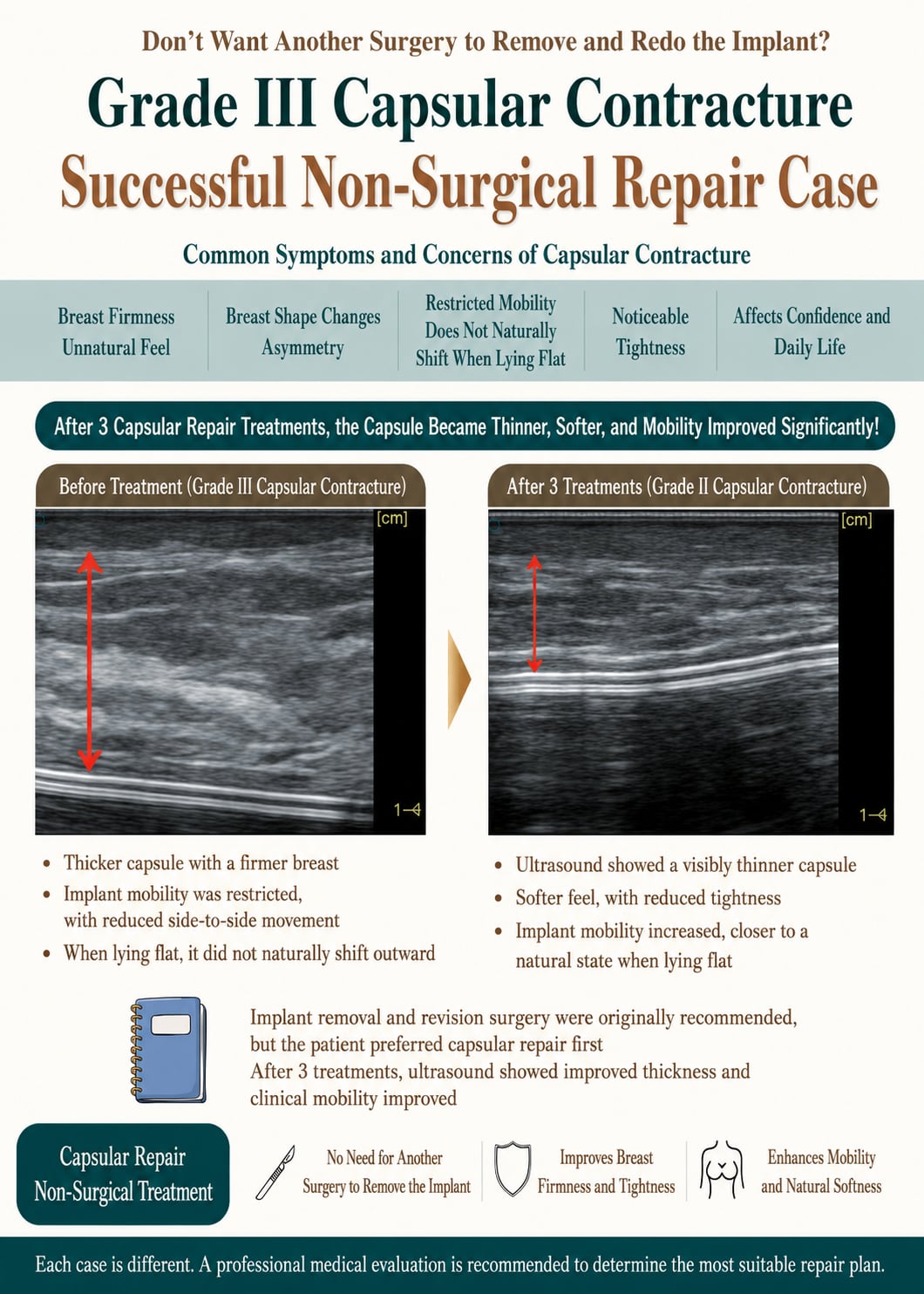
Capsule thickness can be quantified on ultrasound, so before and after are compared with the same ruler — whether it has thinned and softened is something we can see and track, not just a subjective sense.
Draw the boundary honestly
Said up front: non-surgical repair has its limits. When a case suits trying it first, we will; when a case needs surgery, we say so plainly rather than holding on to it.
Softening the Capsule Under Ultrasound
We approach the capsule the same way we approach scars and fibrosis elsewhere — as fibrous tissue that may be loosened and softened. For suitable Baker II–III cases, ultrasound-guided energy is applied to the thickened capsule to encourage fibrous-tissue remodeling, while capsule thickness is tracked objectively on ultrasound before and after. The evidence for non-surgical capsule treatment is still emerging (mostly small case series; long-term durability unclear), so we frame it honestly: a relatively low-risk option to try before removing and redoing — not a guaranteed replacement for surgery.
Ultrasound assessment of capsule thickness, implant state & tissue conditions
Capsule-softening repair sessions targeting the fibrosis
Before / after ultrasound thickness tracking
Decide together: continue conservatively, or refer for surgery
Common Questions
Will this replace surgery?
Who is suitable for non-surgical capsule repair?
How strong is the evidence?
How do you know if it is working?
Posted or commented in the forum? We can help expedite your appointment.
Standard booking takes 3+ months. If you post or comment in the FillerRescue forum first and then reach out via the button below with the link, we’ll prioritize arranging your consultation and add you to our priority standby list. If another patient cancels, you’re the first person we contact.