
Filler Migration Correction
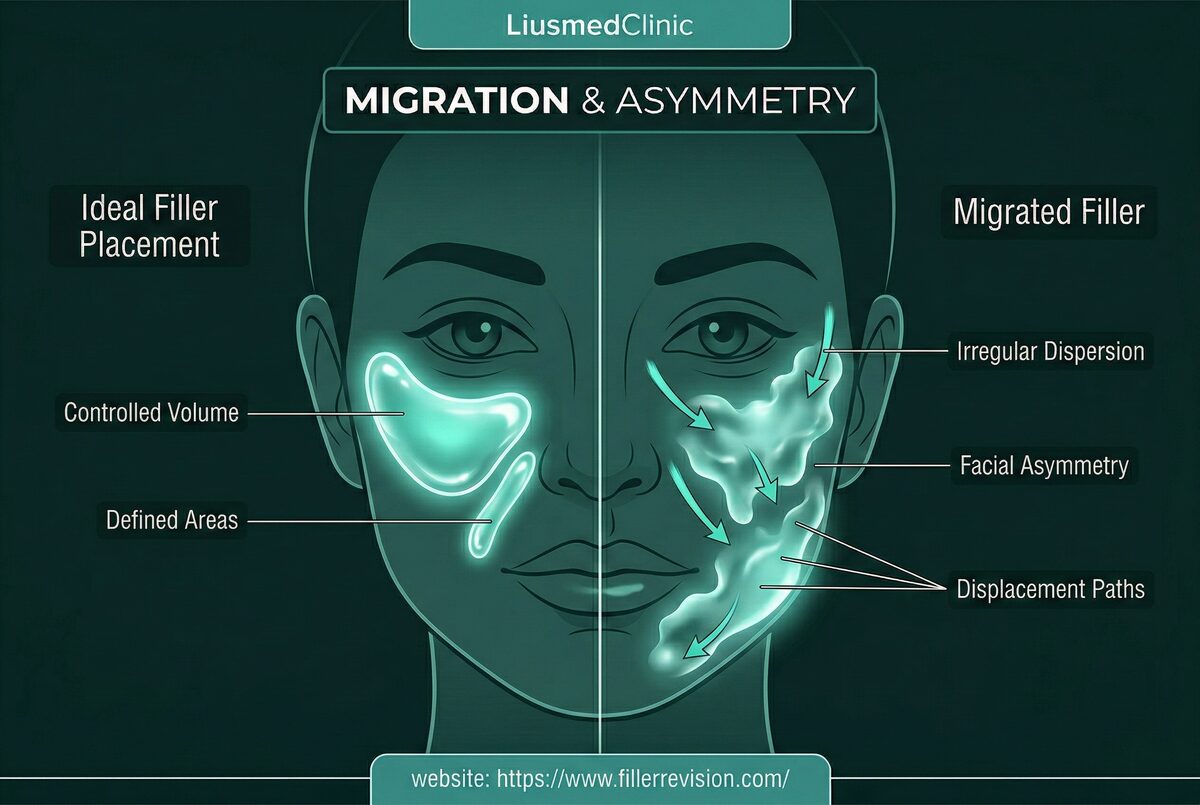
Migration occurs when filler displaces from the injection site to adjacent tissue planes, commonly creating a 'duck lip' shelf above the vermillion border, widening of the nose bridge ('Avatar nose'), or infraorbital puffiness. Research demonstrates that filler migration is more prevalent than previously recognized, with MRI and ultrasound studies revealing displaced product in up to 50-70% of lip augmentation patients upon careful examination. The issue is not merely cosmetic—migrated filler distorts natural facial dynamics and can progressively worsen with subsequent injections.
Three Core Strengths of Liusmed Revision

Clean Removal
Stubborn masses are removed completely so residual tissue does not keep flaring.

Even Result
After removal the surface stays smooth, without new dents or waviness.

Precise, Not Excessive
Like fat grafting in reverse — the amount and location removed are judged precisely.
Common Symptoms
Mechanisms of Filler Displacement
Migration occurs through several biomechanical pathways. High-volume injections in confined anatomic spaces—particularly the lips and periorbital area—create hydrostatic pressure that forces product along tissue planes of least resistance. Low-cohesivity or excessively hydrophilic products are prone to spreading as they absorb water and expand. Repeated injections before previous layers have fully degraded compound the problem, creating pressure gradients that push older product outward. Dynamic muscle forces (orbicularis oris for lips, nasalis for nose) act as perpetual pumps, gradually displacing product over weeks to months. The result is a 3-dimensional volumetric distortion that cannot be corrected by adding more filler.
Why Traditional Treatments Fail
Why Blanket Dissolving Fails
Standard enzymatic dissolution treats migration as a simple dissolving problem, but it is fundamentally a volumetric redistribution problem. Blind injection of hyaluronidase spreads the enzyme in an uncontrolled pattern, dissolving both migrated and correctly-placed filler indiscriminately. This often destroys the desired volume along with the displaced material, leaving patients deflated and unhappy. Without imaging, the clinician cannot distinguish between migrated product in the upper lip shelf and naturally positioned product at the vermillion—resulting in over-correction in some areas and under-correction in others. Multiple dissolution cycles often create a pattern of dissolve-refill-migrate-dissolve that never achieves a stable result.
“Migration is a 3D volumetric problem—you cannot solve it by blindly dissolving in 2D. You need to see exactly where the product has gone and remove only the displaced portion.”
Dr. LiuA Volume Problem, Not a Dissolving Problem
Ultrasound-Guided Pinhole Micro-Extraction
Migration is fundamentally misunderstood. It's a 3D volumetric displacement where product has moved FROM somewhere TO somewhere else. Dissolving everything treats the visible consequence but destroys the original volume the patient wanted — the filler that stayed in the right place is collateral damage.
Displacement Has Two Sides
Every migration has an accumulation zone AND a depletion zone. Dissolving only addresses the visible excess while ignoring the underlying volume deficit that the patient originally sought to correct.
Selective Removal Preserves What Works
The filler that stayed in the right place is still doing its job. The goal is to remove only what moved, not to start from zero and rebuild everything.
Breaking the Dissolve-Refill Cycle
Without addressing migration as a structural problem, patients enter an endless cycle of dissolving and re-injecting that never achieves a stable result.
3D Volumetric Redistribution
We approach migration correction as a volumetric redistribution problem, not a simple dissolving task. Using ultrasound, we map the entire migration pathway in three dimensions—identifying where product has accumulated, where it has depleted, and where normal anatomy remains. We then use multi-point pinhole entries to selectively remove only the displaced material while preserving correctly-positioned filler. This precision approach achieves structural reset of the treated area without sacrificing the patient's desired volume.
Ultrasound Tracking
Migration Channel Mapping
Selective Micro-Dissolution/Aspiration
Contour Reshaping
Common Questions
Can migrated filler be dissolved without affecting good filler?
Why did my lip filler migrate above my lip line?
Can it be fixed in one session?
Will it happen again after correction?
How soon after injection can migration occur?
Will my lips look normal again after migration correction?
Can nose bridge widening from filler be reversed?
Not sure what is going on? Write it down and ask.
Describe what was injected, when, and what you are seeing now. Dr. Ta-Ju Liu replies in the thread with an educational explanation of what it might be, what needs to be told apart, and which signs mean you should be seen soon. Posting can be anonymous, and other patients with the same problem can read the answer too.
Replies are general health education, not a diagnosis, and do not replace an in-person examination.