
Foreign Body Granulomas
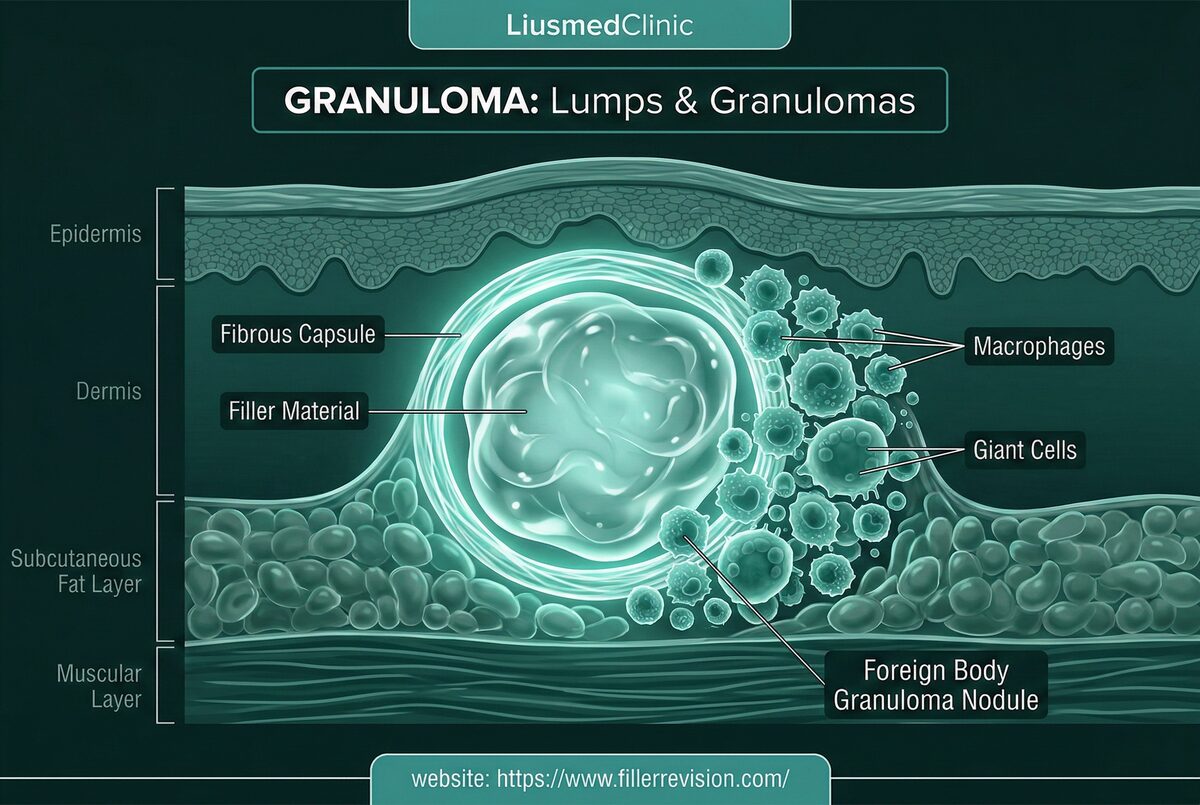
A foreign body granuloma is an organized chronic inflammatory reaction where the immune system forms a dense capsule of macrophages, giant cells, and fibrous tissue around filler material it cannot break down. Unlike simple nodules, granulomas are active immunological processes that can grow, fluctuate, and spread along tissue planes. They can develop with any filler type—including HA, biostimulators, fat, and permanent fillers—and may appear months to years after injection. The unpredictable timing and progressive nature make granulomas one of the most distressing filler complications for patients.
Three Core Strengths of Liusmed Revision

Clean Removal
Stubborn masses are removed completely so residual tissue does not keep flaring.

Even Result
After removal the surface stays smooth, without new dents or waviness.

Precise, Not Excessive
Like fat grafting in reverse — the amount and location removed are judged precisely.
Common Symptoms
The Foreign Body Immune Cascade
Granuloma formation represents the body's most aggressive response to material it identifies as foreign and cannot enzymatically degrade. Macrophages engulf filler particles but cannot break them down, fusing into multinucleated giant cells. These cells release inflammatory cytokines that recruit more immune cells, creating an escalating cycle of inflammation and fibrosis. The resulting granuloma has a characteristic layered architecture: a central core of filler material surrounded by giant cells, then a ring of inflammatory infiltrate, encased in a dense fibrous capsule. This process can be triggered months or years after injection by immune system activation—explaining why granulomas often appear after unrelated illness, vaccination, dental work, or periods of significant stress.
Why Traditional Treatments Fail
Limitations of Immunosuppressive Treatment
The standard treatment—intralesional corticosteroid injection—suppresses the inflammatory component and can temporarily shrink the granuloma. However, it does not remove the foreign body trigger at the core. Once steroid effects dissipate, the immune system re-engages and the granuloma recurs, often with increased fibrosis from each inflammatory cycle. Repeated steroid injections cause cumulative tissue damage: fat atrophy creating visible skin depressions, dermal thinning, telangiectasia, and hypopigmentation that can be more disfiguring than the original granuloma. Other immunomodulatory agents carry similar limitations—they manage symptoms without addressing the root cause. Only physical removal of the foreign body source provides definitive resolution.
“Steroids only buy time—they suppress the immune reaction but the foreign body is still there, waiting. Complete extraction of the capsule and its contents is the approach that fundamentally addresses a granuloma.”
Dr. LiuSource Elimination, Not Symptom Suppression
Ultrasound-Guided Pinhole Micro-Extraction
A granuloma is not a disease — it's the immune system doing exactly what it's supposed to do: attacking a foreign body it cannot break down. Suppressing the immune response with steroids is fighting the wrong enemy. The only definitive solution is removing what the immune system is reacting to.
The Foreign Body Is the Problem, Not the Immune System
Immunosuppression treats the symptom (inflammation) while leaving the cause (foreign body) intact. This is why granulomas always recur after steroids wear off.
Every Steroid Cycle Adds Damage
Each round of inflammation, steroid suppression, and recurrence adds more fibrosis to the area. This makes the condition progressively harder to treat and the tissue progressively more scarred.
One Extraction Breaks the Cycle
Complete removal of the foreign body and its inflammatory capsule removes the trigger at its source. The goal is to break the recurring cycle of flares, steroids, and uncertainty.
Complete Capsule Extraction
We target the root cause: complete removal of the foreign body and its surrounding inflammatory capsule. Using ultrasound to precisely map the granuloma borders—including any satellite lesions—we extract the entire capsule intact through a minimal incision. This removes both the filler trigger and the organized immune tissue, eliminating the source of chronic inflammation rather than merely suppressing symptoms.
Border Mapping
Local + Gentle Pain-Relief Anesthesia
Capsule Extraction
Anti-inflammatory Protocol
Common Questions
Is it cancer?
Will I have a dent after removal?
How long after injection do granulomas appear?
Can steroids cure granulomas permanently?
What causes a granuloma to suddenly flare up?
Do I need a biopsy before granuloma removal?
Can granulomas spread to other areas?
Not sure what is going on? Write it down and ask.
Describe what was injected, when, and what you are seeing now. Dr. Ta-Ju Liu replies in the thread with an educational explanation of what it might be, what needs to be told apart, and which signs mean you should be seen soon. Posting can be anonymous, and other patients with the same problem can read the answer too.
Replies are general health education, not a diagnosis, and do not replace an in-person examination.