
Hyaluronic Acid (HA) Complications
While HA fillers are marketed as temporary and dissolvable, complications such as migration, encapsulation, chronic edema, and the Tyndall effect (bluish tint) can persist for years. Studies show that HA filler can remain detectable on ultrasound up to 10 years post-injection, particularly when encapsulated by fibrotic tissue. These complications are often undertreated because traditional dissolution relies on enzyme penetration—which fails when a scar capsule has formed around the product.
Three Core Strengths of Liusmed Revision

Clean Removal
Stubborn masses are removed completely so residual tissue does not keep flaring.

Even Result
After removal the surface stays smooth, without new dents or waviness.

Precise, Not Excessive
Like fat grafting in reverse — the amount and location removed are judged precisely.
Common Symptoms
The Mechanics of HA Complications
HA filler complications arise from multiple interrelated mechanisms. Repeated injections in the same area create layered deposits that compress and displace tissue planes. Over time, muscle movement pushes product into pockets of least resistance—explaining migration patterns from lips to the perioral shelf or from tear troughs to the malar region. Low-cohesivity products are particularly prone to spreading. When HA persists beyond its expected lifespan, the body mounts a foreign body response, forming a fibrous capsule around the deposit. This encapsulation effectively shields the filler from enzymatic dissolution, creating the frustrating clinical scenario where hyaluronidase injections produce no visible improvement.
Why Traditional Treatments Fail
Limitations of Enzyme Dissolution
Hyaluronidase is the standard treatment for HA complications, but its efficacy drops dramatically when the filler is encapsulated. The enzyme cannot penetrate the dense fibrous capsule wall, leaving the core filler intact. Blind injection of hyaluronidase also risks dissolving the patient's own native hyaluronic acid in surrounding tissue, causing volume loss and tissue hollowing in unintended areas. Repeated high-dose enzyme treatments can trigger allergic sensitization. Furthermore, without imaging guidance, clinicians cannot verify whether the filler has actually been dissolved or simply compressed to a different plane—leading to multiple ineffective treatment cycles.
“The biggest misconception is that all HA filler can be dissolved with enzyme alone. Once a capsule forms, you need to physically break through the wall first—that's where ultrasound guidance becomes indispensable.”
Dr. LiuWhy 'Just Dissolve It' Often Fails
Ultrasound-Guided Pinhole Micro-Extraction
Long-standing HA filler develops fibrous capsules that physically block enzyme from reaching the product inside. The single most important diagnostic question is whether a deposit is encapsulated or free-flowing — because this distinction alone determines whether enzyme injection will work or whether a completely different dual-mechanism approach is needed.
The Capsule Problem
Repeated enzyme injections fail when fibrous encapsulation physically prevents the enzyme from reaching the filler core. The longer filler stays in tissue, the thicker the wall becomes and the greater the resistance to dissolution.
One Product, Two Realities
Encapsulated and free-flowing HA require fundamentally different treatment strategies. Treating them the same way is the number one reason for failed dissolution attempts.
Complete Clearance, Not Partial Reduction
The goal is verifiable complete removal — not repeated partial dissolution sessions that leave residual product behind. Real-time imaging confirms clearance before you leave the clinic.
Ultrasound-Guided Targeted Removal
We use high-frequency ultrasound to visualize every filler deposit in real time, identifying encapsulated versus free-flowing product. For encapsulated HA, we first perform capsulotomy—mechanically disrupting the fibrous wall—before delivering enzyme directly into the exposed core. For product that has migrated or formed deep deposits, we use direct needle aspiration under ultrasound guidance. This dual physical-plus-biochemical approach resolves cases that pure enzymatic dissolution cannot; removal is usually staged — about 30–50% the first time and about 80–90% over two or three sessions, not a guaranteed 100%.
Ultrasound Mapping
Capsule Disruption
Targeted Dissolving/Aspiration
Compression & Verification
Common Questions
Can all HA filler be removed?
Will my skin sag after removal?
Why doesn't hyaluronidase work on my filler lump?
How long does HA filler removal take?
Can I get filler again after removal?
What does encapsulated filler look like on ultrasound?
Is HA filler removal painful?
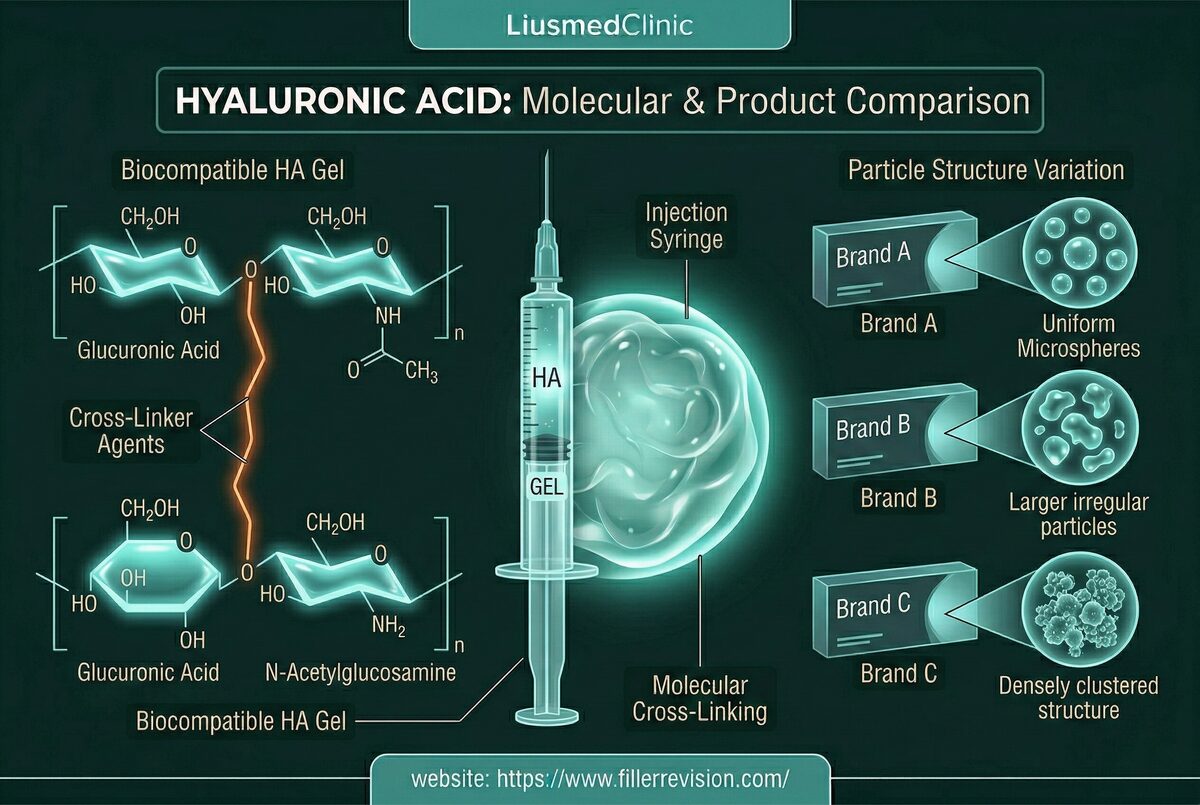
Composition, brands, and removability — compiled on our filler-revision specialty site.
Not sure what is going on? Write it down and ask.
Describe what was injected, when, and what you are seeing now. Dr. Ta-Ju Liu replies in the thread with an educational explanation of what it might be, what needs to be told apart, and which signs mean you should be seen soon. Posting can be anonymous, and other patients with the same problem can read the answer too.
Replies are general health education, not a diagnosis, and do not replace an in-person examination.