
Overfilled Syndrome / Pillow Face
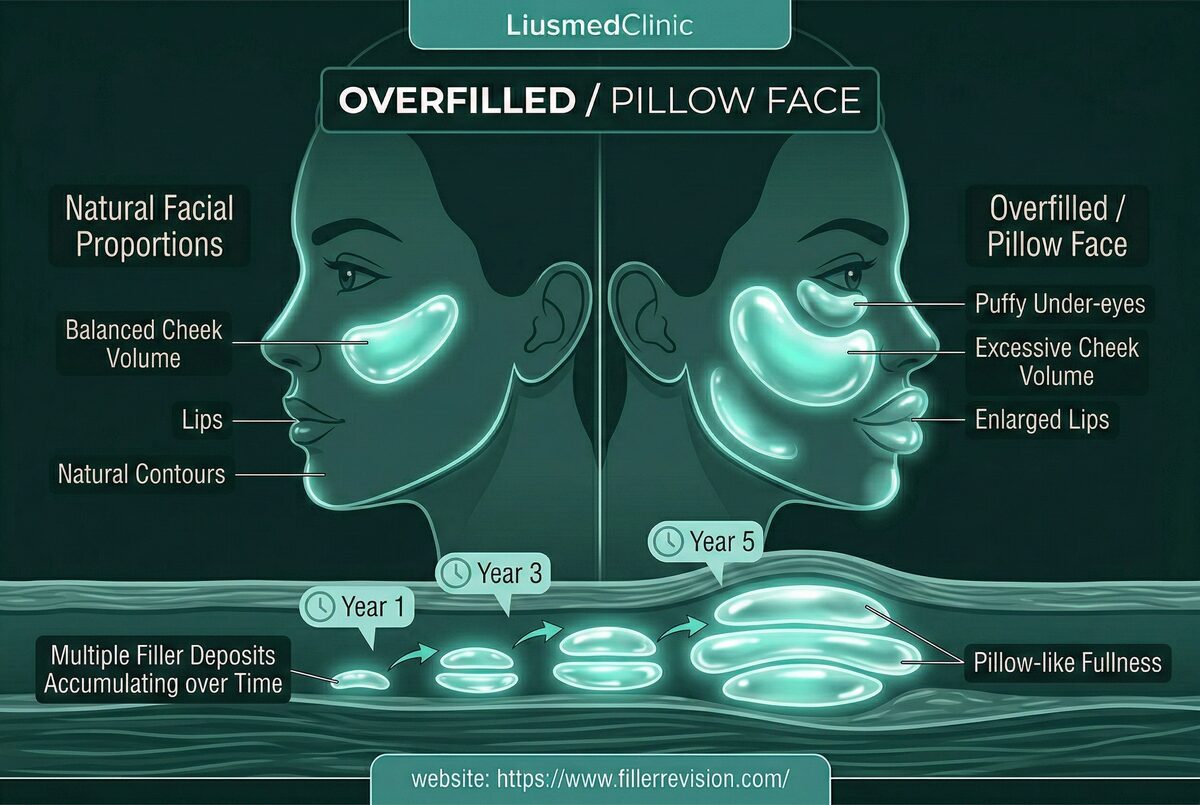
Overfilled syndrome—colloquially known as 'pillow face,' 'filler fatigue,' or 'filler face'—results from cumulative volume overload after years of repeated filler injections. The face loses its natural contours, light-shadow dynamics, and movement patterns. Studies show that patients who receive regular filler treatments over 5+ years may accumulate 2-4x more residual volume than they realize, as products persist far longer than their marketed duration. This condition requires a fundamentally different treatment philosophy: planned volumetric reduction as a form of 'reductive sculpting' rather than simple dissolution.
Three Core Strengths of Liusmed Revision

Clean Removal
Stubborn masses are removed completely so residual tissue does not keep flaring.

Even Result
After removal the surface stays smooth, without new dents or waviness.

Precise, Not Excessive
Like fat grafting in reverse — the amount and location removed are judged precisely.
Common Symptoms
The Cumulative Volume Trap
Overfilled syndrome develops gradually through a predictable cycle. Fillers are marketed with durations of 6-18 months, but imaging studies demonstrate that product can persist for 5-10+ years. When new filler is injected before the previous volume has been absorbed, layers accumulate—compressing native tissue, stretching the skin envelope, and weighing down the facial framework. The skin adapts to the expanded volume, creating a visual 'new normal' that both patient and injector unconsciously calibrate to. Each subsequent treatment adds to the total burden. The face gradually loses its skeletal definition, dynamic movement becomes restricted, and gravity pulls the excessive volume downward—paradoxically accelerating the aged, heavy appearance that filler was meant to prevent.
Why Traditional Treatments Fail
The Dissolve-and-Deflate Fear
The primary barrier to treatment is psychological: patients fear that removing their filler will make them look aged or deflated. This fear is often reinforced by injectors who benefit from continued treatments. Blanket hyaluronidase dissolution—dissolving everything at once—can indeed produce an initial 'deflated' appearance because it removes all product indiscriminately, including volume in areas that still benefit from support. The key is strategic reduction, not total removal. Without ultrasound guidance, clinicians cannot differentiate between excess volume causing distortion and volume that is contributing to proper facial support—leading to over-correction in some areas and under-correction in others.
“Overfilled syndrome is the one complication where subtraction gives you more than addition ever could. The goal is to restore your natural architecture, not to take everything away.”
Dr. LiuYour Face Is Buried Under Volume, Not Aged
Ultrasound-Guided Pinhole Micro-Extraction
The paradox of overfilled syndrome is that patients fear looking older without their filler — when in reality, the excess volume IS what makes them look older. Heavy, stiff, gravity-affected faces with lost skeletal definition are the hallmark of overfilling, not aging. Strategic reduction reveals the youthful architecture that was always there.
Subtraction Gives You More Than Addition
Removing excess volume restores cheekbone definition, jawline contour, and the light-shadow dynamics that define youthful appearance — things no amount of additional filler can achieve.
Staged Reduction Prevents the Feared 'Deflation'
The biggest psychological barrier is fear of looking deflated. A gradual, staged approach lets patients see improvement at each step, building confidence that less truly is more.
Restoring Dynamics, Not Just Shape
The goal isn't just a better-looking resting face. It's restoring natural facial movement — the ability to smile, laugh, and express without restriction.
Strategic Volumetric Sculpting
We treat overfilled syndrome as a reductive sculpting procedure—carefully planned volumetric reduction through pinholes, not wholesale dissolution. Using ultrasound, we create a comprehensive filler volume map showing the location and quantity of product in every facial compartment. We then selectively reduce excess volume in the areas causing the most distortion (typically lower cheeks, perioral region, and periorbital areas) while preserving beneficial volume in structural areas (temples, chin, mid-cheek highlights). The result is restoration of natural facial architecture and dynamic movement.
Comprehensive Volume Assessment
Targeted Reduction by Zone
Skin Retraction Protocols
Staged Refinement
Common Questions
Will I look older after reducing my filler?
Can you remove filler from specific areas only?
How much filler is too much?
Do I need to remove all filler at once?
How fast is recovery?
Will my skin sag after removing so much filler?
Can I still get filler after correction?
Not sure what is going on? Write it down and ask.
Describe what was injected, when, and what you are seeing now. Dr. Ta-Ju Liu replies in the thread with an educational explanation of what it might be, what needs to be told apart, and which signs mean you should be seen soon. Posting can be anonymous, and other patients with the same problem can read the answer too.
Replies are general health education, not a diagnosis, and do not replace an in-person examination.