
Permanent Filler Removal (Silicone/PMMA)
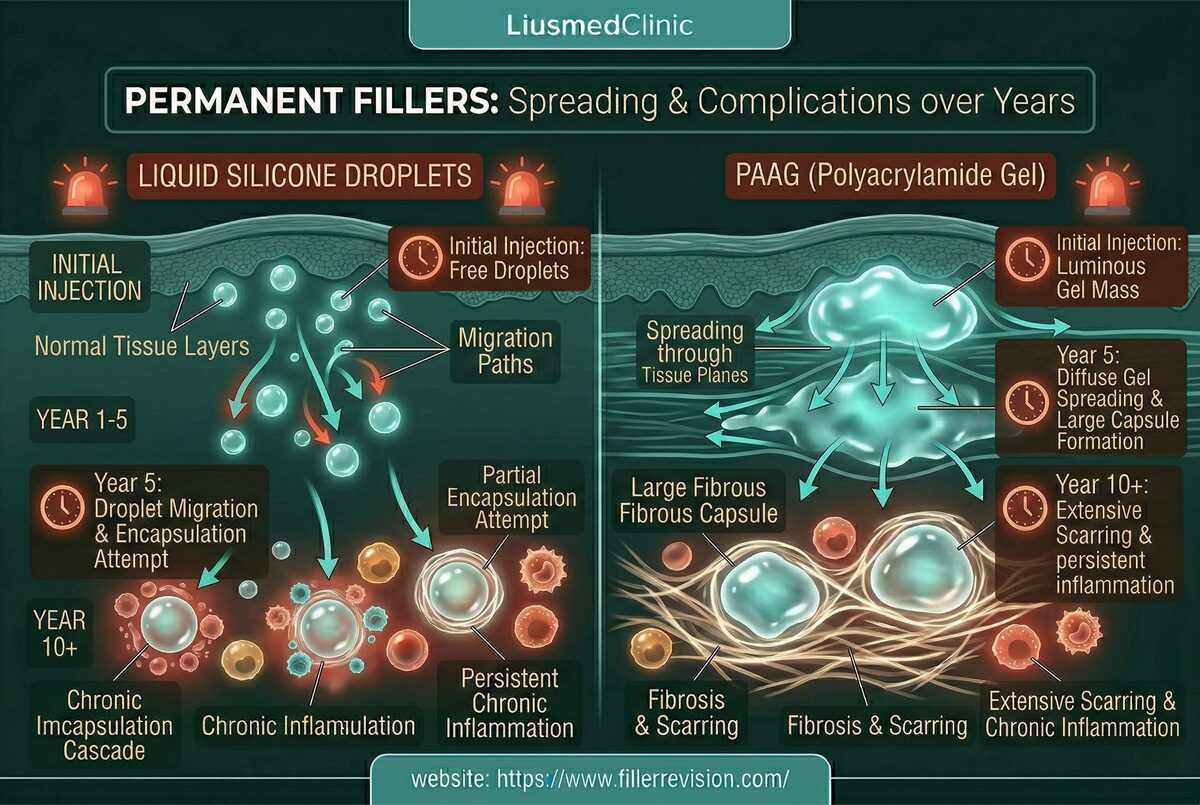
Permanent fillers—including silicone oil, polyacrylamide gel (Aquamid), polymethylmethacrylate (PMMA/Bellafill), and polyalkylimide (Bio-Alcamid)—are designed to last indefinitely but frequently develop late-onset complications years to decades after injection. Published literature documents complication rates of 1-5% per year with cumulative risk over decades. These materials cannot be dissolved by any enzyme or medication, and their long-term tissue integration makes removal significantly more complex than temporary filler complications. Many patients are told by multiple doctors that nothing can be done—but minimally-invasive debulking can safely resolve symptoms and restore contours.
Three Core Strengths of Liusmed Revision

Clean Removal
Stubborn masses are removed completely so residual tissue does not keep flaring.

Even Result
After removal the surface stays smooth, without new dents or waviness.

Precise, Not Excessive
Like fat grafting in reverse — the amount and location removed are judged precisely.
Common Symptoms
Biofilms, Gravity & Chronic Foreign Body Response
Permanent fillers present a unique combination of challenges. Their non-biodegradable surfaces provide an ideal substrate for bacterial biofilm formation—organized bacterial communities protected by a slime matrix that renders them resistant to antibiotics. These biofilms cause cyclical inflammation that can persist for decades. Simultaneously, the weight of the material and the forces of gravity cause progressive downward displacement over years—silicone oil pools in dependent areas, gel-type fillers sag along fascial planes. The body's chronic foreign body response leads to progressive fibrosis and tissue distortion. Unlike temporary fillers, the body cannot break these materials down, so complications compound over time without treatment.
Why Traditional Treatments Fail
The 'Inoperable' Myth
Many plastic surgeons refuse to treat permanent filler complications because open surgical excision—the only approach they are trained in—requires large incisions that leave conspicuous scars, risks motor nerve damage causing facial paralysis, and often produces incomplete removal with significant tissue destruction. Patients are frequently told 'nothing can be done' or 'just live with it.' Some undergo repeated courses of steroids or antibiotics that suppress symptoms temporarily but never address the underlying foreign body. This therapeutic nihilism leaves patients suffering unnecessarily for years when minimally-invasive alternatives exist.
“The word 'permanent' describes the material, not your situation. In most cases, we can safely extract enough material through pinholes to resolve your symptoms and give you your face back.”
Dr. Liu'Untreatable' Is a Myth, Not a Medical Fact
Ultrasound-Guided Pinhole Micro-Extraction
The most damaging aspect of permanent filler complications isn't the material itself — it's being told nothing can be done. This therapeutic nihilism reflects unfamiliarity with modern minimally-invasive techniques, not the actual limits of medicine. Substantial symptom relief and contour restoration is achievable for the vast majority of patients.
60-80% Reduction Changes Everything
Complete removal isn't always possible, but it's rarely necessary. Reducing the bulk material by 60-80% is typically sufficient to resolve inflammation, stop progression, and restore natural contours.
Progressive, Not Aggressive
Attempting complete removal in one session risks tissue damage. A staged approach respects tissue healing capacity and produces better long-term results with less risk.
Biofilm Management Is Part of the Solution
Many permanent filler complications involve subclinical biofilm colonization. Addressing the microbial component alongside material reduction breaks the inflammation cycle that drives ongoing symptoms.
Progressive Minimally Invasive Debulking
We don't promise 100% removal—which is often impossible without destructive surgery—but we safely remove 60-80% of the bulk material through pinhole-sized entries. This is sufficient to resolve symptoms, stop chronic inflammation, and restore natural facial contours. Using ultrasound to map the material and critical structures, we perform multi-session progressive debulking that maximizes result while minimizing tissue trauma.
Mapping Vital Structures
Micro-Dissection & Loosening
Multi-Point Aspiration
Antibiotic Irrigation
Common Questions
Can permanent filler be completely removed?
Can you remove silicone oil?
I was told nothing can be done. Is that true?
How many sessions are needed?
Is it dangerous?
What happens if permanent filler is left untreated?
Will my face look normal after removal?
Composition, brands, and removability — compiled on our filler-revision specialty site.
Not sure what is going on? Write it down and ask.
Describe what was injected, when, and what you are seeing now. Dr. Ta-Ju Liu replies in the thread with an educational explanation of what it might be, what needs to be told apart, and which signs mean you should be seen soon. Posting can be anonymous, and other patients with the same problem can read the answer too.
Replies are general health education, not a diagnosis, and do not replace an in-person examination.