
RE2O Particulated Human ADM Skin-Booster Complications: Ultrasound Typing & Pinhole Micro-Extraction
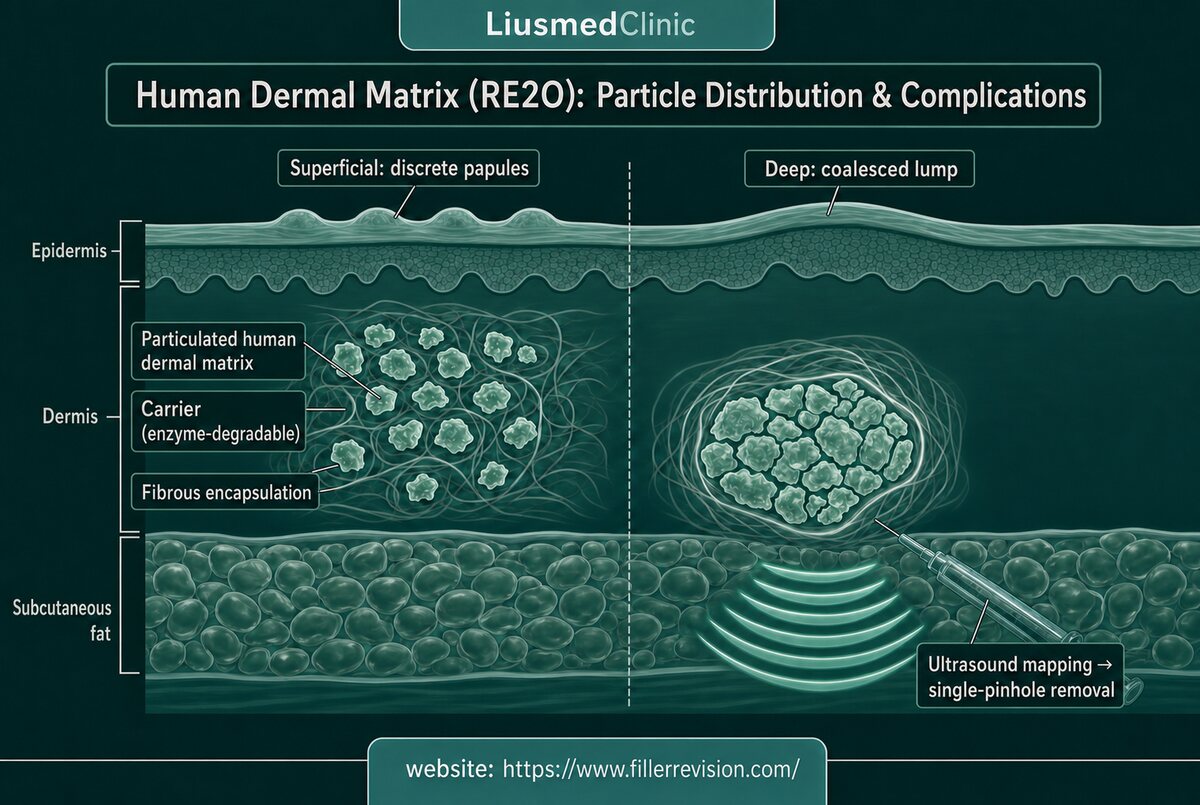
RE2O (Elravie Re2O) is a skin booster made from donor human dermis that has been decellularized and milled into particles (phADM), suspended in a hyaluronic-acid carrier and injected into the dermis. It is a human dermal matrix — not hyaluronic acid, and not simply a collagen solution. It is not approved in Taiwan; most patients we see had it injected in Korea and came home looking for help. Placed too shallow (treated like an ordinary skin booster) it tends to leave raised bumps, redness, inflammation and pigmentation; placed too deep or piled up along a ligament it can consolidate into a firm mass. The catch is that it is only half-reversible: hyaluronidase dissolves the HA carrier, but the human-dermis particles will not dissolve. For these RE2O / human-ADM particulated skin-booster complications that hyaluronidase cannot handle, we offer high-frequency ultrasound typing, inflammation and infection assessment, superficial papule repair, and image-guided pinhole micro-extraction. How much can actually be removed depends on the location, extent and degree of fibrosis of the material and the important structures around it.
Three Core Strengths of Liusmed Revision

Clean Removal
Stubborn masses are removed completely so residual tissue does not keep flaring.

Even Result
After removal the surface stays smooth, without new dents or waviness.

Precise, Not Excessive
Like fat grafting in reverse — the amount and location removed are judged precisely.
Common Symptoms
It comes down to the material and the injection depth
The main body of RE2O is human decellularized dermis milled into particles, suspended in non-crosslinked hyaluronic acid and marketed for skin quality, elasticity, fine lines and pores. What sets it apart from hyaluronic acid is that those dermal particles are a foreign solid the body reacts to. Placed too shallow — spread through the upper dermis like an ordinary skin booster — the particles become visible and palpable and can drive inflammation and pigmentation. Placed too deep, or piled up at a ligament, they consolidate into a mass wrapped in fibrous tissue. So the same RE2O ends up as 'scattered bumps' or 'one firm lump' depending on which layer it went into and how much was placed — which is exactly why repair starts by telling those two patterns apart.
Why Traditional Treatments Fail
Why the lump is still there after hyaluronidase
Many people have hyaluronidase, watch the swelling drop a little while the lump stays, and assume treatment failed. It is actually expected: in the RE2O mixture only the HA carrier can be broken down by hyaluronidase — the human-dermis collagen, elastin and proteoglycan particles will not dissolve. So 'the swelling eases a bit but comes back' does not mean failure, and does not mean the RE2O has been dissolved — it was only ever the carrier that could go. As for collagenase, there is no standardized dose or safety data for RE2O, and it does not selectively target foreign dermal matrix — it can also break down your own collagen. It is an option to weigh very conservatively, not a cure.
“First we find out which product you had and which layer it went into. RE2O is a human dermal matrix, not hyaluronic acid — enzyme cannot dissolve that half. Material consolidated into one lump, we locate on ultrasound and take out through a single pinhole — which solves more than dissolving and suppressing over and over. How much I can remove, I will tell you honestly — it depends on where the material is, how deep, and how fibrotic.”
Dr. LiuForeign particles come out by physical debulking
Ultrasound-guided single-pinhole micro-extraction
Handling human-dermis particles like RE2O follows the same logic as the hardened lumps and filler masses I have worked with for years: see it clearly first, then physically debulk and extract consolidated foreign material rather than chasing something insoluble with more enzyme or steroid. I have over a decade of experience with subcutaneous lumps and fibrosis, and in recent years have handled a number of RE2O complication cases. The real answer is to type it, rule out infection, repair what should be repaired and remove what should be removed — not to treat every lesion as hyaluronic acid to be dissolved.
First tell apart which product and which layer
RE2O is a human dermal matrix — not hyaluronic acid, and not just a collagen solution. Repair starts by seeing on ultrasound which layer the material is in and whether it is scattered papules or a consolidated lump, so the treatment matches the problem.
Say the half-reversibility up front
Hyaluronidase only dissolves the HA carrier; the human-dermis particles do not dissolve. Swelling that eases then returns is not failure — it is that only half of it ever could go. Understanding this stops the endless repeat rounds of dissolver.
Consolidated material comes out through a pinhole
Non-inflamed, consolidated material is best suited to image-guided single-pinhole micro-extraction. How much comes out, I will bound honestly — meaningful debulking, not a guarantee of one hundred percent.
Type it, rule out infection, then decide how to remove it
With RE2O complications we do not rush to keep injecting hyaluronidase or keep suppressing with steroids. First we type it under high-frequency ultrasound (with Doppler): superficial scattered papules, or a deep consolidated mass. For recurrently inflamed cases, we do not go straight to high-dose steroid before infection is ruled out — an ordinary swab sometimes misses the organism, and a less common nontuberculous mycobacterial (NTM) infection has to be considered when warranted. Superficial papules are managed with repair; consolidated, non-inflamed material is best suited to image-guided single-pinhole micro-extraction or debulking.
High-frequency ultrasound (+Doppler) typing — which layer, scattered or consolidated
Inflammation and infection assessment: no high-dose steroid before infection is excluded; consider NTM when warranted
Superficial papule repair, addressing inflammation and pigmentation
Image-guided single-pinhole micro-extraction / debulking of consolidated material
Common Questions
Why didn't the lump fully go after hyaluronidase?
Does RE2O always have to be removed?
Why rule out infection first?
How much can be removed?
Not sure what is going on? Write it down and ask.
Describe what was injected, when, and what you are seeing now. Dr. Ta-Ju Liu replies in the thread with an educational explanation of what it might be, what needs to be told apart, and which signs mean you should be seen soon. Posting can be anonymous, and other patients with the same problem can read the answer too.
Replies are general health education, not a diagnosis, and do not replace an in-person examination.