
Post-Vascular Occlusion Recovery & Repair
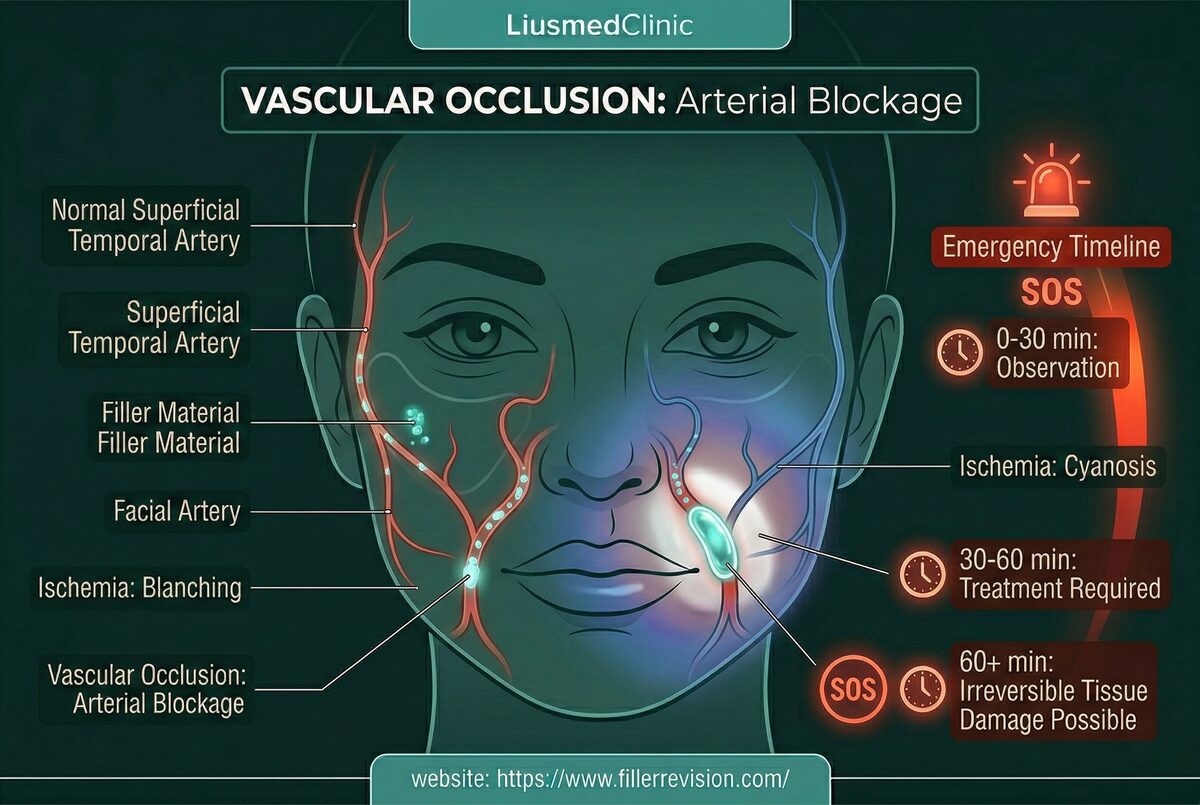
After a vascular occlusion event, even with successful emergency dissolution, ischemic damage and reperfusion injury can cause skin ulceration, necrosis, dendritic pigmentation, and nerve damage. We provide evidence-based, multi-modal recovery protocols to rescue the 'ischemic penumbra' zone and minimize permanent scarring.
Three Core Strengths of Liusmed Revision

Clean Removal
Stubborn masses are removed completely so residual tissue does not keep flaring.

Even Result
After removal the surface stays smooth, without new dents or waviness.

Precise, Not Excessive
Like fat grafting in reverse — the amount and location removed are judged precisely.
Common Symptoms
The Ischemia-Reperfusion Cascade
Tissue damage occurs in two waves. First, ischemia starves cells of oxygen and nutrients. Second, when flow is restored, a surge of reactive oxygen species (ROS) causes 'reperfusion injury'—paradoxically damaging cells more than the ischemia itself. The surrounding 'ischemic penumbra' zone contains viable but vulnerable cells that can still be rescued with timely intervention. Without proper recovery protocols, these cells die, expanding the necrotic zone into permanent scars and pigmentation.
Why Traditional Treatments Fail
The Neglected Recovery Phase
Most clinics focus exclusively on the acute emergency—dissolving the blockage. But the real battle for tissue survival happens in the weeks that follow. Without pharmacological vasodilation to establish collateral circulation, without hyperbaric oxygen to rescue the penumbra zone, and without proper moist wound management, patients are left with disfiguring dendritic scars, permanent pigmentation irregularities, and nerve damage that could have been significantly reduced.
“Vascular occlusion emergencies should be handled at the ER. What we specialize in is the critical recovery window after—rescuing the ischemic penumbra, preventing permanent scarring, and restoring tissue that others assume is already lost.”
Dr. LiuMulti-Modal Tissue Recovery Protocol
Based on the latest clinical evidence, our recovery protocol targets every stage of post-occlusion healing. Functional repair IV drips with vasodilatory and cytoprotective agents rescue ischemic tissue and improve microcirculation. Hyperbaric oxygen delivers dissolved oxygen directly past the blockage. Photobiomodulation (LLLT) activates cellular energy production and modulates inflammation. Regenerative medicine and advanced moist wound care accelerate tissue regeneration and minimize scar formation.
Wound Assessment & Ischemia Staging
Functional Repair IV & Microcirculation Support
Hyperbaric Oxygen Therapy (HBOT)
Photobiomodulation, Wound Care & Scar Prevention
Common Questions
Do you treat the acute emergency (vascular occlusion itself)?
When should I start post-occlusion recovery treatment?
What makes your repair IV drip different from regular IV therapy?
How does hyperbaric oxygen help post-occlusion recovery?
Can the dendritic (branching) pigmentation and scars be improved?
Can nerve damage from vascular occlusion recover?
Not sure what is going on? Write it down and ask.
Describe what was injected, when, and what you are seeing now. Dr. Ta-Ju Liu replies in the thread with an educational explanation of what it might be, what needs to be told apart, and which signs mean you should be seen soon. Posting can be anonymous, and other patients with the same problem can read the answer too.
Replies are general health education, not a diagnosis, and do not replace an in-person examination.