Chin Tightness & Foreign Body Sensation After Filler
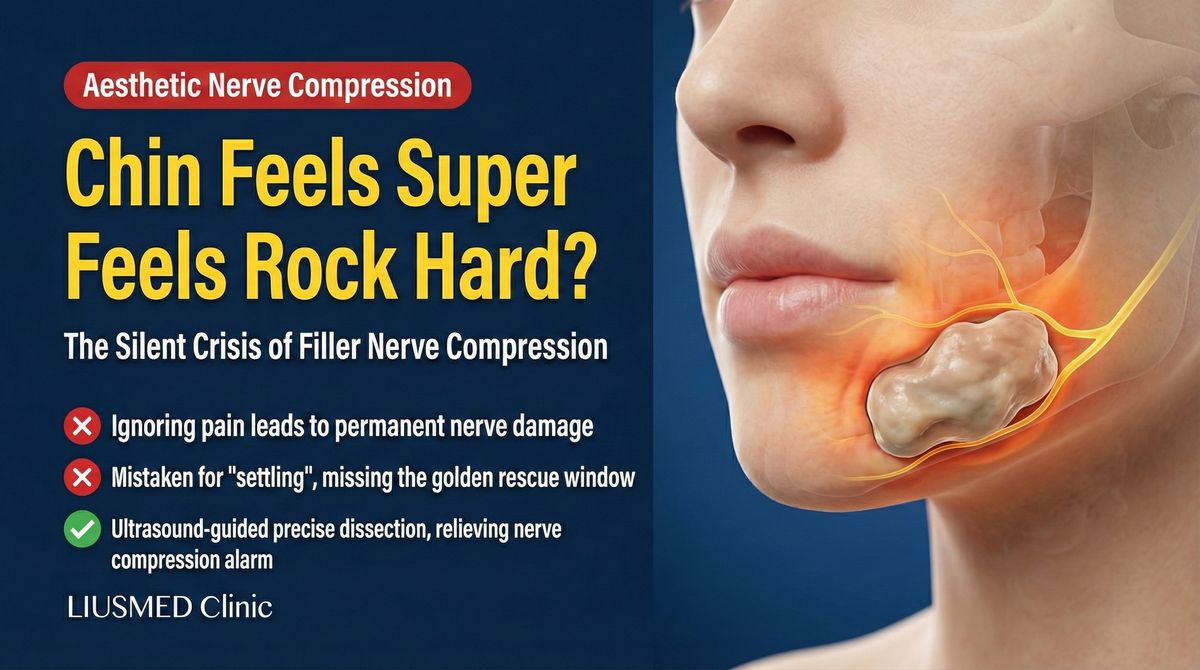
That Mass in Your Chin—You Feel It Every Day
You had filler injected into your chin to improve your profile. The procedure went smoothly, but weeks later you begin noticing a persistent sensation—a constant tightness in the chin area, as though something is "stuffed" inside. Opening your mouth, chewing, even looking down at your phone, you can feel the foreign presence. More worryingly, sometimes the lower lip or chin skin feels numb or tingly.
These sensations are real, and they are telling you something important.
Chin Anatomy: Why This Area Is Especially Sensitive
The Mental Nerve—A Critical Player Hidden in Bone
The chin region contains an extremely important nerve—the mental nerve. It is the terminal branch of the inferior alveolar nerve, emerging from the mental foramen of the mandible, supplying sensation to the lower lip, chin skin, and gingiva.
| Anatomical Structure | Clinical Significance | Filler Risk |
|---|---|---|
| Mental foramen (nerve exit) | Bony opening below the second premolar | Nearby injection may directly compress |
| Mental nerve branches | Fan-shaped distribution to lower lip and chin | Large filler volumes may compress branches |
| Periosteum | Thin membrane covering the mandible surface | Supraperiosteal injection is safest |
| Mentalis muscle | Primary muscle of chin projection | Intramuscular injection may affect function |
| Subcutaneous fat layer | Relatively thin in chin region | Filler easily palpable |
Key Insight: The chin is one of the higher-risk areas for nerve injury during filler injection. Even if filler does not directly contact the nerve, the space it occupies may indirectly compress the nerve or its branches.
Three Sources of Chin Foreign Body Sensation
Source 1: Physical Compression
Filler occupies space that was not there before. If injected near the mental nerve or its branches, the volume effect produces nerve compression, causing persistent foreign body sensation, intermittent numbness, tingling or electric-shock sensations, and lower lip hypoesthesia.
Source 2: Fibrous Encapsulation
Over time, the body forms a fibrous capsule around the filler (see encapsulation). This capsule increases total volume and worsens compression, transforms soft gel into a hard mass, restricts normal tissue mobility creating rigidity, and may extend to envelop nearby nerve bundles.
Source 3: Filler Migration
The chin experiences significant mechanical forces—chewing, speaking, resting on hands. These daily activities can gradually push filler from its original position, potentially moving it closer to nerves.
When Foreign Body Sensation Warrants Concern
| Sensation | Normal Post-Procedure | Signal Requiring Attention |
|---|---|---|
| Tightness | Gradually resolves within 1–2 weeks | Persists or worsens beyond 2 weeks |
| Foreign body feeling | Mild initial awareness possible | Persistent and affecting daily activities |
| Numbness | Temporary from local anesthetic on procedure day | Present days later or newly appearing |
| Tingling | Uncommon | Any persistent tingling needs evaluation |
| Chewing discomfort | Mild initial discomfort from swelling | Chewing difficulty persisting after swelling resolves |
| Lower lip sensation change | Uncommon | Any persistent lower lip sensation change |
Key Insight: "Feeling something" is not necessarily bad—in the first week or two, your body is adjusting to newly introduced material. But if the sensation does not diminish after two weeks, worsens, or new neurological symptoms appear, it demands serious attention.
The Role of Ultrasound in Chin Complications
Ultrasound is particularly valuable in chin assessment because it can locate the mental foramen and mental nerve, show the distance between filler and nerve to assess compression severity, evaluate capsule thickness, detect filler migration, and guide treatment to avoid nerve damage during extraction.
Treatment Strategies
Conservative Management
If symptoms are mild and improving: observation with follow-up ultrasound, avoiding activities that worsen compression (e.g., chin resting on hands), and neuropathic pain medication if needed.
Hyaluronidase (enzyme that dissolves HA filler) Injection
If filler is HA (Hyaluronic Acid — sugar molecule naturally in skin, holds water) without encapsulation: ultrasound-guided precise injection to the compressive filler area. Selective partial dissolution for decompression—complete removal may not be necessary.
Ultrasound-Guided Pinhole Extraction
If filler is encapsulated, non-HA, or hyaluronidase fails: pinhole extraction under real-time imaging, precise removal of nerve-compressing filler, simultaneous release of fibrotic tissue encasing nerves, continuous nerve position monitoring for safety.
Filler Material Risks for the Chin
| Material | Foreign Body Risk | Nerve Compression Risk | Treatment Difficulty |
|---|---|---|---|
| Hyaluronic acid | Medium | Medium (dissolvable for decompression) | Lower |
| Calcium hydroxylapatite | Medium–high | Medium–high (not dissolvable) | Medium |
| Polycaprolactone | Medium | Medium | Medium |
| PMMA | High | High | High |
| Silicone implant | Variable | Medium (may encapsulate nerve) | Requires surgery |
Prevention
- Thorough anatomical knowledge: Choose a physician deeply familiar with chin anatomy
- Appropriate volume: Subcutaneous space in the chin is limited—do not over-inject in a single session
- Correct plane: Supraperiosteal is the relatively safer injection plane
- Follow-up assessment: Post-injection monitoring for early problem detection
Common questions
Is it normal for my chin to feel tight after filler?
For the first week or two, some tightness or awareness is usually just your body adjusting to the new material, and it tends to settle down. What's worth a second look is tightness that hangs on past two weeks, keeps getting stronger, or fades and then comes back — that's not a simple healing reaction.
Should I worry about numbness or tingling in my lower lip or chin?
There's a nerve running through this area called the mental nerve, and it supplies feeling to your lower lip and chin skin. If filler sits close to it or the volume presses on it, you can get numbness or tingling. A little numbness on the day of the injection from the anesthetic is one thing, but numbness that's still there days later, or a new tingling that shows up, is worth having evaluated rather than pushing through.
Why is chin filler so easy to feel?
The fat layer under the chin skin is fairly thin to begin with, so filler placed there is easy to feel. On top of that, the mental nerve runs right through this region and the space is limited, so the chin tends to be more sensitive than other areas that get filler.
I didn't get HA filler and dissolver won't work — is there still an option?
Yes. HA can be broken down with an enzyme, but materials like calcium hydroxylapatite or PMMA don't dissolve, and neither does filler that's already wrapped in a fibrous capsule. For those, ultrasound-guided pinhole extraction lets us take out the part pressing on the nerve under live imaging, and release the tissue wrapped around the nerve at the same time.
Do I have to remove all of the filler?
Not necessarily. The point is to deal with the portion that's causing the compression and the discomfort. With HA, for example, we can dissolve just the part pressing on the nerve under ultrasound to take the pressure off, rather than clearing the whole thing. What makes sense depends on your material, whether it's encapsulated, and your symptoms.
Do Not Endure Foreign Body Sensation
If you can feel the filler in your chin every day, or if numbness, tingling, or other nerve symptoms have appeared, do not accept it as "the normal price to pay." Filler should not cause persistent discomfort in daily life.
Seek professional evaluation early. Ultrasound can clarify the spatial relationship between filler and nerves, enabling a safe and effective treatment plan.
Schedule a consultation to restore your chin to natural comfort.
Related Reading
- Why Dissolvers Fail: The Encapsulation Problem
- The Complete Filler Repair Evaluation Process
- Found a Lump Years After Injection? Do Not Rush to Dissolve
- Chin & Jawline Filler Removal & Contour Revision (by area)
- Which material for the chin, and dissolve vs remove (filler-revision specialty site)
Related Services

Specialties
Credentials
- Kaohsiung Medical University, School of Medicine
- Attending Physician, Dermatology, Kaohsiung Chang Gung Memorial Hospital
- Attending Physician, Aesthetic Center, Kaohsiung Chang Gung Memorial Hospital
- Visiting Physician, Dermatology, Xiamen Chang Gung Hospital
- Visiting Physician, Aesthetic Center, Xiamen Chang Gung Hospital
"For every surgery, I strive to achieve a good outcome through a small incision and refined technique. Minimally invasive surgery is not just a technique — it's a commitment of respect to every patient."
Recovery after any procedure needs peer support too


Want to learn more?
Schedule a consultation for professional evaluation and advice