Facial Fat Grafting: Where the Fat Comes From
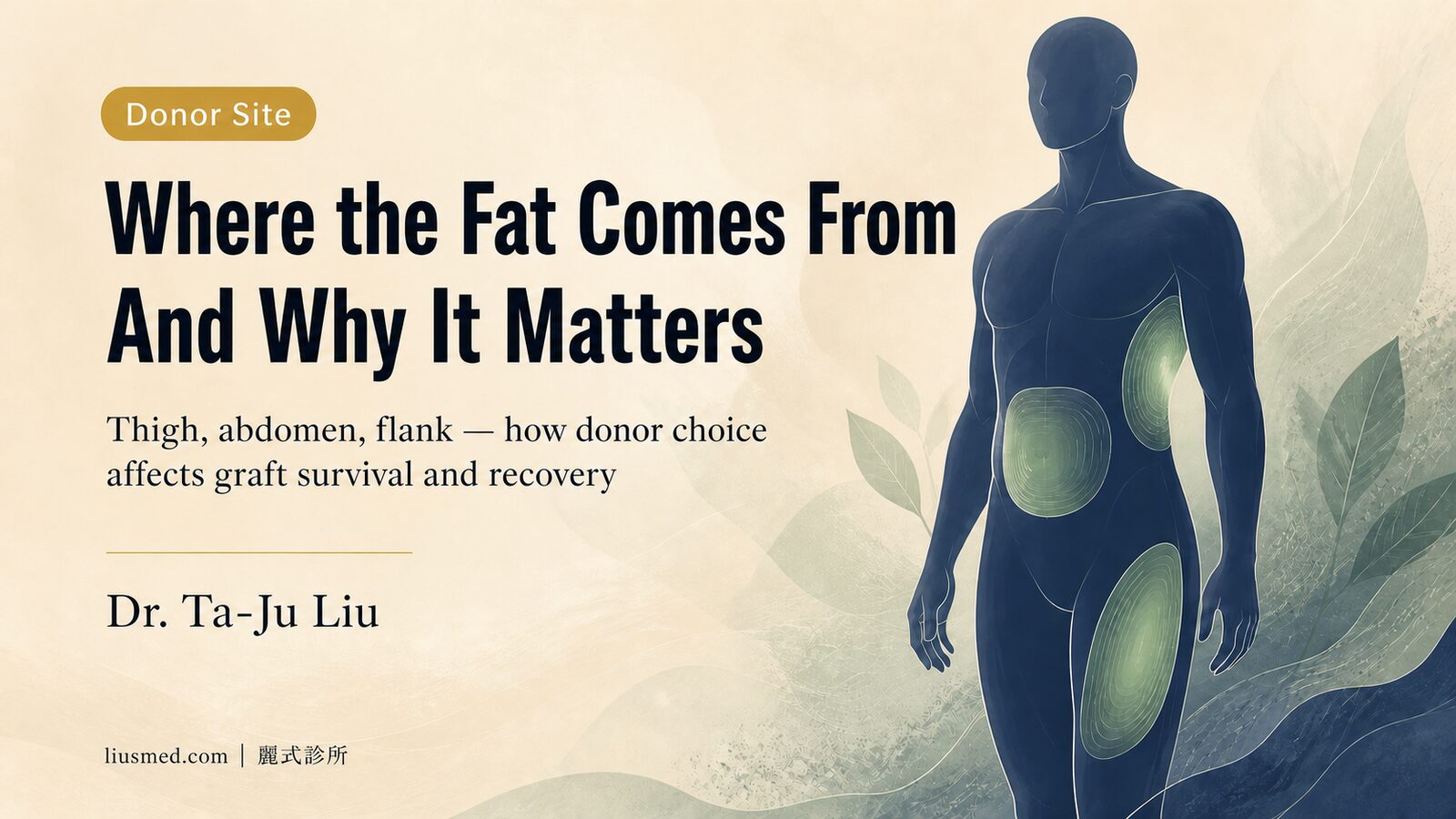
Most people who come in for facial fat grafting ask some version of the same question: where does the fat actually come from? My first question back is usually: where do you have a bit extra?
That's a starting point, not an answer. Choosing a donor site comes down to three things: whether the fat cells there are well-suited for grafting, whether there's enough volume to harvest, and whether the recovery at that site works with your life. All three matter.
Why Donor Site Affects Graft Survival
Fat from different parts of the body isn't identical, even in the same person. The difference that gets the most clinical attention is adipose-derived stem cell (ADSC) concentration. ADSCs support cell survival and blood vessel formation after grafting — the higher the concentration, the better the conditions for the transferred fat to establish itself.
Research consistently shows that fat from the lower abdomen and inner thigh carries higher ADSC concentrations than fat from the upper abdomen, outer thigh, or flanks. That doesn't mean flank fat is unusable. It means it tends to play a supporting role in harvest planning rather than being the primary source.
Tissue texture also varies. Inner thigh fat is typically finer-textured than abdominal fat, which makes it easier to separate during harvest and better suited for injection into precise areas like the tear trough or periorbital region.
Key point: Donor site selection affects not just where you'll swell post-operatively, but how well the transferred fat survives long-term. Getting this right is the first step toward lasting results.
Donor Site Comparison
| Donor Site | Typical Volume | Stem Cell Profile | Main Post-Op Constraint |
|---|---|---|---|
| Lower abdomen | Ample in most patients | High ADSC concentration, good texture | Compression garment 2–4 weeks, limited bending initially |
| Inner thigh | Moderate | High ADSC, finer texture; suits precise sites | Walking tightness for 1–2 weeks |
| Outer thigh | Larger volume | Higher SVF count, slightly lower ADSC | Side-lying limited; compression depends on harvest volume |
| Flanks | Varies considerably | Coarser texture, lower cell activity | Similar to abdominal recovery |
| Posterior thigh | Limited | Less-studied | Sitting restricted; not a routine choice |
Site-by-Site Overview
Lower Abdomen
The most commonly used donor site. Lower abdominal fat ranks high for ADSC concentration, offers good working space for cannula placement, and can accommodate both small and large harvest volumes.
For limited grafting covering one or two facial zones, a small harvest from the lower abdomen is usually sufficient. For larger plans involving multiple zones, the abdomen often provides the bulk of the volume, with flanks or thigh supplementing as needed.
Whether you need compression depends on how much fat is harvested. For a facial-filling volume (roughly up to 100 cc) it is usually not needed; beyond that it is — an elastic bandage for smaller volumes, a compression garment for larger ones. Bending forward is restricted during that time, but most patients are back at a desk job within a week.
Inner Thigh
Comparable to the lower abdomen in ADSC concentration, with finer-textured fat that works well for precise injection sites. Volume is the limitation: the inner thigh can't reliably supply large amounts, so it's best paired with an abdominal harvest when more fat is needed.
Walking tightness typically resolves within two weeks.
Outer Thigh
Offers more harvestable volume than the inner thigh, making it a useful supplement when larger amounts are needed. ADSC concentration is somewhat lower, so it's not the cell-quality leader, but it's a reasonable secondary source.
Side-lying is restricted post-op, and compression placement needs attention during the recovery period.
Flanks
Volume varies a lot by body type. Some patients have very little flank fat, and pushing for a harvest there can lead to surface irregularity. Others have ample flanks and this becomes a useful supplementary source.
Flank fat tends to be coarser and shows slightly lower cell activity in research, so it's typically used to supplement rather than lead.
Posterior Thigh
Limited volume, sitting restricted post-op, and limited research data. Not a routine harvest site.
How We Make the Decision
Body type varies too much for a formula here. The decision happens in consultation, working through the following logic:
First, how much fat do you need? That depends on which facial zones you're targeting, how much volume each needs, and what survival rate to plan around. Then, which sites on your body have enough? Finally, which recovery works with your daily life and schedule.
If you have enough lower abdominal fat, that's usually the starting point. For larger volumes, abdominal harvest leads and flanks or thighs supplement. For fine-detail work on the tear trough or periorbital area, inner thigh fat may be the better choice.
Donor site planning and recipient site planning go together. Where to take from, how much, and where it's going are one integrated question — not three separate ones.
For a full picture of what recovery looks like after fat grafting, this article covers the timeline: How Long Will I Be Swollen After Fat Grafting?
On what determines survival rate, this one goes into detail: Autologous Fat Survival Rate: The Three Stages That Matter
Key point: Donor site selection, recipient zones, and graft volume are one integrated plan. Trying to decide them separately leads to gaps in the planning. Address all three together during consultation.
What Happens to the Donor Site
A reasonable concern: will the harvested area look unusual or uneven afterward?
If the harvest is only for facial filling — around 100 cc — the donor site usually looks much the same afterwards. Some people decide they would rather harvest more and shape the area at the same time; that is a separate choice, and it changes the harvest volume, the compression needed and the recovery. For larger harvests, even distribution of the harvest is essential. Cannula passes need to be spread across multiple planes rather than concentrated in one area. That's a technical aspect of the procedure.
When the harvest volume is larger, post-op compression helps reduce contour irregularity at the donor site. Wearing it for the full recommended duration matters. Stopping early because it's uncomfortable affects how the tissue settles.
Common Questions
Can I choose which site the fat comes from?
You can express a preference, and I'll take it into account. But if your preferred site doesn't have enough volume or its cell profile doesn't suit your grafting plan, I'll explain why and we'll discuss alternatives.
How much does the harvest site hurt afterward?
Mostly aching and tightness, not sharp pain. Oral pain medication is usually sufficient. Most patients are comfortable within five to seven days. Abdominal harvest tends to be managed well with the compression garment; thigh harvest is most noticeable during walking.
Will the donor site gain volume back?
The removed fat cells are gone. But if body weight increases later, remaining fat cells elsewhere (including near the harvest site) can enlarge. Keeping a relatively stable weight after the procedure supports both the facial result and the donor site appearance.
Are harvesting and grafting done in the same procedure?
Yes. Fat is harvested and injected in a single session — no staging required.
If you're exploring facial fat grafting and want to know which areas of the face can be addressed, start here: Which Facial Areas Are Suitable for Fat Grafting?
On what to watch for after grafting, including calcification and nodule formation: Can Fat Grafting Cause Calcification or Hard Lumps?
To schedule a consultation, contact the clinic.
Specialties
Credentials
- Kaohsiung Medical University, School of Medicine
- Attending Physician, Dermatology, Kaohsiung Chang Gung Memorial Hospital
- Attending Physician, Aesthetic Center, Kaohsiung Chang Gung Memorial Hospital
- Visiting Physician, Dermatology, Xiamen Chang Gung Hospital
- Visiting Physician, Aesthetic Center, Xiamen Chang Gung Hospital
"For every surgery, I strive to achieve a good outcome through a small incision and refined technique. Minimally invasive surgery is not just a technique — it's a commitment of respect to every patient."
Recovery after any procedure needs peer support too


Want to learn more?
Schedule a consultation for professional evaluation and advice