Intimate Regenerative Treatment Preparation Checklist: A Practical Guide from Booking to Recovery
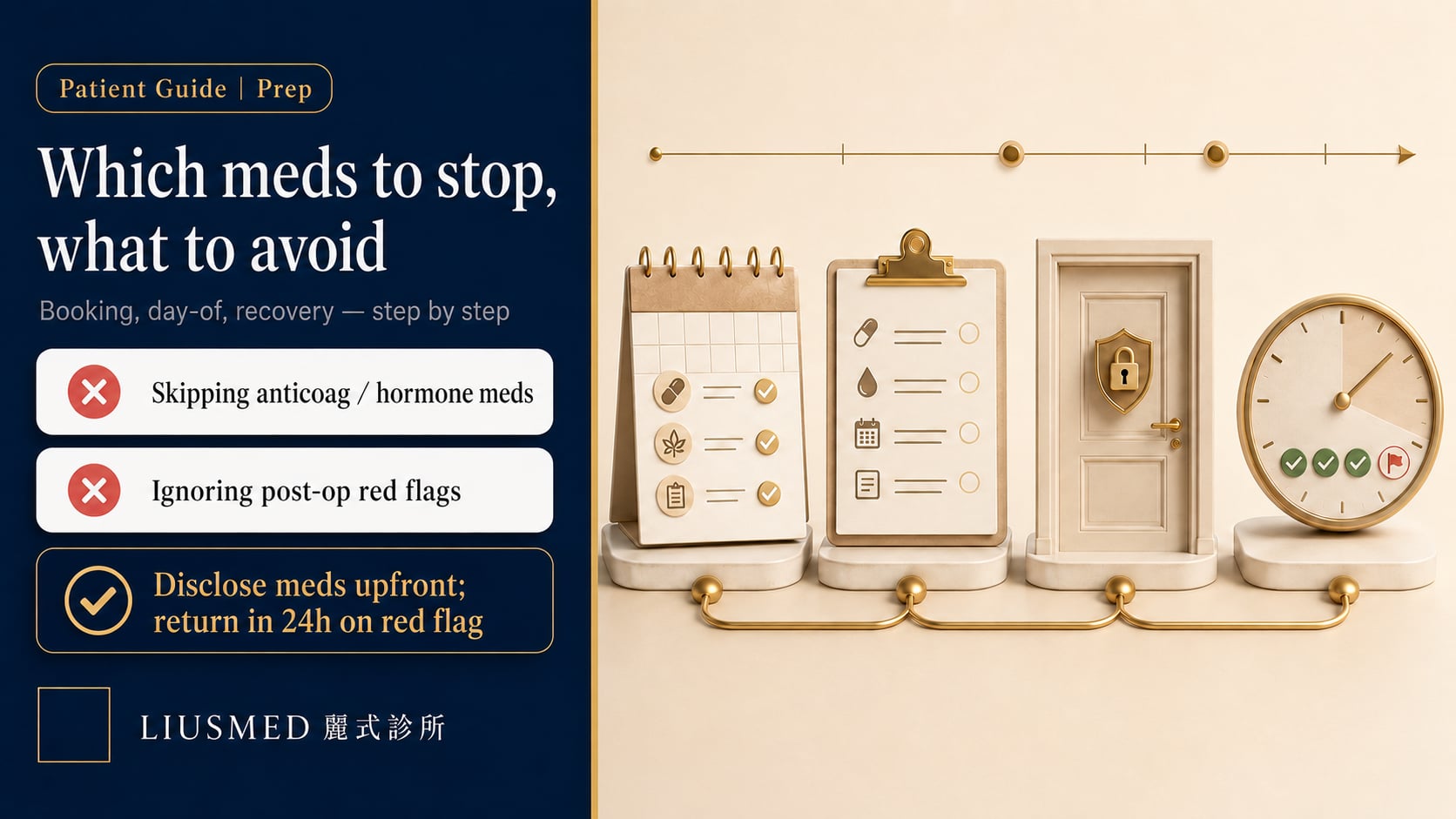
Summary
How smoothly an intimate regenerative treatment (male shockwave + PRP (Platelet-Rich Plasma — concentrate of your own blood platelets rich in growth factors), female PRP + hand-injected mesotherapy — shallow micro-injection of nutrients/meds) goes is highly correlated with your preparation in the 7 days before, your cooperation on the day, and your care in the 24–72 hours after. This checklist organizes what to attend to at each stage — along with the red-flag indicators that require immediate follow-up.
This is general health-education reference; actual precautions follow your physician's individualized guidance.
1. Pre-booking Self-assessment (2–4 Weeks Ahead)
Before booking via LINE or phone, organize the following information. This isn't a threshold — it's so your first evaluation runs efficiently.
✅ Motivation and Expectations
- What's my most bothersome symptom? (dryness, dyspareunia (painful intercourse), laxity, SUI (Stress Urinary Incontinence — leakage on cough/sneeze/exertion), specific ED (Erectile Dysfunction — difficulty maintaining erection) domain, etc.)
- How long has it persisted? (< 3 months / 3–6 months / > 6 months)
- What do I hope to improve? Is my expectation specific and measurable?
- Am I willing to complete a treatment cadence (rather than "try once and see")?
✅ Medical History
- Current medications (especially anticoagulants, antiplatelets, hormones)
- Allergies (medications, local anesthesia, latex, food)
- Chronic conditions (diabetes, hypertension, cardiovascular, autoimmune disease)
- Cancer history (especially breast cancer, gynecologic malignancies — affects estrogen use decisions)
- Recent surgery or invasive procedures (within 3 months)
- Pregnancy plans or current pregnancy possibility
✅ Special Situations to Disclose
- Currently on immunosuppressive therapy
- Recent urinary / genital tract infection
- Active skin disease (e.g., eczema, dermatitis)
- Autoimmune skin disease (lichen sclerosus — chronic autoimmune vulvar skin scarring, vitiligo)
2. 7-Day Pre-Treatment Checklist
✅ Medication Stops and Reductions (must first discuss with prescribing physician)
- Anticoagulants (warfarin, DOACs): adjustment decisions must be made by the prescribing physician — do not self-discontinue
- Aspirin, NSAIDs (ibuprofen, naproxen, etc.): some physicians recommend pausing 3–7 days pre-treatment to reduce bruising risk
- Fish oil, ginkgo, garlic capsules, vitamin E and other supplements with antiplatelet tendency: suggest stopping 7 days pre-treatment
- Oral contraceptives, hormone therapy: do not need to stop (confirm with physician)
✅ Lifestyle Adjustment
- Avoid alcohol from three days before treatment (affects coagulation and healing)
- Avoid excessive caffeine 24 hours pre-treatment (affects vascular response)
- Adequate sleep (7–8 hours)
- Non-smokers: maintain cessation during treatment course; smokers: abstain from at least three days before treatment — smoking affects tissue repair
✅ Menstrual Cycle Planning (Female)
- Avoid menstrual period (2–3 days before and after)
- If irregular, disclose at booking so scheduling can be flexible
3. Day-of-Treatment Checklist
✅ Before Leaving Home
- Wear loose, easy-to-change clothing (recommended: elastic pants, long skirts, loose underwear)
- Bring sanitary products (mild discharge or spotting may occur post-treatment)
- Bring spare underwear
- Eating: intimate PRP (women and men) and manual skin-booster injections are usually given with intravenous gentle pain relief (confirm with the front desk), so fast beforehand (no regular meals or fatty food within 8 hours before, no light solids or dairy within 6 hours, and clear liquids only until 2 hours before); whether it is given depends on the physician and the treatment, so please confirm with the front desk first (if the front desk confirms it will not be given, eat normally)
- Adequate hydration (if you receive intravenous gentle pain relief, clear liquids only until 2 hours before)
- Avoid heavy makeup or perfume (especially during the chaperoned portion for female patients)
- Transportation and companion: if you receive intravenous gentle pain relief, a relative or friend must accompany you that day and you must not drive or ride a scooter yourself; arrange for them to take you home
✅ Personal Hygiene
- Shower on the day of treatment (no baths, no strong cleansers)
- No vaginal douches, intimate perfumes
- If body-hair trimming is needed: complete 2–3 days before treatment (same-day shaving creates micro-wounds)
✅ Arrival Flow
- Arrive on time (10–15 minutes early for paperwork)
- Bring health insurance card, ID (first visit)
- Prepared question list (reference the 7 questions in prior articles)
- Inform physician of any new conditions since last visit
4. Post-Treatment Care (24–72 Hours)
✅ Immediate Care (0–6 Hours Post)
- Rest 15–30 minutes at the clinic before leaving
- If anesthesia was used, wait until it wears off before leaving
- Mild spotting or slight discharge is normal
- Ice pack (if recommended) 10–15 minutes at a time
✅ Avoid Within 24 Hours
- Sexual activity
- Swimming, baths, sauna, hot springs
- Vigorous exercise (running, weights, cycling)
- Alcohol
- Friction or irritation of the treatment area
✅ 72-Hour Attentions
- Shower only (warm water, no strong flushing of treatment area)
- Wear loose cotton underwear
- No vaginal douches or inserts (unless physician instructs)
- Use ice pack or anti-inflammatory ointment per physician's instruction
- Do not self-discontinue or increase physician-prescribed medications
✅ Within 7 Days
- Avoid prolonged sitting (if needed, use a donut cushion)
- Light exercise can resume (walking)
- Sexual activity resumes per physician guidance (generally 3–7 days)
- Log symptom changes (useful for next follow-up)
5. Red-flag Symptoms: When to Seek Immediate Care
If any of the following appear, do not wait for your next scheduled follow-up — contact the clinic immediately or go to the ER:
🚨 Infection Signs
- Persistent fever (body temp > 38°C / 100.4°F)
- Local redness / swelling / heat / pain worsening (not improving > 72 hours)
- Purulent discharge or odor
- Systemic discomfort, chills
🚨 Abnormal Bleeding or Swelling
- Bleeding exceeding normal menstrual volume
- Progressive local swelling with worsening pain
- Hematoma formation (firm mass with bruising)
🚨 Allergic Reaction
- Urticaria, generalized rash
- Difficulty breathing, throat tightness
- Facial or limb swelling
If suspected systemic allergic reaction (anaphylaxis), go directly to the ER.
🚨 Other Warnings
- Severe pain unrelieved by analgesics
- Difficulty urinating or hematuria
- Lower limb swelling or unexplained pain (rule out thrombosis)
6. Follow-up Schedule
Intimate regenerative treatments are usually not "one-and-done" — they follow a scheduled follow-up cadence:
| Timing | Assessment Content |
|---|---|
| Post-op 7–14 days | Acute-phase recovery assessment, wound check |
| Post-op 4 weeks | Early symptom improvement assessment |
| Post-op 3 months | Efficacy assessment (FSFI — Female Sexual Function Index; IIEF-5 — International Index of Erectile Function, 5-item erectile function questionnaire; VHI; ICIQ-SF — International Consultation on Incontinence Questionnaire — Short Form scales) |
| Post-op 6 months | Need for reinforcement or next course cadence |
Log physician-recommended follow-up dates in your phone calendar — don't miss tracking windows.
7. Partner Accompaniment and Consultation
- Yes: partners may accompany to outpatient evaluation; female treatment sessions — for medical reasons — are chaperoned by a female nurse while partners wait in the waiting area
- Suggested: joint partner consultation helps with expectation management and post-op cooperation
- Confidential: you decide whether to share treatment details with your partner — we do not contact partners proactively
8. Frequently Asked Questions
Q1. Can I receive treatment during my period? Not recommended. Endometrial shedding during menstruation raises infection risk; avoid.
Q2. How soon can I exercise after treatment? Avoid vigorous exercise within 24 hours; light walking at 48–72 hours; normal exercise per individual recovery after 1 week.
Q3. What if I miss a follow-up date? Contact the clinic immediately to reschedule. A delay doesn't mean failure, but continuous tracking supports efficacy evaluation and needed adjustment.
Q4. How soon can I repeat the same treatment? Depends on treatment type and physician assessment. PRP typically every 4–6 months; hand-injected mesotherapy every 3–6 months; shockwave per cadence (weekly or biweekly).
Q5. How many items can I have in one session? The physician assesses based on symptom classification and physical status. We don't recommend stacking "for value" — combinations are medical decisions, not consumer bundles.
9. Back to Process: Our Position
We treat "thorough preparation" as part of treatment quality:
- Pre-booking: LINE anonymous consultation lowers the threshold to reach out
- Pre-treatment: thorough intake + scale assessment + formulation / technique explanation
- During treatment: adjust pace and depth to individual response
- Post-treatment: written health education + 24-hour contact channel + scheduled follow-up
→ Service page (male): Male Intimate Shockwave + PRP → Service page (female): Female Intimate PRP + Hand-Injected Mesotherapy → Related reading: Female Intimate Regenerative Therapy Overview · Oral Meds vs Shockwave vs PRP Comparison
If you've decided to book, we suggest first asking 3 anonymous questions via LINE to confirm basic suitability, then scheduling in-person evaluation — your inquiry will not auto-trigger a sales pipeline.
Medical Disclaimer
This checklist is general health-education reference; actual precautions follow your physician's individualized guidance. Any medication stop or adjustment must be assessed by the prescribing physician — do not self-decide. If red-flag symptoms appear, seek immediate care. All treatment decisions should rest on individual physician evaluation, informed consent, and shared decision-making; outcomes vary individually and no specific result can be guaranteed.
Related Services

Specialties
Credentials
- Kaohsiung Medical University, School of Medicine
- Attending Physician, Dermatology, Kaohsiung Chang Gung Memorial Hospital
- Attending Physician, Aesthetic Center, Kaohsiung Chang Gung Memorial Hospital
- Visiting Physician, Dermatology, Xiamen Chang Gung Hospital
- Visiting Physician, Aesthetic Center, Xiamen Chang Gung Hospital
"For every surgery, I strive to achieve a good outcome through a small incision and refined technique. Minimally invasive surgery is not just a technique — it's a commitment of respect to every patient."
Want to learn more?
Schedule a consultation for professional evaluation and advice