Collagen-Stimulator Lumps in the Nasolabial Fold: Can't Be Dissolved, Only Removed
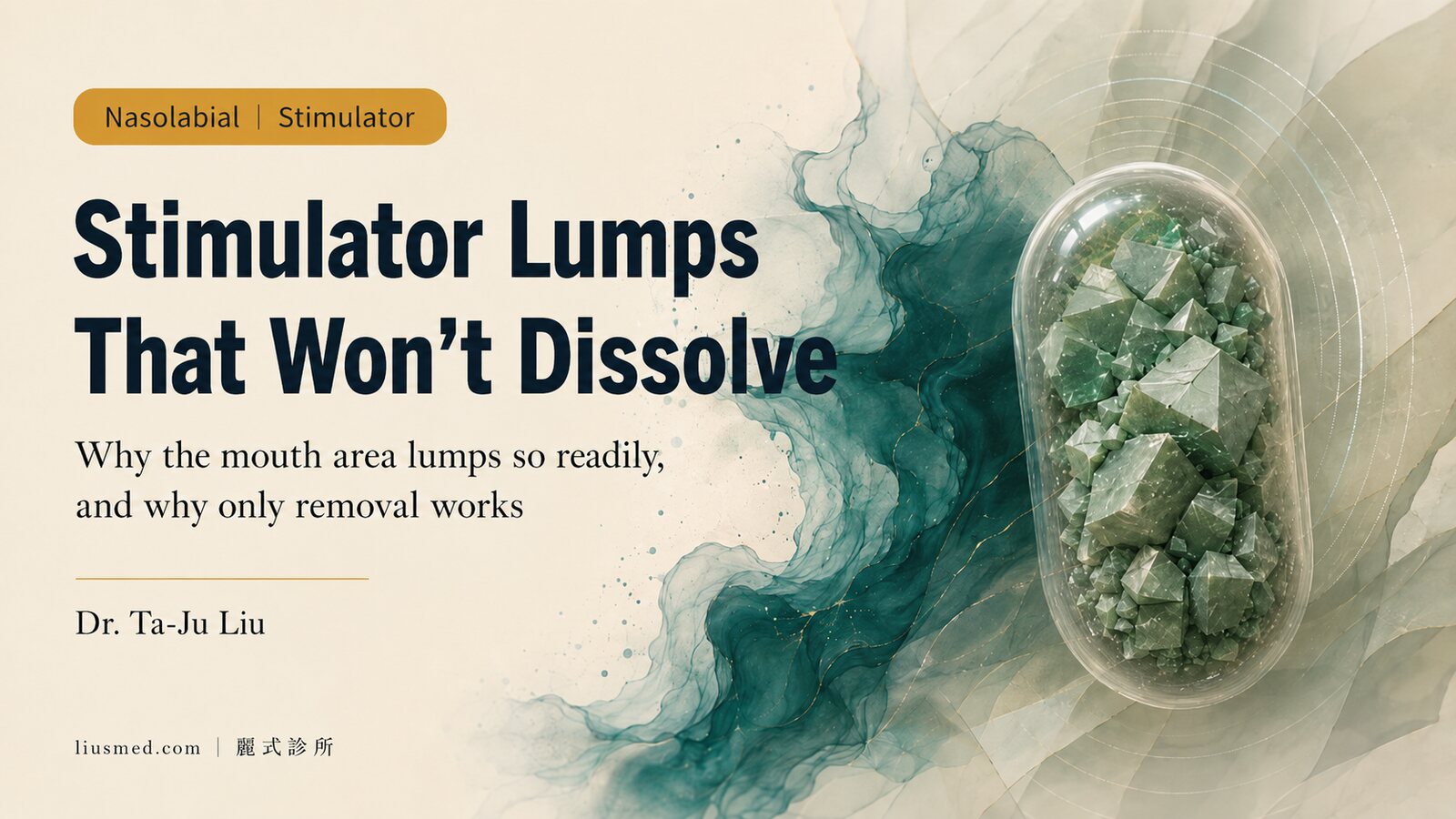
A patient brought her old receipt and told me the nasolabial fold had been treated with a "collagen stimulator," because she'd heard it was more natural than HA and would stimulate her own collagen. A few months later she felt firm lumps around her mouth, went back to have them dissolved, and was told: "this can't be dissolved." She was stunned — wasn't it supposed to be natural? How can it not dissolve?
This misunderstanding is common, and it isn't cheap. So let me walk through what it means to put a collagen stimulator in the nasolabial fold.
Why the nasolabial fold lumps collagen stimulators so readily
Start with the location. The principle of a collagen stimulator is that a material is placed in, and the body grows collagen around it. That collagen-building process needs the material to stay put and spread out evenly.
The problem is that the area around the mouth smiles, talks, and chews all day — it's among the most mobile parts of the whole face. Material placed in a spot that keeps moving tends to get squeezed together, while the body keeps building collagen alongside and walls it off, so over time you get firm lumps and ridges. So the nasolabial fold and the corners of the mouth are inherently an area where collagen stimulators are more prone to nodules — this has nothing to do with the injector's technique; it's a built-in feature of the location.
Which can be dissolved, which can't? Sort out the materials first
This is the thing most people confuse yet matters most. The market's line — "if it goes wrong, you can dissolve it" — really only applies to HA.
Hyaluronic acid (HA) can be broken down with an enzyme; that's one of its biggest advantages, a way back when it goes wrong.
A collagen stimulator is a completely different story, and it further divides into several materials. The common ones:
- Sculptra, whose material is PLLA (poly-L-lactic acid) — the most familiar collagen stimulator in English.
- Ellansé, whose material is PCL (polycaprolactone).
- AestheFill, whose material is PDLLA (a poly-D,L-lactic acid) — an Asian-market brand, less discussed in English.
- Radiesse, whose material is CaHA (calcium hydroxylapatite).
What they share: the dissolving enzyme does nothing to them. They aren't HA; the enzyme can't break them down. Once they've formed a nodule, a single injection won't melt it away.
So the impression that a collagen stimulator is "natural and safe" can make people overlook a very important difference — it isn't reversible on demand the way HA is. Choosing it means accepting that the material is relatively irreversible.
Once it's lumped, why not just keep injecting to calm it down?
After lumping, many people's first move is to go back and keep getting injections to deal with it. Here we need to be clear.
If the injection is dissolving enzyme, it does nothing for a collagen-stimulator lump, because that enzyme is designed to break down HA. Some situations use medications such as a steroid to soften a nodule and settle inflammation, but that's more like "pressing it down" than actually clearing the material out — and repeated steroid injections carry their own risks.
Put plainly, if the material itself has clumped and been walled off in a capsule, those "just inject something" approaches usually can't address the underlying problem. To genuinely clear it, you often have to find it and remove it.
So how is it removed? Physical removal under ultrasound guidance
My approach is minimally invasive removal under ultrasound guidance.
A collagen-stimulator lump can be felt but its margins can't be seen by eye, which is where ultrasound matters. It lets me see clearly before doing anything: which layer the lump is caught in, how large it is, and how close it runs to branches of the facial artery. Once that's clear, a small port goes in, watching the real-time image, taking out what should come out a little at a time while avoiding vessels.
Honestly, removal of this kind of lump usually reaches about eighty or ninety percent, not a hundred, and it varies from person to person — especially where collagen has grown and fused it with the tissue, there's no guaranteeing it comes out spotless. But compared with keeping up ineffective injections or leaving it to keep inflaming, clearing the main mass first and bringing the area back to a relatively clean state is usually the more realistic direction. This is usually reached over two or three sessions; the first typically removes about 30–50%.
If what you feel is a hard ridge and you're not sure yet whether it's a complication, start with the piece on feeling a hard ridge in the nasolabial fold; and if you want to understand why soft filler won't hold this groove while firm filler lumps so easily, see the soft-versus-firm dilemma of nasolabial filler.
One note about safety
One more thing. Branches of the facial artery run fairly close in the nasolabial region, making it a relatively higher-risk spot, so whether at the original injection or the later removal, you need to see clearly where the vessels are. That's one reason I keep stressing ultrasound.
So decide carefully at the moment you choose the material
Back to the stunned patient. What I told her was this: a collagen stimulator isn't a bad material in itself; used in the right spot, for the right person, it has its value. But its biggest difference from HA is that it's relatively irreversible — once it's in, you can't dissolve it and start over the way you can with HA.
So what really needs thinking through in advance is, before injecting: is this spot suitable for a material that stimulates growth and can't be dissolved? For a spot like the nasolabial fold, which keeps moving and lumps easily, I'm more cautious myself. Rather than spending more effort removing it afterward, it's better to think through the relationship between material and location from the start.
If you've already had a collagen stimulator and can feel lumps in the nasolabial fold, book an ultrasound assessment — we'll look clearly at what's inside first, then decide on a steadier way to handle it. You can also start from the nasolabial revision area overview to see related approaches.
This article is educational. Individual situations require in-person consultation and imaging assessment; actual treatment and results vary from person to person.
Specialties
Credentials
- Kaohsiung Medical University, School of Medicine
- Attending Physician, Dermatology, Kaohsiung Chang Gung Memorial Hospital
- Attending Physician, Aesthetic Center, Kaohsiung Chang Gung Memorial Hospital
- Visiting Physician, Dermatology, Xiamen Chang Gung Hospital
- Visiting Physician, Aesthetic Center, Xiamen Chang Gung Hospital
"For every surgery, I strive to achieve a good outcome through a small incision and refined technique. Minimally invasive surgery is not just a technique — it's a commitment of respect to every patient."
Recovery after any procedure needs peer support too


Want to learn more?
Schedule a consultation for professional evaluation and advice