Facial Rebuilding After Filler Removal: When Can You Resume Aesthetic Treatments?
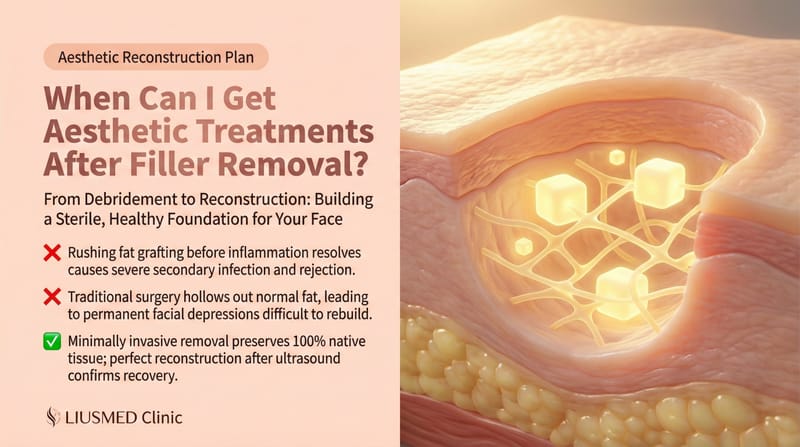
After Extraction, What Comes Next?
After successfully removing problematic filler, many patients face new questions: "Will my face look sunken?" "When can I have other aesthetic treatments?" "Can I ever get injections again?"
These concerns are completely understandable. After filler extraction, the face may indeed show temporary volume loss. However, this does not mean you need to rush to fill the gap. In fact, patience and staged planning are the keys to achieving the best long-term outcome.
Common Appearance Changes After Extraction
Why Might My Face Look "Hollow"?
The longer filler has been in the tissue, the more the surrounding structures adapt to its presence. When the filler is removed, tissues need time to contract and readjust.
| Appearance Change | Cause | Duration |
|---|---|---|
| Mild hollowing | Loss of filler volume | Most improve within 2-4 weeks |
| Skin laxity | Previously stretched skin contracting | Gradual improvement over 1-3 months |
| Asymmetry | Different filler volumes on each side | May need evaluation for treatment |
| Deepened lines | Lines previously masked by filler now visible | Can be addressed after stabilization |
Key Insight: The appearance immediately after extraction is not the final result. Tissues need 1-3 months to remodel and adapt. Many patients find that their appearance improves more than expected during this waiting period.
The Rebuilding Timeline
Phase 1: Waiting and Observation (0-3 Months Post-Op)
This is the most important phase. During this period:
- Tissue recovery and remodeling: The true contour only emerges after swelling resolves
- Skin elasticity recovery: Skin gradually retracts
- Scar maturation: Pinhole wounds fully heal
- Ultrasound follow-up: Confirms whether all filler has been removed
Treatments NOT recommended during this phase:
- Injectable treatments (hyaluronic acid, collagen stimulators, etc.)
- Laser or radiofrequency treatments (on the surgical area)
- Facial surgery
Phase 2: Assessment and Planning (3-6 Months Post-Op)
Once tissues have stabilized, systematic evaluation begins:
| Assessment Item | Details |
|---|---|
| Ultrasound scan | Confirm no residual filler |
| Appearance analysis | Evaluate hollowing and laxity |
| Skin condition | Elasticity, texture, tone |
| Patient goals | Discuss desired outcomes |
| Treatment plan | Develop a personalized rebuilding strategy |
Phase 3: Gradual Rebuilding (6+ Months Post-Op)
Based on individual circumstances, possible rebuilding options include:
Volume Restoration Options:
| Option | Advantages | Considerations |
|---|---|---|
| Autologous fat grafting | Natural, long-lasting, no rejection risk | Requires liposuction to harvest fat; survival rate varies |
| Hyaluronic acid injection | Controllable, dissolvable, predictable | Requires maintenance; repeat issues possible |
| Collagen stimulators | Stimulates natural collagen production | Slower results; requires careful assessment |
| No treatment | Zero risk, natural aging | Suitable for patients satisfied with their appearance |
Key Insight: Rebuilding does not mean "putting filler back in." Patients who have experienced filler complications need to be especially careful about choosing materials, physicians, and timing. Our goal is to achieve a natural result through the safest possible approach.
Fat Grafting as a Rebuilding Option
Why Is Fat Grafting a Good Choice?
For patients who need volume restoration after filler removal, autologous fat grafting offers unique advantages:
- Best biocompatibility: Your own tissue will not cause rejection
- Natural texture: Closest feel and appearance to natural tissue
- Long-lasting results: Surviving fat cells are permanent
- Dual benefit: The donor site also benefits from contouring
Important Considerations for Fat Grafting
| Factor | Details |
|---|---|
| Survival rate | Approximately 50-70% of grafted fat survives |
| Irregularity risk | Requires an experienced surgeon |
| May need multiple sessions | 2-3 sessions may be needed depending on volume |
| Recovery period | Slightly longer than injectable treatments |
| Adequate fat needed | Slim patients may have limited donor sites |
Learn more about managing volume loss after extraction.
Safety Considerations for Re-Injection
When Can You Get Injections Again?
Many patients ask: "Can I ever get hyaluronic acid again?" The answer is: under the right conditions, yes, but certain principles must be followed:
Prerequisites for re-injection:
- The original problem has been completely resolved
- Tissues have fully stabilized (typically 3-6 months)
- Ultrasound confirms no residual filler
- Choose an experienced physician
- Use certified, quality filler products
Risk Management for Re-Injection
| Strategy | Details |
|---|---|
| Small amounts, multiple sessions | Avoid large-volume single injections |
| Ultrasound-assisted | Injection under ultrasound guidance is safer |
| Choose dissolvable products | Prioritize biodegradable fillers |
| Avoid high-risk areas | Extra caution where previous problems occurred |
| Regular follow-up | Periodic ultrasound monitoring after injection |
Non-Filler Alternatives
Beyond injectable fillers, other options can improve your appearance:
Skin Tightening Treatments
| Treatment | Mechanism | Best For |
|---|---|---|
| Radiofrequency | Heat stimulates collagen contraction | Mild laxity |
| Ultrasound lifting | Focused ultrasound energy | Moderate laxity |
| Microneedling | Promotes new collagen formation | Skin quality improvement |
| Laser | Photothermal effect promotes tightening | Skin texture and tone |
Lifestyle Adjustments
Sometimes the best "treatment" is a healthy lifestyle:
- Adequate sleep: Promotes skin repair
- Balanced diet: Sufficient protein and vitamin C
- Regular exercise: Improves blood circulation
- Sun protection: Prevents photoaging from worsening hollowing
- Quit smoking: Improves skin circulation
Psychological Preparation
Adjusting Expectations
The rebuilding journey after filler removal requires patience and realistic expectations:
- It is not possible to "go back to how it was before injection": Tissue structure has changed
- Rebuilding is a gradual process: Rushing increases the risk of new problems
- Each treatment should represent progress: Perfection in one session is not the goal
- Communication is essential: Discuss your expectations and concerns thoroughly with your physician
Key Insight: Many patients discover after removing problematic filler that "less is more." Not every hollow needs to be filled. Accepting your natural appearance with modest enhancements often brings greater satisfaction than chasing "perfection."
Creating a Personalized Rebuilding Plan
Every patient's rebuilding plan should be tailored to their individual situation:
| Factor | Impact |
|---|---|
| Age | Affects skin retraction ability and collagen regeneration speed |
| Extraction site | Different areas require different rebuilding strategies |
| Original problem | Influences which treatments are appropriate |
| Volume removed | Determines how much restoration may be needed |
| Personal goals | Natural versus more noticeable improvement preference |
| Budget and schedule | Practical treatment arrangement considerations |
Conclusion: Safety First, Step by Step
The rebuilding journey after filler removal is not a sprint — it is a process that requires wisdom and patience. The most important principles are:
- Wait for tissues to fully stabilize
- Complete a thorough evaluation
- Choose the safest approach
- Set realistic expectations
- Build a long-term relationship with a trusted physician
If you are considering next steps after filler removal, start by learning about our filler repair evaluation process, or book a consultation directly so we can plan the most suitable rebuilding strategy together.
We also recommend reading about filler extraction techniques to understand how our minimally invasive approach lays the foundation for successful rebuilding.
Related Services
Specialties
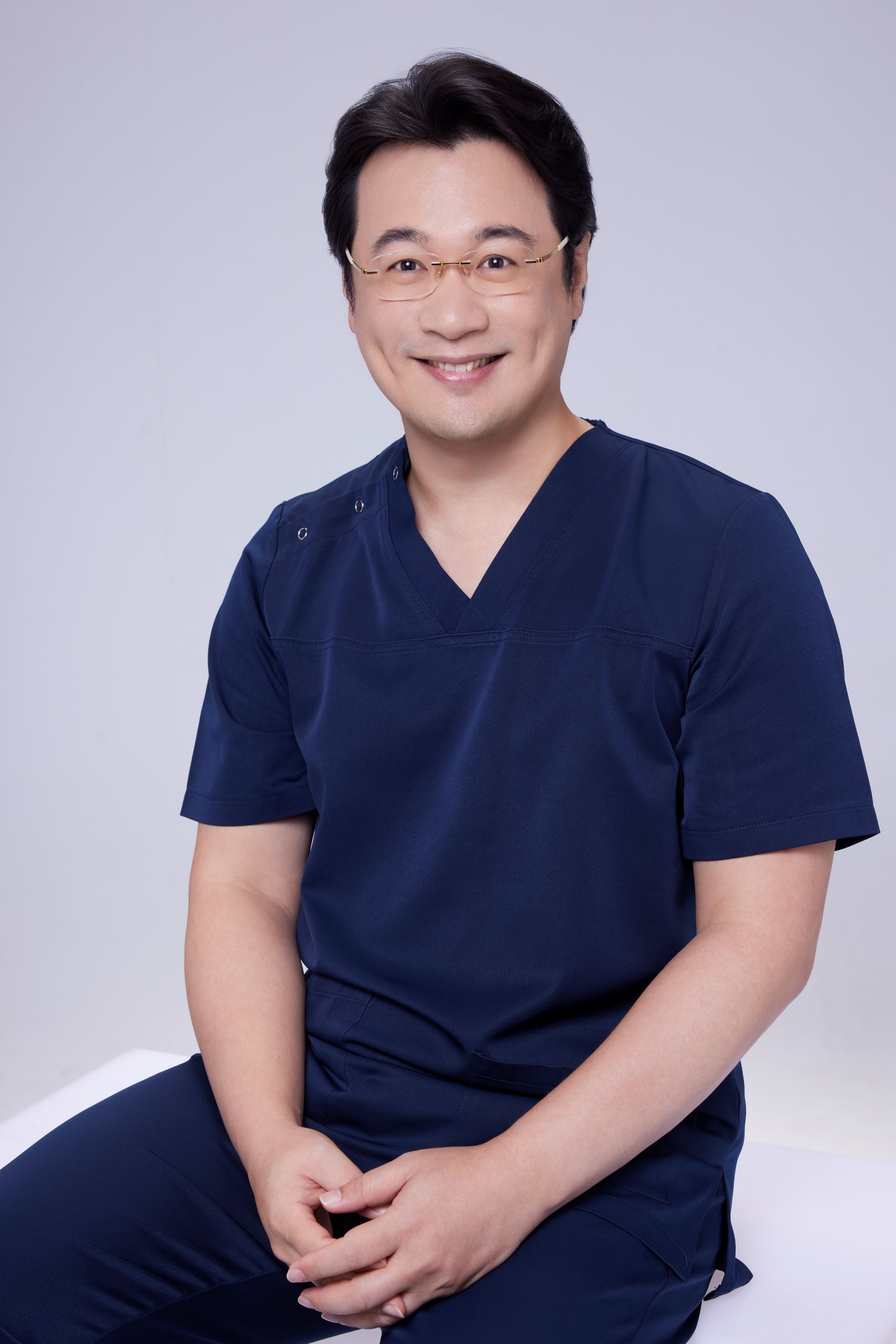
Credentials
- Kaohsiung Medical University, School of Medicine
- Attending Physician, Dermatology, Kaohsiung Chang Gung Memorial Hospital
- Attending Physician, Aesthetic Center, Kaohsiung Chang Gung Memorial Hospital
- Visiting Physician, Dermatology, Xiamen Chang Gung Hospital
- Visiting Physician, Aesthetic Center, Xiamen Chang Gung Hospital
"For every surgery, I strive to achieve a good outcome through a small incision and refined technique. Minimally invasive surgery is not just a technique — it's a commitment of respect to every patient."
Recovery after any procedure needs peer support too


Want to learn more?
Schedule a consultation for professional evaluation and advice