Afraid to Trust a Doctor Again After Aesthetic Failure? How Specialized Repair Clinics Rebuild Confidence
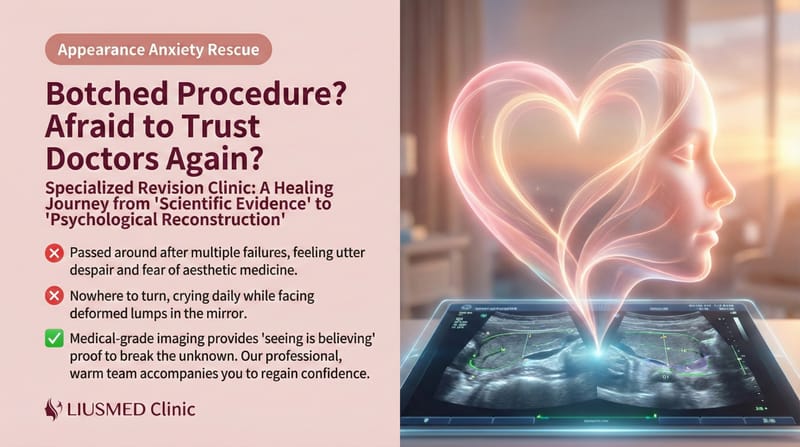
The Psychological Impact of Aesthetic Failure
The damage caused by aesthetic failure extends far beyond physical appearance. When a decision meant to make you feel better leads to unexpected consequences, the feelings of betrayal and loss of control are often more painful than the visible problem itself.
In my clinic, nearly every patient who comes for repair carries a psychological burden — anxiety, self-blame, anger, social withdrawal, and deep distrust of the medical system. These feelings are all normal, and they all deserve to be acknowledged and addressed.
Common Psychological Responses After Aesthetic Failure
The Emotional Response Spectrum
| Stage | Common Expressions | Explanation |
|---|---|---|
| Shock and denial | "This cannot be happening to me" | Initial psychological defense mechanism |
| Anger | Toward the original practitioner, toward one's own decision | A valid emotional response |
| Self-blame | "I chose to do this myself" | Taking on excessive responsibility |
| Anxiety | Repeatedly checking mirrors, difficulty sleeping | Worry about appearance and the future |
| Social withdrawal | Avoiding going out, photos, social situations | Damaged self-confidence |
| Depressive feelings | Persistent low mood, loss of interest | A warning sign requiring attention |
| Post-traumatic responses | Panic at seeing needles or clinics | Reactions similar to PTSD |
Key Insight: If you are experiencing these reactions, please know: you are not alone, these feelings are normal, and help is available. Aesthetic failure is not your fault, and seeking repair is not a sign of weakness.
The Path to Rebuilding Trust
Why Trust Is So Important
Aesthetic medicine fundamentally involves placing your appearance in someone else's hands. When that trust is violated, the injury goes beyond the surface — it damages your belief in professional care. Rebuilding this trust is the most important first step in the entire repair process.
How We Rebuild Trust
| Practice | Details |
|---|---|
| Complete transparency | Detailed pre-operative explanation of all possible outcomes and risks |
| No judgment | We do not criticize previous practitioners; we focus on solving the problem |
| Sufficient time | First consultations do not rush to schedule surgery; space is given for reflection |
| Ultrasound demonstration | Imaging lets you see the issue for yourself |
| Gradual treatment | We do not do everything at once; progress is incremental |
| Always stoppable | At any stage, you have the right to pause or change your mind |
What Makes a Specialized Repair Clinic Different
Compared to General Aesthetic Clinics
| Aspect | General Aesthetic Clinic | Specialized Repair Clinic |
|---|---|---|
| Patient mindset | Anticipating beauty | Arriving with pain and distrust |
| Communication focus | Showcasing results | Safety assurance and risk explanation |
| First visit | May proceed with treatment immediately | Assessment, communication, relationship-building |
| Treatment pace | Efficiency-driven | Respects the patient's psychological pace |
| Follow-up | Standard check-ups | Proactive care and close monitoring |
| Psychological care | Rarely addressed | Integrated into the treatment plan |
What Happens at Your First Consultation?
The initial consultation typically takes 30-60 minutes and includes:
- Listening to your experience: Understanding what happened and how it has affected you
- Ultrasound examination: Objectively assessing the filler's condition and location
- Explaining options: Clearly describing possible treatments and expected outcomes
- Answering all questions: No question is too small to deserve a thoughtful answer
- No pressure: You do not need to make any decision that day
Key Insight: A good repair physician spends more time listening and communicating than rushing to schedule surgery. If you feel pushed or misunderstood during a consultation, it may not be the right place for you.
Simultaneous Psychological and Physical Repair
Three Dimensions of Treatment
| Dimension | Goal | Method |
|---|---|---|
| Physical | Resolve appearance issues caused by filler | Ultrasound-guided extraction, subsequent rebuilding |
| Psychological | Reduce anxiety, rebuild confidence | Transparent communication, gradual progress, support |
| Social | Restore normal social life and quality of life | Realistic recovery planning, concealment techniques |
Why Psychological Care Matters
Even when the physical issue is completely resolved, without psychological support patients may:
- Remain dissatisfied with their appearance (despite objective improvement)
- Be unable to enjoy their improved life
- Continue to feel anxious about potential future problems
- Feel terrified of receiving aesthetic treatments again
For Those Currently Experiencing Aesthetic Failure
Helpful Actions
| Action | Details |
|---|---|
| Acknowledge your feelings | These emotions are normal and should not be suppressed |
| Seek professional evaluation | Understanding the actual situation is usually more manageable than feared |
| Do not rush to act | Unless it is an emergency, give yourself time to process |
| Confide in trusted people | Share your feelings with trusted family or friends |
| Document changes | Photograph appearance changes to help physicians evaluate |
| Professional psychological support | If emotions affect daily life, consider counseling |
Actions to Avoid
| Behavior | Why to Avoid |
|---|---|
| Self-treatment | Squeezing or massaging may worsen the problem |
| Internet self-diagnosis | Information quality varies widely and can increase anxiety |
| Rushing to repair | Impulsive decisions may create additional problems |
| Blaming yourself | Aesthetic failure should not be placed entirely on the patient |
| Complete isolation | Isolating yourself intensifies the psychological burden |
When to Seek Professional Psychological Support
Warning Signs to Watch For
If you experience any of the following, professional counseling is recommended:
| Signal | Details |
|---|---|
| Insomnia lasting over 2 weeks | Severely disrupted sleep quality |
| Unable to work or attend school normally | Daily functioning is impaired |
| Complete social avoidance | Prolonged unwillingness to go out or see people |
| Intrusive repetitive thoughts | Uncontrollable replay of negative experiences |
| Thoughts of self-harm | Seek professional help immediately |
| Substance dependence | Using alcohol or medication to cope with emotions |
Key Insight: Seeking psychological support does not mean you are "overreacting." The impact of appearance changes on mental health is real and profound. Many patients find that with psychological support, not only do their emotions improve, but the repair process goes more smoothly as well.
Psychological Adjustment After Successful Repair
Why Adjustment Takes Time
Even when surgery is highly successful, patients need time to adapt to their new appearance:
- Self-image updating: The brain needs time to accept the new face in the mirror
- Emotional fluctuations: Appearance changes during recovery may trigger mood swings
- Expectation management: Accepting "improvement" rather than "perfection"
- Social readjustment: Facing others again requires courage
Methods That Help Psychological Adjustment
| Method | Details |
|---|---|
| Set realistic milestones | Do not aim for "perfection"; celebrate every step forward |
| Regular follow-ups | Periodic check-ins reduce uncertainty |
| Resume daily activities | Gradually return to normal routines |
| Build a support network | Stay connected with people who understand you |
| Be kind to yourself | Recovery takes time; give yourself patience |
Conclusion: Your Feelings Matter as Much as Your Appearance
Aesthetic repair is not just a medical procedure — it is a journey of rebuilding confidence. On this journey, your mental health is just as important as your physical recovery.
If you are struggling with aesthetic failure, learn more about our repair evaluation process. For deeper insight into the psychological dimensions of aesthetic repair, see The Psychology of Aesthetic Repair.
Regardless of what stage you are at, you are welcome to contact us. Even if you just want to talk about your situation, we are happy to listen. You do not have to face this alone.
You're not alone. On the FillerRescue Patient Forum, many patients share their emotional journeys and repair experiences. If you're not ready for a consultation, you're welcome to read others' stories first or share anonymously. You can also visit Dr. Liu's Community for more professional insights.
Related Services

Specialties
Credentials
- Kaohsiung Medical University, School of Medicine
- Attending Physician, Dermatology, Kaohsiung Chang Gung Memorial Hospital
- Attending Physician, Aesthetic Center, Kaohsiung Chang Gung Memorial Hospital
- Visiting Physician, Dermatology, Xiamen Chang Gung Hospital
- Visiting Physician, Aesthetic Center, Xiamen Chang Gung Hospital
"For every surgery, I strive to achieve a good outcome through a small incision and refined technique. Minimally invasive surgery is not just a technique — it's a commitment of respect to every patient."
Recovery after any procedure needs peer support too

Want to learn more?
Schedule a consultation for professional evaluation and advice